
The House at the Edge of the Map, Part 7: The Library of Locked Stories

A hidden shelf of blank books reveals clues about Samuel Horský, but one missing memory still waits in the dark.
The House at the Edge of the Map, Part 7: The Library of Locked Stories
The Story Begins
The blue light in the upstairs window was visible even from the old lime tree by the road. Fog hung low over the ground and curled around the narrow house, as if it did not want to let it fully out into the street.
“There it is,” Mia said softly. Her yellow scarf stirred in the cold wind like a little flame.
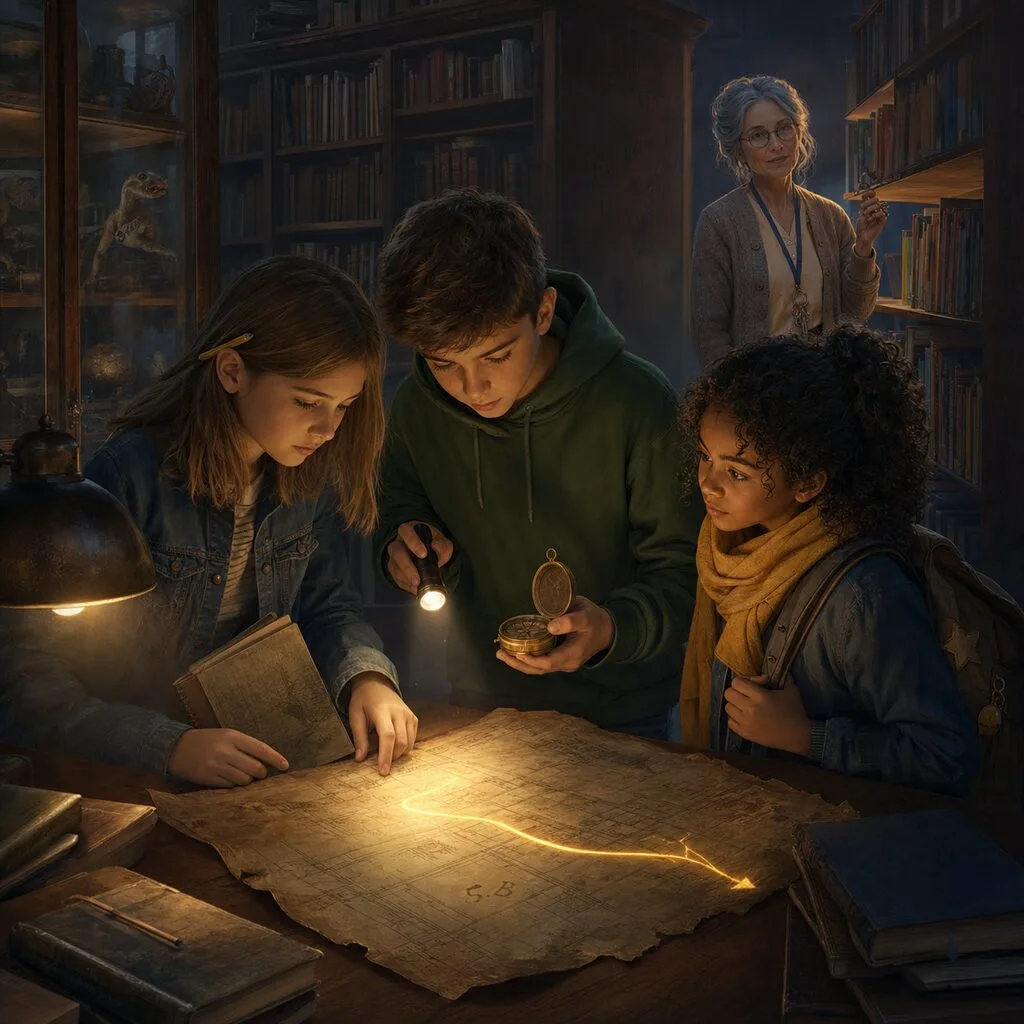
Nina pulled the old map from beneath her denim jacket. It was folded in half, but the paper unfolded itself as soon as they came near the gate. The street lines on it rippled. At the edge of the map, where there had been nothing yesterday, dark blue symbols appeared.
5.B.
Oliver shone his small torch on it, though there was enough light from the window. “That’s a class. A real class, not a password or a treasure mark.”
“Samuel’s notebook had school lines on the cover,” Nina reminded him. The pencil behind her ear tilted as she bent over the map. “And the photograph was taken in a classroom. Maybe it’s finally coming together.”
There was nothing frightening about the house at the edge of the map. The door was shut, the plaster by the doorstep was a little cracked, and two dry leaves lay on the stairs. Even so, Nina felt the familiar pinch in her stomach. She did not like the darkness behind the house at all.
Mia noticed, but said nothing. She simply stepped closer to Nina.
When Oliver put his hand on the handle, the air by the door trembled gently. It was neither a sound nor a gust of wind. It felt more as though someone had turned a page very quietly.
“I think it’s waiting for us,” Oliver said.
“Or it will let us in if we pay attention,” Nina corrected him.
The door opened without a creak.
Inside, it smelled of wood, old paper, and faintly of a wet coat, though no coat hung there. The hallway was lit by thin strips of blue light coming from behind doors upstairs. The children went in, and the house let them pass as calmly as if they were returning to a familiar library after school.
At the end of the hallway, the map in Nina’s hands moved again. A blue dot appeared beside a small room they had not noticed before.
“Not upstairs,” Nina said. “Here. Behind the stairs.”
At first, the room beneath the staircase looked completely ordinary. It was narrow and empty, with faded wallpaper patterned with tiny grey flowers. A low chair stood in the corner. Dust lay so evenly on the floor that they could make out their own footprints in it.
Oliver swept his torch beam across the back wall. “No door. No window. No secret lever that looks like a secret lever.”
“Secret levers probably try not to look secret,” Mia said.
He looked at her. “That is annoyingly good advice.”
Meanwhile, Nina moved closer to the wall. Between two strips of wallpaper, she noticed a narrow line of light. It was as thin as a ruler-drawn line and ran from the floor to the wooden ceiling.
“Here,” she said. “This panel isn’t part of the wall. Look, the flowers repeat wrongly near the edge.”
Oliver slipped his fingers into the crack. At first, the panel did not move at all. Then there came a soft tap from behind the wall, and the wood gave way a little.
Behind it was a shelf.
When Things Start to Change
It was not large, but it reached from the floor almost to the ceiling. Dozens of books of different heights stood on it. Some had leather spines, others cloth covers, but none had titles. Fine dust lay along their edges, glinting in the blue light like grey sand.
Mia stepped only a little closer. “It isn’t cold in here,” she whispered. “It’s just… something is waiting.”
“Books,” Oliver said. “Blank books, if I’m not mistaken.”
He pulled one out very carefully. It had a pale cover and clean pages without a single letter. When he opened it, they rustled like dry leaves.
On the middle shelf, a gap yawned open. It was a perfect rectangle, and no dust had settled around it. As if something had been lying there only moments before.
Nina placed the map on the low chair. “The shelf is looking for something.”
“And we have three things,” Oliver said.
One by one, they took a bell, an old photograph, and the notebook marked Samuel H. from his backpack. The bell was small and brass, and it chimed softly whenever it moved. In the photograph, children sat at desks, but their faces remained blurred. The notebook had worn corners, with Samuel H. written on its cover and an old drawing of a ship beside the name.
They placed the objects on the chair in front of the shelf.
“Let’s try the bell,” Oliver decided. “A bell means the beginning or end of a lesson. That makes sense.”
Nina nodded. “Just don’t put it in that gap. That’s for something else.”
The boy held the bell against the book with the pale cover. The blank page trembled at first. Then, in its middle, a grey corridor appeared, with coat hooks, tall windows, and a floor shining as though it belonged to an old school.
Chime.
The sound was so soft that they felt it in their fingers more than they heard it with their ears.
A single sentence appeared on the page: The last bell before the holidays rang while suitcases still stood in the corridor.
Mia drew in a breath. “That’s the last day.”
Before she could say more, the sentence faded. Only a pale shadow of the letters remained on the page.
“One sentence,” Oliver muttered. “That isn’t much, but the rule is clear. Each object opens one book.”
He held the photograph against the second book, this one with a dark green spine. A classroom rose from its pages. Rows of wooden desks, open textbooks, chalk dust by the board. At the back, near the window, a noticeboard appeared with 5.B written on it.
“The class really existed!” Nina blurted out.
“Of course it existed,” Oliver said quickly. “Now we need to find out where Samuel sat, who the teacher was, and why—”
The image blurred. The desks became white smears, the letters on the noticeboard vanished, and the book closed.
Oliver froze, his hand still in the air. “Right. That wasn’t helpful.”
Mia took Samuel’s notebook. She did not hold it to a book straight away. First, she laid it beside the photograph, exactly so that the drawing of the ship pointed towards its lower corner.
Then the third book opened by itself.
Names written in children’s handwriting appeared on the pages. Some were slanted, others large and round. Among them flashed Samuel Horský. Beneath his name were the words: don’t forget to bring the map on the last day.
Nina leaned closer. “A map. Not our map, right?”
“Maybe another one,” Oliver said. “Or the same one, many years ago.”
An Important Moment
He wanted to lift the notebook and move it towards the bell, but Mia stopped him with her hand.
“Wait. If you put it somewhere else, it feels sad. Like the letters are hiding.”
Oliver sighed. “Mia, letters can’t be sad.”
“They don’t have to be. But the room is suddenly tense.”
“We need order, not feelings.”
“And you need to stop talking as if you’re the only one looking!” Nina snapped. She pointed at the map. “The number 5.B appeared by the blue line. That must mean the photograph comes first.”
“No. The bell is the last day, so the timeline begins with the bell,” Oliver argued.
“But the photograph shows the place!”
Nina’s voice echoed off the wooden walls. At that moment, the dust on the shelf stirred. The blue light dimmed. The letters in the open book spread into grey blotches.
The silence that followed was as thick as a closed door.
Mia looked at them both. “See? The library doesn’t want us talking over each other.”
Oliver lowered his torch. Its beam fell on the floor. “Sorry. I just don’t like not knowing how it works.”
Nina bit her lip. Then she took the pencil from behind her ear and placed it beside the map. “I don’t like being afraid we’ll spoil something either. That’s why I want everything labelled straight away.”
Mia sat on the floor in front of the shelf. “Then let’s not each try to be right on our own. Let’s say only what we can really see.”
Soon, all three of them were sitting close together. The bell lay between them, the photograph by Nina’s knee, and the notebook beside Mia.
“I see a corridor and suitcases,” Oliver began. “The bell belongs to the moment when something ended.”
“I see classroom 5.B and open textbooks,” Nina said. “The photograph belongs to the place where they were before.”
Mia put a finger beside Samuel’s name. “And the notebook has names. It isn’t about a moment or a place. It’s about the people who were there.”
“Place, people, end of the day,” Oliver repeated. “Maybe it isn’t the order of the objects. Maybe they’re layers of one memory.”
Nina lifted the map. The blue line beside 5.B was made of three tiny symbols: a rectangle, a small letter, and a circle. They were not arranged by chance. They led from the classroom to the corridor and finally to the school bell.
“First the photograph,” she said calmly. “Then the notebook. And finally the bell.”
Oliver did not argue. He simply looked more closely. “Yes. Classroom, names, last bell. We can test that.”
First, they placed the photograph on the dark green book. The classroom image returned, clearer this time. At the third desk by the window sat a boy with his head bent over a notebook. Beside him was a small drawing of a ship.
Then Mia held Samuel’s notebook against the book of names. The writing glowed a soft blue. Samuel Horský, 5.B. Beside his name, a note appeared: sits by the window, likes drawing maps and ships.
“So Samuel really was here,” Nina breathed.
At last, Oliver took the bell. He held it in both hands for a moment, as if preparing for a science experiment. Then he held it against the first book.
Chime.
The corridor opened in all three books at once. The children in the photograph rose from their desks, quick notes appeared in the notebook, and a pile of suitcases appeared by the classroom door. Samuel’s ship was drawn on the last page, as if it were leaving along a line on the map.
What Comes Next
A new sentence assembled itself in the middle of the shelf.
Class 5.B was waiting for Samuel, but before the holidays his story was divided between those who remembered him and those who…
The sentence ended. No next word came.
Mia looked at the unfinished line for a long time. “Someone is holding the last piece.”
“But now we know Samuel wasn’t just a name on a map,” Oliver said. This time, he spoke quietly. “He was a pupil. He had a desk. Drawings. Classmates.”
At the end of the shelf, a small blue letter lit up. It was not a whole word, only the letter K. The light moved towards the corridor and stopped at the wall behind which the stairs stood.
Just then, a soft rustle of fabric sounded behind them.
Mrs Urbanová stood in the doorway. Her silver glasses reflected the blue light, and the bunch of keys hanging from a ribbon did not move at all.
“I knew you would find that shelf one day,” she said.
Oliver stood up quickly. “Mrs Urbanová, who is K?”
The librarian smiled so faintly that it was almost impossible to see. “Someone from the school still remembers Samuel. For now, that must be enough.”
“And what happened on the last day?” Mia asked.
Mrs Urbanová let her gaze travel over the open books. “Stories don’t return all at once. Especially stories that had nowhere to belong for a long time.”
Then she turned towards the hallway. “Leave the books open only while they are shining. They will know that you read them properly.”
When she disappeared around the corner, the blue light in the room slowly changed into a soft, peaceful glow. The books closed by themselves, but their covers were no longer empty. A barely visible blue line had appeared on each one.
Outside by the gate, Nina opened the map again. The number 5.B remained on it. But at the lower edge, a new symbol had appeared: a small K in a circle and a narrow line leading sometimes to the house, sometimes to the school.
Oliver switched on his grandfather’s compass. For a moment, the needle turned towards the house’s dark roof, then settled.
Mia wrapped her scarf more tightly around her neck. “Maybe the next clue won’t run away.”
“I hope not,” Nina said, folding the map. “Because now we know how to listen more slowly.”
For a while longer, blue light shone from the upstairs window of the house at the edge of the map. Then it disappeared behind the fog, but a thin bright line remained on the map, and one day it would lead them onwards.
To be continued…