
The Unnumbered Corridor, Part 1: The Door at the End of the Hall

When the lights fail, a corridor appears where a wall should be. At its end waits a nameless door—and something behind it.
The Unnumbered Corridor, Part 1: The Door at the End of the Hall
The Story Begins
Mrs. Richterová’s house stood at the end of a quiet street, a little apart from the other homes. It had tall windows, a worn green façade, and an iron gate that gave a long squeak every time it moved.
“Is that a welcoming sound?” Filip asked when the gate cried out again.
“No,” Ben said, pulling the strap of his dark backpack tighter. “That is the sound that says: better turn back.”
Nora smiled, even though she felt a little cold. It was not only the evening wind. The house had a strange way of seeming older than it really was. As if something in its dark windows remembered.
Mrs. Richterová opened the door almost at once. She had silver hair cut to her chin, a dark burgundy sweater, and a bunch of brass keys in her hand. They gave a soft clink when she moved.
“So you’re the brave ones who want to sleep here,” she said. “Come in before your things get wet.”
The hall was warm, but the light from the ceiling lamp was weak and yellow. Black-and-white photos hung on the walls, showing people the children did not know. Under the stairs stood an old umbrella stand, and beside it was a cabinet with a faded marble top.
When Nora put down her backpack, she took a small paper notebook and a pencil from its front pocket.
Filip raised his eyebrows. “You brought that to a sleepover?”
“It’s practical,” she answered calmly. “A phone can run out of battery. A notebook can’t.”
“A notebook doesn’t have a battery either,” he argued.
“Exactly. That’s why it lasts so long.”
Ben laughed quietly. Mrs. Richterová looked at the notebook for a moment, then turned toward the stairs.
“Your room is upstairs. The bathroom is at the end of the hall. And if you need anything, call for me. This house sometimes…” She stopped, and the keys in her hand fell still. “Sometimes it makes noises. It’s old.”
“What kind of noises?” Nora asked directly.
The older woman looked at her. “The kind old houses make.” Then she added more softly, “It also has parts that no one has really used for a long time. But stay where there is light.”
Upstairs, a guest room waited for them with two beds, a foldout armchair, and a large lamp by the window. Filip chose the chair at once, saying it had the best view of the door. Ben said that sounded more like the worst view of the door.
Nora sat on a bed and placed the notebook on the blanket. Outside the window, a streetlamp came on. Its light drew a thin, pale strip across the wall.
“Old houses crack, hum, and sound strange at night,” Filip explained as he clipped a small flashlight to his belt. “Pipes cool down, wood shifts, electricity flickers. Nothing mysterious.”
“Mrs. Richterová didn’t only say that,” Ben reminded them. He stood by the door and listened to the hall. “She said there are old parts nobody uses.”
“Maybe an old storage room,” Filip said. “Or a locked laundry room. People sound mysterious even when they’re talking about a broom.”
Nora tapped the pencil against her knee. “Where exactly is the oldest part on the ground floor?”
“Why?”
“Because if something hums or moves there, I’d like to know where it comes from.”
Ben pointed downstairs. “There’s a small space with a chair by the stairs. Then there’s the hall toward the kitchen. That’s where the photos were.”
When Things Start to Change
“We’ll look there later,” Nora decided. “But we won’t pretend everything is scary if it might not be.”
“Agreed,” Filip said. “I’ll be the expert on ordinary things.”
“And me?” Ben asked.
“You’ll be the expert on what Mrs. Richterová didn’t say,” Nora said with a smile.
Later, they went down to the ground floor on stairs that sighed softly beneath their feet. Mrs. Richterová was in the kitchen, pouring tea into mugs. The hall smelled of old wood, cleaning liquid, and something sweet, perhaps dried apples.
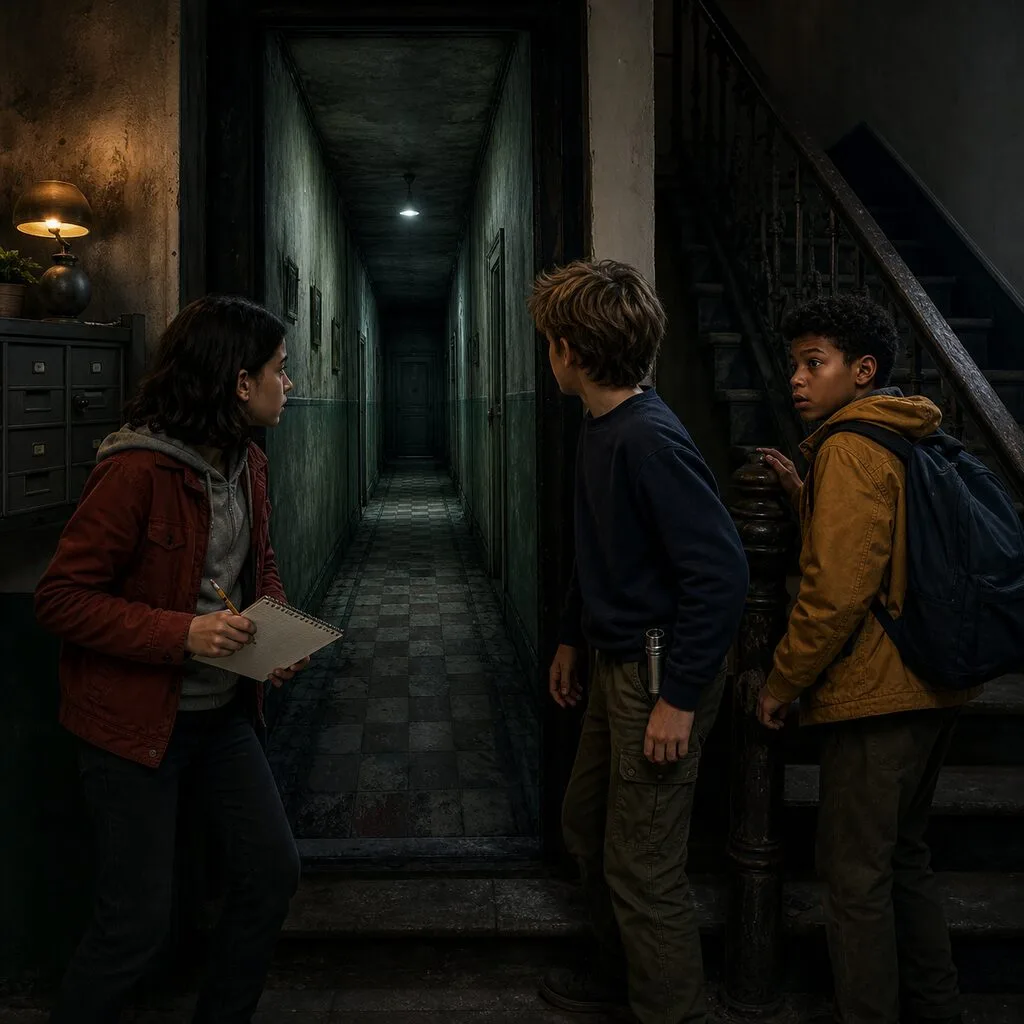
Nora stopped at the last step. In front of them was a short hall with a coat rack, a kitchen door, and a wall with a mirror. Nothing else.
Just then, the light went out.
It was not a slow dimming. The lamp above them simply clicked, and everything sank into thick darkness.
Nora held her breath.
A moment ago, there had been a wall beside the mirror. Now the wall was not in its place.
Instead, a narrow corridor opened there. It stretched straight ahead, farther than any space in the house should have been able to hold. Its floor was not made of the same dark boards as the hall. It was covered with small, yellowed square tiles arranged in a pattern of dark green and cream diamonds.
At the end of the corridor stood a closed door.
It had no number and no nameplate. Yet on the left side of the frame was a small faded mark, perhaps a circle, perhaps a letter. Nora did not have time to make it out.
Something was behind the door.
Not a clear figure. More like a darker shadow in the thin gap beneath it, as if someone were standing there without moving.
Then the light came back.
The yellow lamp shone again. In front of Nora were the wall, the mirror, and the coat rack. No long corridor. No door.
“What happened?” Ben asked very softly.
Nora did not move. “There was a corridor.”
Filip switched on his flashlight, even though the light was already on. He swept the beam over the wall, the mirror frame, and the floor. “Where?”
“There. Behind the mirror. I mean, not behind it. In the place where that wall was.”
The boy tilted his head. “Nora, eyes need a moment to adjust in the dark. You might have seen a reflection or a shadow.”
“I didn’t see a shadow.” Her voice shook, but she continued calmly. “I saw tiles. They were green and cream. And there was a door at the end.”
A spoon clinked in the kitchen. Mrs. Richterová stood in the doorway with mugs in her hands.
“A power cut?” Filip asked.
“Old wiring,” she answered too quickly. “It happens sometimes.”
Nora turned to her. “Was there ever a corridor behind the mirror?”
Mrs. Richterová looked at the wall. Her face remained calm, but her fingers tightened around the mug handle.
“This house used to have all sorts of things,” she said at last. “Now have some tea.”
At the little table by the stairs, no one felt much like drinking. Filip kept studying the socket by the lamp, as if he might find an answer there. Ben sat where he could see both the hall and Mrs. Richterová in the kitchen.
Nora opened the notebook to the first empty page.
“What are you writing?” Filip asked.
“Only what I’m sure of.” The pencil scratched across the paper. “Ground floor. Short power cut. Corridor appeared for a few seconds.”
“And green tiles,” Ben added.
The girl looked at him in surprise. “You saw them?”
An Important Moment
“No. But you said it right away. It didn’t sound as if you had made it up.” For a moment, he lowered his voice. “And I heard something here already. Earlier, when we were bringing our things in.”
“What?”
“A muffled creak. Like someone slowly dragging a heavy chair across the floor. But there isn’t even a room where I heard it coming from.”
Filip stopped poking around by the lamp. “Sound travels in old houses in all sorts of ways.”
“I know,” Ben said. “But I still heard it.”
Nora closed the notebook. “We won’t argue. We’ll wait. If the light goes out again, we’ll stand here. No one goes anywhere, and no one opens any doors. We only watch.”
After a moment, Filip nodded. “That’s sensible. And I have my flashlight.”
“Don’t switch it on in the dark,” Nora said. “First we want to see what happens.”
“Okay. But I’ll keep it ready.”
Waiting was worse than the first blackout. The minutes dragged. From the kitchen came the sound of water in the pipes now and then. Somewhere upstairs, wood gave a crack. Meanwhile, Mrs. Richterová took away the empty mugs and acted as if she did not notice the children by the stairs at all.
Then the lamp clicked a second time.
Darkness.
This time, all three of them stood side by side.
The corridor appeared exactly where Nora had seen it. The tiles gleamed dully in the weak light from the window. At the end stood the same nameless door. By the frame, the faded mark shone like a dirty silver dot.
And then came a creak.
It was low, slow, and brief. It did not come from above or from the kitchen. It seemed to come from behind the wall, from the very place where the impossible corridor began.
Ben squeezed Nora’s sleeve. “That’s it.”
Filip’s flashlight remained off in his hand. “I heard it,” he whispered. “And I can see the corridor too.”
Mrs. Richterová’s silhouette appeared by the kitchen door. The keys in her hand clinked. For a moment, she looked straight toward the end of the corridor.
The light came back.
Everything vanished so fast that Nora blinked. The wall was back. The mirror showed only their three pale faces.
“That wasn’t an ordinary fault that makes simple shadows,” Filip said. He tried to sound matter-of-fact, but his voice was quieter than before.
“No,” Nora agreed.
Ben turned to Mrs. Richterová. “You knew about that corridor.”
The older woman did not frown. She only took a tired breath. “I knew the stories about it.”
“What stories?” Filip blurted out.
“The kind that linger in houses longer than wallpaper.” She looked at the ground floor, then at the children. “I don’t want you to be afraid. But I don’t want you playing at being heroes either. The ground floor is not quite ordinary. It never was.”
Nora noticed that, as she said this, Mrs. Richterová’s gaze slid toward the door beside the kitchen. It was low, gray, and locked with a brass lock.
“What’s in there?” she asked.
“A storage room. Old things.”
Filip looked at the lock. “And maybe old parts of the house?”
Mrs. Richterová did not answer at once. “Maybe.”
In the storage nook, they could see a few boxes, a rolled-up carpet, a frame without a picture, and a wooden crate with metal labels. Nora did not move closer, though. The corridor was no longer visible, and Mrs. Richterová had clearly said not to rush into anything without thinking.
What Comes Next
“That mark by the door,” Nora said. “It looked a little like a metal label. Or a marker from an old lock.”
Filip nodded. “If that door is real, maybe something belongs with it. A key, a plate, a piece of a mechanism… something that could have been separated from it.”
“Among old things, there are often objects that seem unimportant,” Ben said. “Until you find out where they belong.”
Mrs. Richterová gave him a strange, searching look. Then she lifted the bunch of keys. “Not all keys open doors. Some only remind us that doors exist.”
“So will you help us look?” Filip asked.
“Not tonight.” Her tone was firm, but not harsh. “Tonight, just remember what you saw. In the morning, we’ll look at things that can be examined in daylight.”
That sounded sensible. It was also a little disappointing. Still, Nora knew that if they wanted to return to the door at the end of the corridor, they could not simply jump into the dark and hope everything would turn out well.
She sat down again at the little table by the stairs. The light above her shone steadily now. In the notebook, she wrote slowly and clearly: The corridor appears only after a short power cut. Only on the ground floor. It lasts only a few seconds. A creak is heard when it appears.
Below that, she added: Nameless door. Faded mark by the frame.
Filip leaned over her shoulder. “All right. I’m not saying it was only an optical illusion anymore.”
“That’s progress,” Ben said.
“I’m not saying it’s a ghost,” Filip added quickly.
“Neither am I,” Nora replied. “I’m only saying there is something there.”
Mrs. Richterová paused for a moment by the kitchen door. She looked toward the dark part of the ground floor, as if listening for a sound the others had not yet heard. Then she slipped the keys into her sweater pocket.
Nora closed the notebook and ran a finger over its cover. Fear still sat somewhere inside her, small and cold. But it was no longer alone. Curiosity had settled beside it.
Somewhere in the old house, an object was waiting that belonged with the nameless door.
To be continued…