
Vypočujte si slovenskú audio verziu príbehu
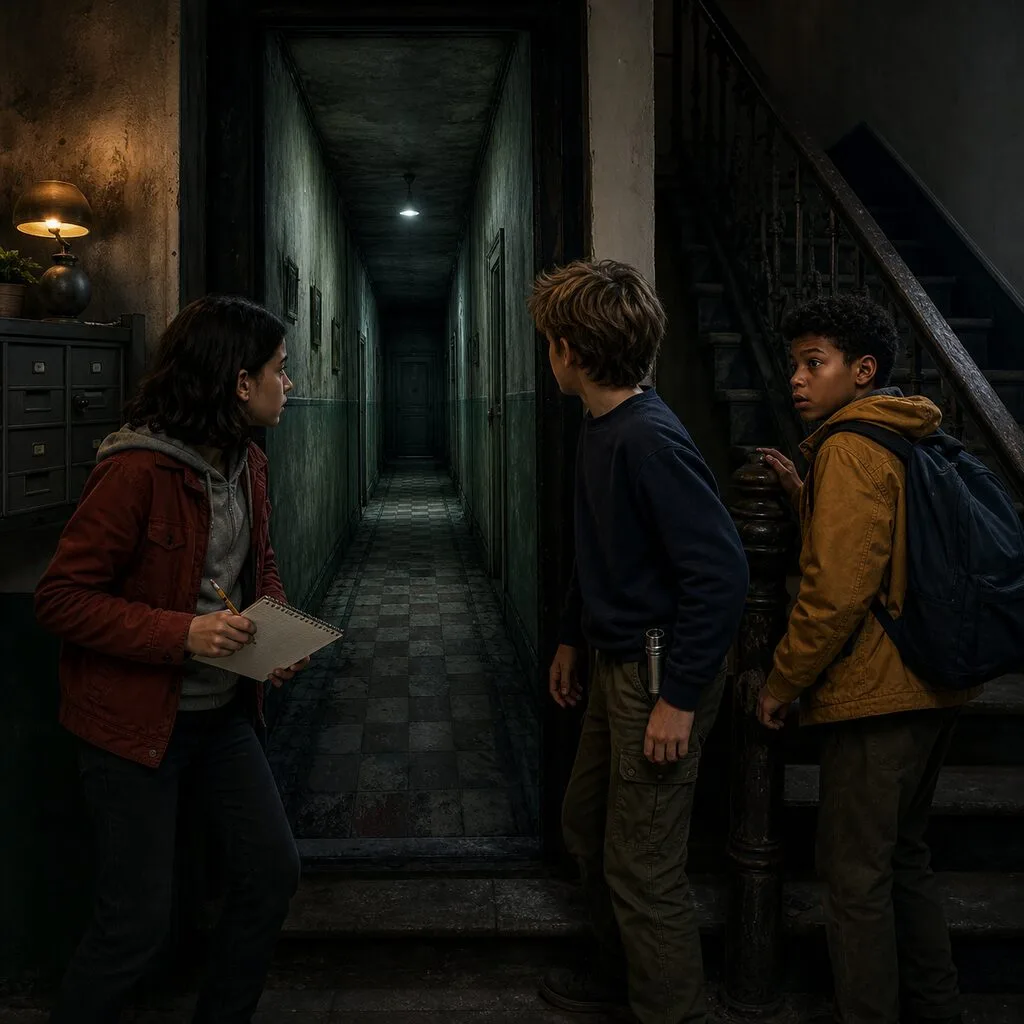
Nora, Filip a Ben stoja v tme pri schodoch, keď sa pred nimi zjaví tajomná stará chodba.

dvere na konci chodby je nová časť seriálu Chodba bez čísla, pripravená ako dvojjazyčný detský príbeh v slovenčine aj angličtine.

dvere na konci chodby: začína sa príbeh

Dom pani Richterovej stál na konci tichej ulice, trochu bokom od ostatných domov. Mal vysoké okná, ošúchanú zelenú fasádu a železnú bránu, ktorá sa pri každom pohybe ozvala dlhým zavŕzganím.

„To je vítací zvuk?“ spýtal sa Filip, keď brána zakvílila ešte raz.

„Nie,“ povedal Ben a pevnejšie si pritiahol popruh tmavého batoha. „To je zvuk, ktorý hovorí: radšej sa otočte.“

Nora sa usmiala, hoci jej bolo trochu chladno. Nebolo to len večerným vetrom. Dom mal zvláštny spôsob, ako pôsobiť staršie, než naozaj bol. Akoby si v tmavých oknách niečo pamätal.

Pani Richterová im otvorila takmer hneď. Mala strieborné vlasy ostrihané po bradu, tmavý bordový sveter a v ruke zväzok mosadzných kľúčov. Pri pohybe jemne zacinkali.

„Tak vy ste tí odvážlivci, čo tu chcú prespať,“ povedala. „Poďte ďalej, kým vám nezmoknú veci.“

V predsieni bolo teplo, no svetlo zo stropnej lampy bolo slabé a žlté. Na stenách viseli čiernobiele fotografie ľudí, ktorých deti nepoznali. Pod schodmi stál starý stojan na dáždniky a vedľa neho komoda s vyblednutým mramorovým vrchom.

Keď Nora položila batoh na zem, vytiahla z predného vrecka malý papierový notes a ceruzku.

Filip nadvihol obočie. „Ty si si ho vzala aj na prespávačku?“

„Je to praktické,“ odpovedala pokojne. „Mobil môže mať vybitú batériu. Notes nie.“

„Notes tiež nemá baterku,“ namietol.

„Práve preto vydrží dlho.“

Ben sa potichu zasmial. Pani Richterová sa na notes chvíľu zadívala, potom sa otočila ku schodom.

„Vaša izba je hore. Kúpeľňa je na konci chodby. A keby ste niečo potrebovali, zavolajte na mňa. Tento dom občas…“ Zarazila sa a kľúče v jej ruke stíchli. „Občas vydáva zvuky. Je starý.“

„Aké zvuky?“ spýtala sa Nora presne.

Staršia pani sa na ňu pozrela. „Také, aké vydávajú staré domy.“ Potom dodala tichšie: „Má aj časti, ktoré už dlho nikto poriadne nepoužíva. Ale vy sa držte tam, kde je svetlo.“

Na poschodí ich čakala hosťovská izba s dvoma posteľami, rozkladacím kreslom a veľkou lampou pri okne. Filip si hneď vybral kreslo, vraj preto, že má najlepší výhľad na dvere. Ben tvrdil, že to znie skôr ako najhorší výhľad na dvere.

Nora si sadla na posteľ a položila notes na prikrývku. Vonku za oknom sa rozsvietila pouličná lampa. Jej svetlo kreslilo na stenu tenký bledý pás.

„Staré domy praskajú, hučia a v noci znejú divne,“ vysvetľoval Filip, keď si pripínal malú baterku k opasku. „Potrubie sa ochladí, drevo sa pohne, elektrina zabliká. Nič záhadné.“

„Pani Richterová nepovedala len to,“ pripomenul Ben. Stál pri dverách a počúval chodbu. „Povedala, že sú tu staré časti, ktoré nikto nepoužíva.“

„Možno stará komora,“ odvetil Filip. „Alebo zamknutá práčovňa. Ľudia znejú tajomne aj vtedy, keď hovoria o metle.“

Nora si poťukala ceruzkou o koleno. „Kde presne je na prízemí najstaršia časť?“

„Prečo?“

„Lebo ak tam niečo hučí alebo sa hýbe, chcela by som vedieť odkiaľ.“

Ben ukázal smerom dolu. „Pri schodoch je malý priestor s kreslom. A potom chodba ku kuchyni. Tam boli tie fotografie.“

„Večer sa tam pozrieme,“ rozhodla Nora. „Len sa nebudeme tváriť, že všetko je strašidelné, keď to možno nie je.“

„Dohodnuté,“ povedal Filip. „Ja budem odborník na obyčajné veci.“

„A ja?“ spýtal sa Ben.

„Ty budeš odborník na to, čo pani Richterová nepovedala,“ usmiala sa Nora.

Neskôr zostúpili na prízemie po schodoch, ktoré pod nohami ticho vzdychali. Pani Richterová bola v kuchyni a nalievala čaj do hrnčekov. Z chodby sem prenikala vôňa starého dreva, čistiaceho prostriedku a niečoho sladkého, možno sušených jabĺk.

Nora sa zastavila pri poslednom schode. Pred nimi bola krátka chodba s vešiakom, dverami do kuchyne a stenou, na ktorej viselo zrkadlo. Nič viac.

Práve vtedy svetlo zhaslo.

Nebolo to pomalé stmavnutie. Lampa nad nimi jednoducho cvakla a všetko sa ponorilo do hustej tmy.

Keď sa veci začnú meniť

Nora zadržala dych.

Pred malou chvíľou tam bola stena vedľa zrkadla. Teraz však stena nebola na svojom mieste.

Namiesto nej sa otvárala úzka chodba. Viedla rovno dopredu, ďalej, než by sa do domu mohlo zmestiť. Jej podlaha nebola z rovnakých tmavých dosiek ako predsieň. Tvorili ju malé štvorce zo zažltnutých dlaždíc, poskladané do vzoru tmavozelených a krémových kosoštvorcov.

Na konci chodby stáli zatvorené dvere.

Nemali číslo ani menovku. Pri ľavej strane zárubne sa však črtala malá vyblednutá značka, možno kruh, možno písmeno. Nora ju nestihla rozoznať.

Za dverami niečo bolo.

Nie jasná postava. Skôr tmavší tieň v tenkej medzere pod dverami, akoby tam niekto stál a nehýbal sa.

Potom sa svetlo vrátilo.

Žltá lampa znovu zažiarila. Pred Norou bola stena, zrkadlo a vešiak. Žiadna dlhá chodba. Žiadne dvere.

„Čo sa stalo?“ ozval sa Ben veľmi potichu.

Nora sa ani nepohla. „Bola tam chodba.“

Filip zapol baterku, hoci svetlo už svietilo. Kužeľom prešiel po stene, po ráme zrkadla aj po podlahe. „Kde?“

„Tam. Za zrkadlom. Teda nie za ním. Namiesto tej steny.“

Chlapec naklonil hlavu. „Nora, oči sa v tme chvíľu prispôsobujú. Mohla si vidieť odraz alebo tieň.“

„Nevidela som tieň.“ Hlas sa jej zachvel, no pokračovala pokojne. „Videla som dlaždice. Boli zelené a krémové. A na konci boli dvere.“

Z kuchyne sa ozval štrngot lyžičky. Pani Richterová stála vo dverách s hrnčekmi v rukách.

„Výpadok?“ spýtal sa Filip.

„Staré vedenie,“ odpovedala prirýchlo. „Občas sa to stane.“

Nora sa otočila k nej. „Bola tu niekedy chodba za zrkadlom?“

Pani Richterová sa zadívala na stenu. Jej tvár zostala pokojná, ale prsty sa jej pevnejšie zovreli okolo ucha hrnčeka.

„V tomto dome bolo kedysi všeličo,“ povedala napokon. „Teraz si dajte čaj.“

Pri malom stolíku vedľa schodov sa nikomu veľmi nechcelo piť. Filip stále skúmal zásuvku pri lampe, akoby v nej mohol nájsť odpoveď. Ben si sadol tak, aby videl na chodbu aj na pani Richterovú v kuchyni.

Nora otvorila notes na prvej čistej strane.

„Čo píšeš?“ spýtal sa Filip.

„Iba to, čím som si istá.“ Ceruzka zaškrípala po papieri. „Prízemie. Krátky výpadok svetla. Chodba sa objavila na pár sekúnd.“

„A zelené dlaždice,“ dodal Ben.

Dievča naňho prekvapene pozrelo. „Ty si ich videl?“

„Nie. Ale povedala si to hneď. Nevyzeralo to, že si si to vymyslela.“ Na chvíľu stíšil hlas. „A ja som tu už niečo počul. Ešte predtým, keď sme vykladali veci.“

„Čo?"

„Také tlmené zavŕzganie. Ako keby niekto pomaly odsúval ťažkú stoličku po podlahe. Lenže odtiaľ, kde som to počul, žiadna izba nie je.“

Filip sa prestal hrabať pri lampe. „Zvuk sa v starých domoch prenáša všelijako.“

„To viem,“ povedal Ben. „Ale aj tak som ho počul.“

Nora zatvorila notes. „Nebudeme sa hádať. Počkáme. Ak svetlo zhasne znova, postavíme sa sem. Nikto nikam nepôjde a nikto nebude otvárať žiadne dvere. Len sa pozrieme.“

Filip po chvíli prikývol. „To je rozumné. A mám baterku.“

„Baterku nezapínaj počas tmy,“ povedala Nora. „Najprv chceme vidieť, čo sa stane.“

„Dobre. Ale držím ju pripravenú.“

Čakanie bolo horšie než prvý výpadok. Minúty sa vliekli. Z kuchyne občas prišiel zvuk vody v potrubí. Niekde hore puklo drevo. Medzitým pani Richterová odniesla prázdne hrnčeky a tvárila sa, že deti pri schodoch vôbec nepozoruje.

Potom lampa cvakla druhý raz.

Tma.

Tentoraz stáli všetci traja vedľa seba.

Chodba sa objavila presne tam, kde ju Nora videla. Dlaždice sa matne leskli v slabom svetle z okna. Na konci boli tie isté dvere bez mena. Pri zárubni žiarila vyblednutá značka ako špinavá strieborná bodka.

A ozvalo sa zavŕzganie.

Bolo nízke, pomalé a krátke. Neprišlo zhora ani z kuchyne. Zdalo sa, že prichádza spoza steny, presne z miesta, kde začínala nemožná chodba.

Ben stisol Norin rukáv. „To je ono.“

Dôležitý okamih

Filipova baterka zostala vypnutá v jeho dlani. „Počul som to,“ zašepkal. „A chodbu tiež vidím.“

Pri dverách do kuchyne sa zjavila silueta pani Richterovej. Kľúče v jej ruke cinkli. Na okamih sa pozrela priamo na koniec chodby.

Svetlo naskočilo.

Všetko zmizlo tak rýchlo, až Nora žmurkla. Stena bola späť. Zrkadlo ukazovalo iba ich tri bledé tváre.

„To nebola porucha, čo robí obyčajné tiene,“ povedal Filip. Snažil sa znieť vecne, no hlas mal tichší než predtým.

„Nie,“ súhlasila Nora.

Ben sa obrátil k pani Richterovej. „Vy ste tú chodbu poznali.“

Staršia žena sa nezamračila. Len sa unavene nadýchla. „Poznala som príbehy o nej.“

„Aké príbehy?“ vyhŕkol Filip.

„Také, ktoré sa v domoch držia dlhšie než tapety.“ Pozrela na prízemie, potom na deti. „Nechcem, aby ste sa báli. Ale nechcem ani, aby ste sa hrali na hrdinov. Prízemie nie je celkom obyčajné. Nikdy nebolo.“

Nora si všimla, že pani Richterová pri tých slovách pohľadom skĺzla ku dverám vedľa kuchyne. Boli nízke, sivé a zamknuté mosadzným zámkom.

„Čo je tam?“ spýtala sa.

„Sklad. Staré veci.“

Filip sa pozrel na zámok. „A možno staré časti domu?“

Pani Richterová neodpovedala hneď. „Možno.“

V skladovom kúte bolo vidieť zopár škatúľ, zvinutý koberec, rám bez obrazu a drevenú debničku s kovovými štítkami. Nora sa však nepohla bližšie. Chodba už nebola viditeľná a pani Richterová jasne povedala, aby sa nepúšťali do ničoho bez rozmyslu.

„Tá značka pri dverách,“ povedala Nora. „Vyzerala trochu ako kovový štítok. Alebo značka pri starom zámku.“

Filip prikývol. „Ak sú tie dvere skutočné, možno k nim niečo patrí. Kľúč, tabuľka, kus mechanizmu… niečo, čo sa dalo oddeliť.“

„V starých veciach bývajú veci, ktoré vyzerajú nepodstatne,“ povedal Ben. „Až kým nezistíte, kam patria.“

Pani Richterová sa naňho zahľadela zvláštnym, skúmavým pohľadom. Potom zdvihla zväzok kľúčov. „Nie všetky kľúče otvárajú dvere. Niektoré iba pripomínajú, že dvere existujú.“

„Tak nám pomôžete hľadať?“ spýtal sa Filip.

„Dnes už nie.“ Jej tón bol pevný, ale nie prísny. „Dnes si len zapamätajte, čo ste videli. Ráno sa pozrieme na veci, ktoré sa dajú preskúmať za svetla.“

To znelo rozumne. Zároveň to bolo trochu sklamanie. Nora však vedela, že ak sa chcú vrátiť k dverám na konci chodby, nemôžu len skočiť do tmy a dúfať, že všetko dobre dopadne.

Sadla si ešte raz ku stolíku pri schodoch. Svetlo nad ňou tentoraz svietilo pokojne. Do notesu napísala pomaly a čitateľne: Chodba sa objavuje iba po krátkom výpadku svetla. Iba na prízemí. Trvá len pár sekúnd. Pri objavení počuť zavŕzganie.

Pod to pridala: Dvere bez mena. Vyblednutá značka pri zárubni.

Filip sa naklonil ponad jej rameno. „Dobre. Už nehovorím, že to bol len optický klam.“

„To je pokrok,“ povedal Ben.

„Nehovorím, že je to duch,“ dodal Filip rýchlo.

„Ani ja,“ odvetila Nora. „Hovorím len, že tam niečo je.“

Pri dverách do kuchyne pani Richterová na okamih zastala. Pozerala smerom k tmavej časti prízemia, akoby počúvala zvuk, ktorý ostatní ešte nepočuli. Potom kľúče schovala do vrecka svetra.

Nora zavrela notes a prstom prešla po jeho obálke. Strach stále sedel niekde v nej, malý a chladný. Už však nebol sám. Vedľa neho sa usadila zvedavosť.

Niekde v starom dome čakal predmet, ktorý sa hodil k dverám bez mena.

Pokračovanie nabudúce…

Nabudúce: Objaví sa záhadný kľúč

The Unnumbered Corridor, part 1: The Door at the End of the Hall

The Story Begins

Mrs. Richterová’s house stood at the end of a quiet street, a little apart from the other homes. It had tall windows, a worn green front, and an iron gate that gave a long squeak every time it moved.

"Is that a welcoming sound?" Filip asked when the gate cried out again.

"No," Ben said, pulling the strap of his dark backpack tighter. "That is the sound that says: maybe turn back."

Nora smiled, even though she felt a little cold. It was not only the evening wind. The house had a strange way of seeming older than it really was. As if something in its dark windows remembered things.

Mrs. Richterová opened the door almost at once. She had silver hair cut to her chin, a dark burgundy sweater, and a bunch of brass keys in her hand. They gave a soft clink when she moved.

"So you’re the brave ones who want to sleep here," she said. "Come in before your things get wet."

The hall was warm, but the light from the ceiling lamp was weak and yellow. Black-and-white photos hung on the walls, showing people the children did not know. Under the stairs stood an old umbrella stand, and next to it was a cabinet with a faded marble top.

When Nora put down her bag, she took a small paper notebook and a pencil from the front pocket.

Filip lifted his eyebrows. "You brought that even for a sleepover?"

"It’s useful," she said calmly. "A phone can run out of battery. A notebook cannot."

"A notebook doesn’t have a light either," he argued.

"That’s exactly why it lasts so long."

Ben gave a quiet laugh. Mrs. Richterová looked at the notebook for a moment, then turned toward the stairs.

"Your room is upstairs. The bathroom is at the end of the hall. And if you need anything, call me. This house sometimes…" She stopped, and the keys in her hand grew still. "Sometimes it makes noises. It’s old."

"What kind of noises?" Nora asked carefully.

The older woman looked at her. "The kind old houses make." Then she added more softly, "It also has parts that no one has really used for a long time. But stay where there is light."

On the first floor, a guest room waited for them with two beds, a folding chair, and a big lamp by the window. Filip chose the chair at once, saying it had the best view of the door. Ben said that sounded more like the worst view of the door.

Nora sat on one bed and placed the notebook on the blanket. Outside, a streetlamp came on. Its light drew a thin pale полос?— No, a thin pale strip across the wall.

"Old houses crack, hum, and sound weird at night," Filip explained while he clipped a small flashlight to his belt. "Pipes cool down, wood shifts, electricity flickers. Nothing strange."

"Mrs. Richterová didn’t only say that," Ben reminded them. He stood by the door and listened to the hall. "She said there are old parts nobody uses."

"Maybe an old storage room," Filip said. "Or a locked laundry room. People sound mysterious even when they are talking about a broom."

Nora tapped the pencil against her knee. "Where exactly is the oldest part on the ground floor?"

"Why?"

"Because if something hums or moves there, I want to know where it starts."

Ben pointed downward. "By the stairs there’s a small space with a chair. And then the hall toward the kitchen. That’s where the photos were."

When Things Start to Change

"We’ll look there later," Nora decided. "We just won’t act like everything is scary if it maybe isn’t."

"Agreed," Filip said. "I’ll be the expert on ordinary things."

"And me?" Ben asked.

"You’ll be the expert on what Mrs. Richterová did not say," Nora said with a smile.

Later, they went down to the ground floor on stairs that sighed quietly under their feet. Mrs. Richterová was in the kitchen, pouring tea into mugs. The hall smelled of old wood, cleaning liquid, and something sweet, maybe dried apples.

Nora stopped at the last step. In front of them was a short hall with a coat rack, kitchen door, and a wall with a mirror. Nothing else.

Just then, the light went out.

It was not a slow dimming. The lamp above them clicked, and everything dropped into thick darkness.

Nora held her breath.

A moment ago, there had been a wall next to the mirror. Now the wall was not in its place.

Instead, a narrow corridor opened there. It stretched straight ahead, farther than any space in the house should have been able to hold. Its floor was not made of the same dark boards as the hall. It was covered with small square tiles, yellowed with age, set in a pattern of dark green and cream diamonds.

At the end of the corridor stood a closed door.

It had no number and no nameplate. Yet on the left side of the frame, there was a small faded mark, maybe a circle, maybe a letter. Nora could not make it out in time.

Something was behind the door.

Not a clear figure. More like a darker shadow in the thin space under it, as if someone stood there without moving.

Then the light came back.

The yellow lamp shone again. In front of Nora was only the wall, the mirror, and the coat rack. No long corridor. No door.

"What happened?" Ben asked very softly.

Nora did not move. "There was a corridor."

Filip switched on his flashlight, even though the light was already on. He swept the beam over the wall, the mirror frame, and the floor. "Where?"

"There. Behind the mirror. I mean, not behind it. In the place where that wall was."

The boy tilted his head. "Nora, eyes need a moment to adjust in the dark. You might have seen a reflection or a shadow."

"I didn’t see a shadow." Her voice shook, but she kept going calmly. "I saw tiles. They were green and cream. And there were doors at the end."

A spoon clinked from the kitchen. Mrs. Richterová stood in the doorway with mugs in her hands.

"A power cut?" Filip asked.

"Old wiring," she answered too quickly. "It happens sometimes."

Nora turned to her. "Was there ever a corridor behind the mirror?"

Mrs. Richterová looked at the wall. Her face stayed calm, but her fingers tightened around the mug handle.

"This house used to have all sorts of things," she said at last. "Now have some tea."

At the little table by the stairs, no one felt much like drinking. Filip kept studying the socket by the lamp, as if he might find an answer there. Ben sat where he could see both the hall and Mrs. Richterová in the kitchen.

Nora opened the notebook to the first empty page.

"What are you writing?" Filip asked.

"Only what I’m sure of." The pencil scratched across the paper. "Ground floor. Short power cut. Corridor appeared for a few seconds."

"And green tiles," Ben added.

The girl looked at him in surprise. "You saw them?"

An Important Moment

"No. But you said it right away. It didn’t sound like you made it up." For a moment, he lowered his voice. "And I heard something here already. Before, when we were bringing things in."

"What?"

"A dull creak. Like someone slowly dragging a heavy chair across the floor. But from where I heard it, there isn’t even a room there."

Filip stopped poking at the lamp. "Sound travels in old houses in strange ways."

"I know," Ben said. "But I still heard it."

Nora closed the notebook. "We won’t argue. We’ll wait. If the light goes out again, we stand here. No one goes anywhere, and no one opens any doors. We only watch."

After a moment, Filip nodded. "That makes sense. And I have my flashlight."

"Don’t switch it on during the dark," Nora said. "First we want to see what happens."

"Okay. But I’ll keep it ready."

Waiting was worse than the first blackout. The minutes dragged. From the kitchen came the sound of water in the pipes now and then. Somewhere upstairs, wood gave a small crack. Meanwhile, Mrs. Richterová took the empty mugs away and acted as if she did not notice the children by the stairs at all.

Then the lamp clicked again.

Darkness.

This time, all three of them stood side by side.

The corridor appeared exactly where Nora had seen it. The tiles gleamed softly in the weak light from the window. At the end were the same nameless doors. By the frame, the faded mark shone like a dirty silver dot.

And then came a creak.

It was low, slow, and short. It did not come from above or from the kitchen. It seemed to come from behind the wall, right from the place where the impossible corridor began.

Ben squeezed Nora’s sleeve. "That’s it."

Filip’s flashlight stayed off in his hand. "I heard it," he whispered. "And I can see the corridor too."

By the kitchen door, Mrs. Richterová’s silhouette appeared. Her keys clinked softly. For one moment, she looked straight toward the end of the corridor.

The light came back.

Everything vanished so fast that Nora blinked. The wall was there again. The mirror showed only their three pale faces.

"That wasn’t a normal broken light that makes simple shadows," Filip said. He tried to sound matter-of-fact, but his voice was quieter now.

"No," Nora agreed.

Ben turned to Mrs. Richterová. "You knew about that corridor."

The older woman did not frown. She only took a tired breath. "I knew the stories about it."

"What stories?" Filip burst out.

"The kind that stay in houses longer than wallpaper." She looked at the ground floor, then at the children. "I don’t want you to be scared. But I also don’t want you playing at being heroes. The ground floor is not quite ordinary. It never was."

Nora noticed that when she said that, Mrs. Richterová’s eyes slid toward the door next to the kitchen. It was low, gray, and locked with a brass lock.

"What’s in there?" Nora asked.

"A storage room. Old things."

Filip looked at the lock. "And maybe old parts of the house?"

Mrs. Richterová did not answer right away. "Maybe."

Inside the storage corner, they could see a few boxes, a rolled-up carpet, a frame without a picture, and a wooden crate with metal labels. Nora did not move closer, though. The corridor was no longer visible, and Mrs. Richterová had clearly said not to rush into anything without thinking.

What Comes Next

"That mark by the door," Nora said. "It looked a bit like a metal label. Or a sign from an old lock."

Filip nodded. "If those doors are real, maybe something belongs with them. A key, a plate, a piece of a mechanism… something that can be taken off."

"Old things often have objects that look unimportant," Ben said. "Until you find out where they belong."

Mrs. Richterová gave him a strange, careful look. Then she lifted the bunch of keys. "Not all keys open doors. Some only remind us that doors exist."

"Will you help us look?" Filip asked.

"Not tonight." Her tone was firm, but not harsh. "Tonight you only remember what you saw. In the morning, we’ll look at things that can be checked in daylight."

That sounded sensible. It was also a little disappointing. Still, Nora knew that if they wanted to return to the doors at the end of the corridor, they could not just jump into the dark and hope everything would be fine.

She sat down again at the little table by the stairs. The light above them was steady now. In the notebook, she wrote slowly and clearly: The corridor appears only after a short blackout. Only on the ground floor. It lasts only a few seconds. A creak can be heard when it appears.

Below that she added: Nameless door. Faded mark by the frame.

Filip leaned over her shoulder. "Okay. I’m not saying it was only an optical trick anymore."

"That’s progress," Ben said.

"I’m still not saying it’s a ghost," Filip added quickly.

"Neither am I," Nora replied. "I’m only saying there is something there."

By the kitchen door, Mrs. Richterová stopped for a moment. She looked toward the dark part of the ground floor, as if listening for a sound the others had not yet heard. Then she put the keys away in her sweater pocket.

Nora closed the notebook and ran one finger over its cover. Fear still sat somewhere inside her, small and cold. But it was no longer alone. Curiosity had settled beside it.

Somewhere in the old house, an object was waiting. It fit the nameless door.

To be continued…

Next time: A new mystery appears