
Vypočujte si slovenskú audio verziu príbehu
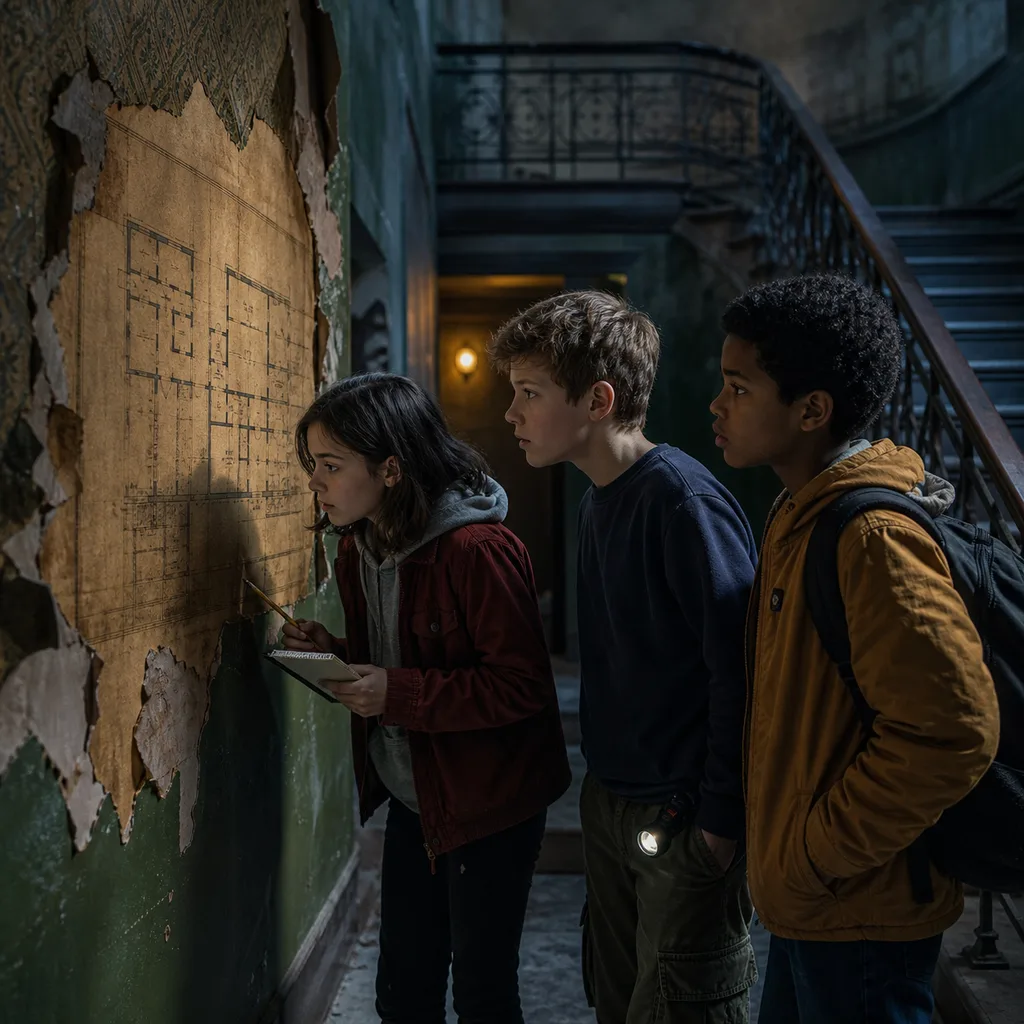
mapa za tapetou je nová časť seriálu Chodba bez čísla, pripravená ako dvojjazyčný detský príbeh v slovenčine aj angličtine.
mapa za tapetou: začína sa príbeh
V pondelok popoludní sa staré schodisko zdalo obyčajnejšie než inokedy. Z prízemia bolo počuť buchnutie domových dverí, o poschodie vyššie niekto púšťal vodu a žiarovka nad medziposchodím vrhala na steny mäkké žlté svetlo.
Nora však zastala tak náhle, až do nej Ben takmer vrazil.
„Čo je?“ zašepkal.
Dievča ukázalo na roh tapety pri poslednom schode. Vyblednutý vzor zelených listov sa tam odliepal od steny. Nebol to veľký kus, len úzky pásik, ktorý sa na konci zvinul ako suchý lístok.
„To tam včera nebolo,“ povedala Nora.
Filip si napravil baterku pripnutú na opasku, hoci na chodbe svietilo. „Možno bolo. Len si si to nevšimla. Staré lepidlo, vlhkosť, prievan… budovy majú viac spôsobov, ako sa rozpadávať nudne.“
„Toto miesto nikdy nie je nudné,“ namietol Ben. Hneď sa pozrel, či ho niekto nepočul. „A vždy je tu nejako tichšie. Aj keď vonku hučí výťah.“
Nora už vytiahla svoj malý papierový zápisník. Telefóny im v chodbe bez čísla aj tak strácali signál, preto si všetko dôležité zapisovala ceruzkou. Na čistú stranu načrtla schodisko, okno oproti nemu a roh tapety.
„Tretie poschodie, staré schody, stena vedľa zamurovaného miesta,“ povedala potichu. „Tapeta sa odliepa asi dvanásť centimetrov nad lištou.“
„Asi?“ Filip zdvihol obočie.
Nora vytiahla z vrecka krátke kovové pravítko. „Dvanásť a pol.“
Ben sa usmial, no len na okamih. Potom si všimol niečo pod zvlneným rohom. Nebola to sivá omietka, ktorú by tam čakal. Medzi stenou a tapetou presvital matný, zažltnutý papier.
„To nie je stena,“ vydýchol.
Filip k nemu pristúpil. „Dobre. Nikto netrhá nič veľké. Ak je to starý dokument, môže sa rozpadnúť.“
Zo školskej tašky vytiahol tenkú plastovú záložku, ktorú zvykol používať pri technických knihách. Veľmi opatrne ju zasunul pod odlepený kraj. Tapeta zašušťala. Zvuk bol slabý, ale na prázdnom schodisku znel príliš jasne.
Pod ňou sa ukázala tmavá rovná čiara.
Všetci traja na chvíľu stíchli.
„To vyzerá ako plán,“ povedala Nora.
Filip už neodpovedal. Jemne nadvihol ďalší kúsok, iba natoľko, aby sa papier neroztrhol. Na žltej ploche pribudli tenké čierne čiary, malé štvorčeky a niekoľko vyblednutých značiek. Jedna časť kresby viedla presne pozdĺž steny, pri ktorej stáli.
Nora si čupla. „Počkaj. Tu je schodisko. Vidíš tie dve paralelné čiary?“
„Vidím,“ prikývol Filip. „A toto bude chodba. Podľa šírky sedí takmer presne.“
Ben sa naklonil ponad jeho plece. „Tá chodba bez čísla?“
Na pláne nebolo napísané žiadne číslo. Len úzky pruh medzi miestnosťami, akoby ho niekto zakreslil a potom zabudol pomenovať. Viedol od starého schodiska do časti domu, ktorá na dnešnom pôdoryse vôbec neexistovala.
Nora prebehla pohľadom po čiarach. Boli jemné, miestami poškodené vlhkosťou, ale stále čitateľné. Vedľa schodiska našla malú šípku. Šípka smerovala k priestoru za stenou, ktorá bola teraz zamurovaná.
„Takže to nebola samostatná chodba,“ povedala. „Bola súčasťou väčšieho krídla domu.“
Filip si odmeral vzdialenosť očami, potom prešiel pár krokov ku koncu chodby a späť. „Ak je tento plán správny, za dnešnou stenou kedysi pokračovalo ďalšie rameno schodov. A za ním miestnosti. Nie jedna. Aspoň tri.“
„Zaniknuté krídlo,“ zašepkal Ben.
Nora zdvihla zrak. „Pani Richterová to tak nazvala?“
Chlapec chvíľu mlčal. Mal dobrú pamäť na vety, ktoré dospelí povedali akoby mimochodom. Najmä na tie, po ktorých sa hneď tvárili, že vlastne nič nepovedali.
„Minulý týždeň,“ prikývol. „Keď sme jej pomáhali s nákupom. Povedala: ,V tomto dome bolo kedysi viac dverí, než ľudí, ktorí sa na ne pamätajú.‘ A potom ešte…“ Zamračil sa. „,Krídlo pri starom schodisku stíchlo skôr než ostatné.‘ Presne tak to povedala.“
Filip sa pozrel na plán znova. „Stíchlo? To môže znamenať, že ho uzavreli pri prestavbe.“
„Alebo že sa tam prestalo niečo ozývať,“ doplnil Ben.
„Prosím, nezačínaj s tým druhým vysvetlením,“ povedal Filip, aj keď jeho hlas neznel úplne presvedčene.
Keď sa veci začnú meniť
Za tapetou sa niečo ticho pohlo.
Nebolo to buchnutie ani škrabanie. Skôr krátke, suché zašustenie, ako keď niekto obracia veľmi starú stránku knihy.
Ben spravil krok späť. Nora tiež, hoci sa snažila, aby to nebolo vidieť. Iba Filip zostal pri stene, no plastovú záložku hneď vytiahol.
„Možno sa papier posunul,“ vysvetlil rýchlo. „Keď sme zdvihli tapetu.“
„Papier sa neposunie sám od seba proti stene,“ povedala Nora.
„Vlhkosť, vzduch, rozdiel teploty.“
„A tajná armáda drobných stavebných škriatkov,“ dodal Ben. Nervózne sa pousmial. „Prepáč. To bol zlý vtip.“
Nora sa vrátila bližšie. Teraz si všimla niečo, čo jej predtým uniklo. Plán sa nekončil roztrhnutým okrajom. Pri zamurovanej stene bol vyrezaný tak rovno, že jej po chrbte prebehol chlad.
Chýbal obdĺžnik papiera. Približne veľký ako dlaň dospelého človeka.
„Pozrite,“ povedala a ceruzkou, bez dotyku, ukázala na prázdne miesto. „Toto nie je poškodenie. Niekto to vystrihol.“
Filip sa sklonil. „Ale prečo by niekto lepil plán za tapetu a potom z neho odstránil jedinú časť, ktorá vedie sem?“
„Aby nikto nevedel, čo bolo za stenou,“ odpovedal Ben.
Na chvíľu nebolo počuť ani vodu z horného bytu. Len stará žiarovka slabo bzučala.
Nora otvorila zápisník na novej dvojstrane. Starostlivo prekreslila chodbu, schodisko a prázdne miesto. Pri chýbajúcom obdĺžniku spravila malé šrafovanie. Vedľa neho napísala: vyrezané zámerne?
Filip medzitým pristúpil k zamurovanej stene. Tehly pod omietkou vytvárali nepravidelný obdĺžnik, ktorý sa od zvyšku chodby odlišoval o trochu tmavším odtieňom. Poklepal naň hánkami.
Prvé dve klepnutia zneli tvrdo.
Tretie sa ozvalo dutým tónom.
Chlapec stuhol a poklepal znova, o kúsok vyššie. Dutý zvuk sa zopakoval. Nebol hlasný, ale akoby sa kdesi za stenou odrazil a vrátil späť neskoro.
„To nemá byť duté,“ povedal.
„Nie je tam len servisná šachta?“ opýtala sa Nora.
„Možno. Staré domy ich majú. Lenže táto by bola príliš široká.“ Filip si prešiel dlaňou po brade, ako to robieval, keď mu niečo nesedelo. „A navyše, podľa plánu tu mala byť chodba. To nie je technický priestor.“
Ben sa zahľadel na šrafovanie v Norinom zošite. „Pani Richterová raz povedala aj niečo iné. Neviem, či to súvisí. Hovorila o Kláre.“
Obaja sa k nemu obrátili.
„Čo povedala?“ spýtala sa Nora.
„Že Klára si vraj zapisovala veci, ktoré ostatní nechceli stratiť. Mená, príbehy, komu patrila ktorá vec. A keď prišla prestavba, niektoré spomienky vraj schovala tam, kde ich nikto nebude hľadať.“
„Za tapetu?“ navrhol Filip.
„Alebo za stenu,“ povedal Ben.
Práve vtedy svetlo nad nimi zhaslo.
Nebolo to úplné ticho, pretože budova okolo nich stále žila. Kdesi zapraskalo potrubie. Zdola zaštekal pes. No pri starom schodisku zostala na niekoľko sekúnd hustá modrosivá tma.
Nora automaticky zovrela zápisník.
Filip cvakol baterkou. Jej úzky kužeľ rozrezal šero a zastal na zamurovanej stene.
Svetlá opäť naskočili.
Tehly tam neboli.
Namiesto nich sa v stene črtal úzky otvor. Nemal dvere ani kľučku. Viedol do priestoru, kde nebolo vidno strop, len pár krokov tmavej podlahy a na konci bledú stenu.
Ben prehltol. „To je ono, však?“
Nora si všimla, že otvor je presne tam, kde na pláne končila šípka. Srdce jej bilo rýchlo, ale slová vyslovila pokojne. „Nie je to tá chodba bez čísla. Je to prepojenie k nej. Ale asi sa ukáže len vtedy, keď zhasnú svetlá.“
„Výborne,“ povedal Filip. „Steny si teraz vyberajú pracovný čas.“
„Nevstúpime tam len tak,“ rozhodla Nora.
Chlapci prikývli. To bolo dôležité. Neznamenalo to, že sa neboja. Znamenalo to, že sa nemusia tváriť, že strach neexistuje.
Rýchlo si rozdelili úlohy. Filip pôjde prvý s baterkou a bude sledovať podlahu aj strop. Nora ostane v strede a bude zaznamenávať, čo uvidia. Ben pôjde posledný, aby si všímal cestu späť a miesto otvoru.
„Ak sa niečo zmení, povieme to hneď,“ dodala Nora. „A ak sa niekomu nebude páčiť, otočíme sa.“
Dôležitý okamih
„To je plán, ktorý schvaľujem,“ povedal Ben.
Priechod bol chladnejší než chodba. Vzduch v ňom voňal po prachu, starej omietke a niečom kovovom, možno po hrdzi. Stačili štyri kroky a staré schodisko za nimi už vyzeralo vzdialenejšie, než by malo.
Našťastie priestor nepokračoval hlboko. O chvíľu sa otvoril do úzkeho výklenku, širokého sotva ako malá komora. Na ľavej stene boli obnažené tehly. Na pravej zostal pás vyblednutej zelenej maľby.
Filip posvietil na podlahu. „Žiadne diery. Žiadne uvoľnené dosky. Môžeme tu byť.“
Nora sa však pozerala vyššie. Na stene, takmer vo výške jej ramena, objavila tenkú značku vytvorenú tmavomodrou ceruzkou. Nebola väčšia než tanier. Tvoril ju obdĺžnik, cez ktorý viedla šípka, a vedľa nej malé písmeno K.
Pod symbolom bolo zopár sotva čitateľných slov.
Filip priblížil svetlo. „Nechcem sa chváliť, ale moja baterka práve zachránila dejiny.“
Nora prešla prstom tesne nad nápisom, bez toho, aby sa ho dotkla. „Je tam: Nezazdívať celkom. A pod tým… Pozri, Ben.“
Chlapec prižmúril oči. Potom sa jeho výraz zmenil.
„,Pamäti zostávajú v bočnom kroku,‘“ prečítal pomaly. „To povedala pani Richterová. Myslel som, že hovorila o nejakom mieste v byte. Ale ona povedala bočný krok. Nie bočná izba.“
Nora vytiahla zápisník a položila ho vedľa značky, aby porovnala kresbu s plánom. Šípka na stene smerovala presne na vyrezaný obdĺžnik na mape. Chýbajúci kus neukazoval bežnú miestnosť. Ukazoval tento úzky priechod a niečo za ním.
„Niekto ho odstránil, aby nikto nevedel o bočnom kroku,“ povedala.
Filip dlho mlčal. Potom si baterku sklopil. „Dobre. Beriem späť polovicu svojich vysvetlení. Toto nie je náhodná dutina ani chyba pri oprave. Niekto presne vedel, čo skrýva.“
„A možno prečo to skrýva,“ doplnil Ben. „Ak Klára schovávala spomienky pred prestavbou… možno tu schovala aj niečo svoje.“
Za stenou sa ozvalo jemné šuchnutie.
Všetci traja sa otočili.
Filip posvietil do rohu výklenku. Nič sa tam nehýbalo. Len pri podlahe ležal kúsok odlúpenej tapety, zrolovaný do tenkej trubičky. Vietor sem nemal kadiaľ vojsť.
„Späť?“ opýtal sa Ben ticho.
Nora sa pozrela na značku, potom na otvor, cez ktorý stále videli žlté svetlo schodiska. Nechcela odísť. Zároveň vedela, že príliš dlhé skúmanie v priestore, ktorý sa objavil po zhasnutí, nie je dobrý nápad.
„Späť,“ povedala. „Máme dôkaz. A potrebujeme ho prekresliť skôr, než zmizne.“
Vrátili sa v rovnakom poradí. Ben sa pri prechode ešte raz obzrel, aby si zapamätal vyblednutú stenu, značku K a presný počet krokov. Keď Nora prešla posledná, svetlo nad schodmi krátko zablikalo.
Priechod sa zavrel bez zvuku.
Namiesto otvoru bola opäť zamurovaná stena. Omietka vyzerala staro, popraskane a úplne obyčajne.
Len tapeta pri schodisku zostala odchlipnutá.
Nora si sadla na schody a zapísala všetko, čo videli. Celý plán prekreslila opatrnejšie než predtým. Chodbu bez čísla označila dvojitou čiarou. Miesto pri stene vyfarbila modrou ceruzkou a do rohu pridala písmeno K v malom štvorčeku.
„Ak existuje jeden bočný krok, môžu byť aj ďalšie,“ povedal Filip. „V tom zaniknutom krídle mohli zostať výklenky, servisné priestory, staré značky. Čokoľvek.“
Ben si pritiahol popruh batoha vyššie na plece. „A možno ďalšie veci, ktoré si Klára zapisovala. Ak chcela uchovať príbehy ľudí z domu, musela ich niekam dávať.“
„Budeme hľadať značku K,“ rozhodla Nora. „Nie naslepo. Najprv porovnáme staré pôdorysy, čo nájdeme, s týmto.“
Filip sa usmial. „To znie skoro ako normálne pátranie. Až na chodbu, ktorá sa objaví iba pri výpadku elektriny.“
„Skoro normálne,“ súhlasil Ben.
Keď sa už chystali odísť, Nora si všimla niečo pri lište. Tam, kde sa tapeta odlepila, zostal prilepený drobný ústrižok zažltnutého papiera. Nebol väčší než jej necht.
Opatrne ho vybrala. Na jednej strane mal časť čiernej čiary. Na druhej, sotva viditeľne, stáli dve písmená: BO.
Nora ústrižok vložila medzi stránky zápisníka.
Čo sa ukáže neskôr
Za nimi staré schodisko ticho čakalo. A niekde za zamurovanou stenou zostal bočný krok, ktorý možno ešte stále viedol ďalej.
Pokračovanie nabudúce…
The Unnumbered Corridor, part 7: The Map Behind the Wallpaper
The Story Begins
On Monday afternoon, the old stairwell seemed more ordinary than usual. From the ground floor came the bang of the front door, someone upstairs was running water, and the light bulb above the landing cast a soft yellow glow on the walls.
Still, Nora stopped so suddenly that Ben almost bumped into her.
“What is it?” he whispered.
The girl pointed to the corner of the wallpaper near the last step. The faded pattern of green leaves was peeling away from the wall there. It was not a big piece, only a narrow strip, and its end curled up like a dry leaf.
“That wasn’t there yesterday,” Nora said.
Filip adjusted the flashlight clipped to his belt, even though the corridor was lit. “Maybe it was. You just didn’t notice. Old glue, damp air, a draft… buildings have many boring ways to fall apart.”
“This place is never boring,” Ben said. He looked around at once to see if anyone had heard him. “And it’s always quieter here. Even when the lift is making noise outside.”
Nora had already pulled out her small paper notebook. Phones lost signal in the corridor without a number anyway, so she wrote down everything important with a pencil. On a clean page, she sketched the stairwell, the window across from it, and the corner of the wallpaper.
“Third floor, old stairs, wall beside the bricked-up place,” she said softly. “The wallpaper is peeling about twelve centimetres above the skirting board.”
“About?” Filip lifted an eyebrow.
Nora took a short metal ruler from her pocket. “Twelve and a half.”
Ben smiled, but only for a second. Then he noticed something under the curled edge. It was not the grey plaster he expected. Between the wall and the wallpaper, a dull yellow piece of paper showed through.
“That’s not a wall,” he breathed.
Filip stepped closer. “All right. Nobody tears off anything big. If it’s an old document, it could fall apart.”
He took a thin plastic bookmark from his school bag, the kind he used in technical books. Very carefully, he slid it under the peeled edge. The wallpaper rustled. The sound was small, but in the empty stairwell it seemed too clear.
Underneath, a dark straight line appeared.
All three children went quiet for a moment.
“That looks like a plan,” Nora said.
Filip did not answer. He lifted another small piece, just enough so the paper would not tear. Thin black lines, tiny squares and a few faded marks appeared on the yellow surface. One part of the drawing ran exactly along the wall beside them.
Nora crouched down. “Wait. Here is the stairwell. Do you see those two parallel lines?”
“I do,” Filip said. “And this will be a corridor. By the width, it fits almost exactly.”
Ben leaned over his shoulder. “The corridor without a number?”
No number was written on the plan. Only a narrow strip between rooms, as if someone had drawn it and then forgotten to name it. It led from the old stairwell into a part of the house that did not exist on today’s floor plan at all.
Nora followed the lines with her eyes. They were fine, damaged in places by damp, but still readable. Beside the stairwell she found a small arrow. It pointed to the space behind the wall, which was now bricked up.
“So it was not a separate corridor,” she said. “It was part of a bigger wing of the building.”
Filip measured the distance with his eyes, then walked a few steps to the end of the corridor and back. “If this plan is right, there used to be another part of the stairs behind today’s wall. And after that, rooms. Not one. At least three.”
When Things Start to Change
“The lost wing,” Ben whispered.
Nora looked up. “Did Mrs. Richterová call it that?”
The boy was quiet for a moment. He had a good memory for things adults said as if by accident. Especially the things they pretended they had not really said at all.
“Last week,” he said. “When we helped her with the shopping. She said, ‘This building used to have more doors than people who remember them.’ And then she said, ‘The wing by the old stairwell went quiet before the others.’ That is exactly how she said it.”
Filip looked at the plan again. “Went quiet? That could mean they closed it during rebuilding.”
“Or that something stopped echoing there,” Ben added.
“Please don’t start with the second explanation,” Filip said, though he did not sound completely sure himself.
Behind the wallpaper, something moved softly.
It was not a bang or a scratch. More like a short, dry rustle, as if someone were turning a very old page in a book.
Ben stepped back. Nora did too, though she tried not to show it. Only Filip stayed by the wall, but he quickly pulled the plastic bookmark away.
“Maybe the paper shifted,” he said fast. “When we lifted the wallpaper.”
“Paper does not move by itself against a wall,” Nora said.
“Dampness, air, temperature change.”
“And a secret army of tiny building gnomes,” Ben added. He gave a nervous smile. “Sorry. That was a bad joke.”
Nora moved closer again. Now she noticed something she had missed before. The plan did not end with a torn edge. Near the bricked-up wall, it had been cut so neatly that a cold feeling ran down her back.
A rectangle of paper was missing. About as big as an adult’s hand.
“Look,” she said, and pointed with her pencil, without touching anything. “This is not damage. Someone cut it out.”
Filip bent down. “But why would someone glue a plan behind wallpaper and then remove the one part that leads here?”
“So nobody would know what was behind the wall,” Ben answered.
For a moment, not even water could be heard from the apartment upstairs. Only the old bulb buzzed softly.
Nora opened her notebook to a new spread. Carefully, she copied the corridor, the stairwell and the empty space. At the missing rectangle, she made a small shading mark. Next to it she wrote: cut out on purpose?
Meanwhile Filip stepped up to the bricked wall. The bricks under the plaster formed an uneven rectangle, a little darker than the rest of the corridor. He tapped it with his knuckles.
The first two taps sounded hard.
The third made a hollow sound.
The boy froze and tapped again, a little higher. The hollow sound came back. It was not loud, but it felt as if it bounced from somewhere behind the wall and returned late.
“It should not sound hollow,” he said.
“Isn’t there just a service shaft there?” Nora asked.
“Maybe. Old buildings have them. But this one would be too wide.” Filip ran a hand over his chin the way he did when something did not fit. “And anyway, according to the plan, there used to be a corridor here. That is not a technical space.”
Ben stared at the shading in Nora’s notebook. “Mrs. Richterová once said something else too. I don’t know if it matters. She talked about Klára.”
Both of them turned to him.
“What did she say?” Nora asked.
“She said Klára wrote down things other people did not want to lose. Names, stories, who owned which thing. And when rebuilding came, she supposedly hid some memories where nobody would look for them.”
An Important Moment
“Behind wallpaper?” Filip suggested.
“Or behind a wall,” said Ben.
Just then, the light above them went out.
It was not completely silent, because the building around them was still alive. Somewhere a pipe creaked. A dog barked downstairs. But at the old stairwell, thick blue-grey darkness stayed for several seconds.
Nora automatically held her notebook tighter.
Filip clicked on the flashlight. Its narrow beam cut through the dimness and stopped on the bricked wall.
The lights came back on.
The bricks were gone.
In their place, a narrow opening appeared in the wall. It had no door and no handle. It led into a space where the ceiling could not be seen, only a few steps of dark floor and, at the end, a pale wall.
Ben swallowed. “That’s it, isn’t it?”
Nora noticed that the opening was exactly where the arrow ended on the plan. Her heart beat faster, but she spoke calmly. “It’s not the corridor without a number. It’s the connection to it. But it only seems to appear when the lights go out.”
“Great,” Filip said. “So walls now choose working hours.”
“We’re not going in just like that,” Nora decided.
The boys nodded. That was important. It did not mean they were not afraid. It meant they did not have to pretend fear did not exist.
Quickly, they shared the tasks. Filip would go first with the flashlight and watch the floor and ceiling. Nora would stay in the middle and write down what they saw. Ben would go last, so he could remember the way back and the place of the opening.
“If anything changes, we say it right away,” Nora added. “And if someone does not like it, we turn back.”
“That is a plan I approve of,” Ben said.
The passage was colder than the stairwell. The air smelled of dust, old plaster and something metallic, maybe rust. Four steps were enough for the old stairwell behind them to seem farther away than it should have been.
Luckily, the space did not continue far. After a moment it opened into a narrow recess, barely wider than a small cupboard. The left wall was bare brick. On the right, a strip of faded green paint remained.
Filip shone the light onto the floor. “No holes. No loose boards. We can stay here.”
Nora, however, was looking higher. On the wall, almost at the level of her shoulder, she found a thin mark made with a dark blue pencil. It was not bigger than a plate. It showed a rectangle with an arrow running through it, and next to it a small letter K.
Under the symbol, there were a few barely readable words.
Filip moved the flashlight closer. “I don’t want to brag, but my torch just saved history.”
Nora traced the air just above the writing, without touching it. “It says: Do not brick up completely. And below that… Look, Ben.”
The boy squinted. Then his face changed.
“‘Memories stay in the side step,’” he read slowly. “That’s what Mrs. Richterová said. I thought she meant some place in an apartment. But she said side step. Not side room.”
Nora took out her notebook and placed it beside the mark to compare the drawing with the plan. The arrow on the wall pointed exactly to the cut-out rectangle on the map. The missing piece did not show an ordinary room. It pointed to this narrow passage and something beyond it.
“Someone removed it so nobody would know about the side step,” she said.
What Comes Next
Filip was silent for a long time. Then he lowered the flashlight. “All right. I take back half of my explanations. This is not a random hollow space or a mistake from repairs. Someone knew exactly what it hid.”
“And maybe why it was hidden,” Ben added. “If Klára was hiding memories before the rebuilding… maybe she hid something of her own here too.”
A soft rustle sounded behind the wall.
All three turned.
Filip pointed the flashlight into the corner of the recess. Nothing moved there. Only a piece of peeled wallpaper lay by the floor, rolled into a thin tube. There was no way for wind to get in here.
“Back?” Ben asked quietly.
Nora looked at the mark, then at the opening, where they could still see the yellow light of the stairwell. She did not want to leave. At the same time, she knew that staying too long in a space that appeared after the lights went out was not a good idea.
“Back,” she said. “We have proof. And we need to copy it before it disappears.”
They returned in the same order. As Ben passed through, he looked back once more so he could remember the faded wall, the letter K and the exact number of steps. When Nora went through last, the light above the stairs flickered briefly.
The passage closed without a sound.
Instead of an opening, there was only the bricked-up wall again. The plaster looked old, cracked and completely ordinary.
Only the wallpaper near the stairwell remained peeled away.
Nora sat on the steps and wrote down everything they had seen. She copied the whole plan more carefully than before. The corridor without a number was marked with a double line. The place by the wall was shaded in blue pencil, and in the corner she added the letter K inside a small square.
“If there is one side step, there could be more,” Filip said. “In that lost wing there might be hidden spaces, service areas, old marks. Anything.”
Ben pulled his backpack strap higher on his shoulder. “And maybe more things Klára wrote down. If she wanted to keep the stories of the people in the building, she had to put them somewhere.”
“We’ll look for the letter K,” Nora decided. “Not blindly. First we compare the old floor plans we can find with this one.”
Filip smiled. “That sounds almost like a normal investigation. Except for the corridor that only appears during a power cut.”
“Almost normal,” Ben agreed.
When they were just about ready to leave, Nora noticed something by the skirting board. Where the wallpaper had peeled away, a tiny scrap of yellowed paper was stuck there. It was no bigger than her fingernail.
She carefully picked it up. On one side was part of a black line. On the other side, barely visible, were two letters: BO.
Nora slipped the scrap between the pages of her notebook.
Behind them, the old stairwell waited in silence. And somewhere behind the bricked-up wall, the side step remained, maybe still leading farther on.
To be continued…