
The Unnumbered Corridor, Part 4: The Room with the Covered Mirror

A hidden room appears in the unnumbered corridor, where Nora, Filip and Ben find a mirror showing a hallway from the past.
The Unnumbered Corridor, Part 4: The Room with the Covered Mirror
The Story Begins
The lights in the hallway outside Mrs. Richterová’s apartment went out at the exact moment Filip finished his sentence about a broken timer.
“See?” he said in the dark. “A normal building. A normal fault. Nothing supernatural.”
Then the lights came back.
But instead of the familiar hallway with the mailboxes, Nora, Filip and Ben were standing in a narrow space they knew only too well. The walls were faded green, old metal pipes ran near the ceiling, and the air smelled of dust, damp wood and something metallic.
The unnumbered corridor had appeared again.
Nora immediately pulled her small paper notebook from her pocket. A comet sticker was stuck to the cover, a little worn from frequent use. She looked at her watch.
“Five seventeen,” she whispered, writing down the time. “The blackout lasted maybe three seconds.”
“Four,” Filip corrected her. He had not switched on his flashlight yet, but his hand was already near it. “I counted. In my head.”
Ben looked over his shoulder. The door they had come through was gone. There was only a long wall and, on it, a darker rectangle, as if something had once hung there.
“It’s quieter than last time,” he said.
Filip smiled, but only with one corner of his mouth. “That’s because in silence you can hear how frightened you are better.”
“I don’t hear fear,” Ben said. “It feels more like the whole house is waiting.”
Nora wanted to say that houses did not wait. But then she noticed something new.
A few steps ahead stood a door.
It had definitely not been there before. She remembered the corridor almost exactly; since their first visit, she had written down every stain on the wall and every crack in the floor. The door was narrow and dark brown, with no number or nameplate. A thin grey layer of dust lay on its brass handle.
“A new room?” Ben asked.
“Or an old service entrance,” Filip said. He stepped closer, but did not touch the handle. “Buildings used to have utility shafts, storage rooms, rooms for cables. When they rebuilt something, they might have bricked it…”
He stopped.
There was a small carved symbol on the door. It looked like a square divided into two halves by a diagonal line.
Nora quickly copied it into her notebook.
“Was that symbol here last time?” she asked.
“No,” Ben said at once.
Filip drew a breath. “Right. So we have a door that appeared in a corridor that only appears during a blackout. That still does not rule out a technical explanation.”
“It doesn’t,” Nora agreed. “But first we need to find out where it leads. Do we have a way back?”
All three turned towards where they had come from. Behind them was the corridor, bending beside an old lamp. It was not long, perhaps twenty steps. They only had to turn and run.
“We do,” Ben said. “If nothing changes.”
“Then we don’t split up,” Nora decided. “And we only open the door if we open it together.”
Filip nodded. Then he gripped the handle through the sleeve of his hoodie, like a technician in a detective show. Dust gave a faint scrape beneath the fabric.
The door was not locked.
It opened so slowly that at first it did not let them into the room, only into a dark strip beyond it. Cold, stale air drifted out. It was not unpleasant, only old. It smelled like a wardrobe that had not been opened for years.
Filip switched on his flashlight.
The beam swept across the narrow floor and bare walls, then stopped on a large grey shape by the back wall.
When Things Start to Change
A sheet hung over something tall.
It reached almost to the floor. It was thick and dusty, with dark age stains along the edges. Beneath it, they could make out a straight rectangle taller than Filip.
“Furniture,” Filip said too quickly. “Probably a wardrobe.”
“A wardrobe would have sides,” Nora objected.
“Or an old window,” Ben added. “The kind that comes out of a wall and then… I don’t know. Why would there be an old window here?”
For a moment, they all fell silent.
The room was not large. On the left stood a narrow chair without a seat, just its wooden frame. Beneath a window bricked up with masonry lay a rusty hook. On the right wall was a narrow recess covered by a metal panel. The panel was painted the same colour as the wall, but the paint was peeling around the screws.
“First, we walk around the room,” Nora said. “Without touching anything.”
They moved slowly along the walls. The floor creaked only beneath Ben’s shoe, and he froze at once.
“Sorry,” he whispered.
“The floor isn’t offended,” Filip said. “At least, I hope not.”
They laughed nervously. Nora did too. The laughter did not last long, but it helped them breathe a little more easily.
When they returned to the sheet, Ben stretched out his hand and stopped a few centimetres from the fabric.
“Did you notice?” he asked.
“What?”
“There’s a draught in the corridor. I felt it by the door. But the sheet doesn’t move at all.”
Nora looked at the lower edge. Small clumps of dust lay still beside the cloth. Not one of them trembled.
Filip swallowed. “Maybe the air here is too heavy to move. That sounds silly, but…”
“It does,” Ben said. “But we still want to pull it aside.”
Nora nodded. “Together. More slowly than you’d like.”
“That is an insult to my scientific caution,” Filip muttered.
Together, they gripped the sheet along its lower edge. On three, they pulled it down.
The cloth slid down without a rustle, as if someone had kept it stretched tight for years. It fell to the floor.
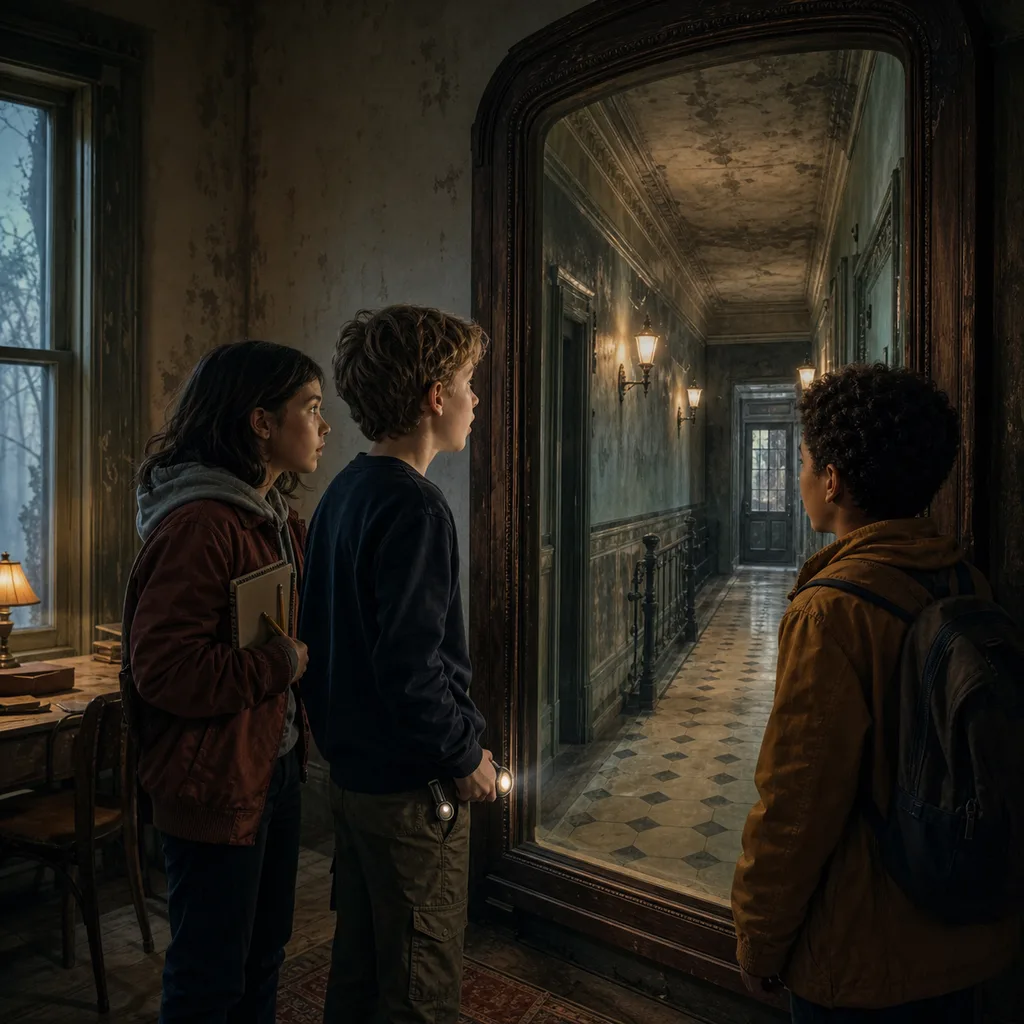
Behind it stood a mirror.
It had a tall, dark wooden frame carved with simple waves. Tiny brass flowers sat in the corners. The glass was neither broken nor dirty. It was so perfectly clean that it seemed stranger than the dust covering everything else.
Nora expected to see the three of them, the flashlight and the small room.
She did not.
In the mirror stretched a corridor.
It was not exactly the one they were standing in. It was wider and brighter. The walls were cream-coloured, with a green strip near the floor. Lamps with amber glass shades hung from the ceiling, and their light gleamed on a dark railing. Small porcelain plates with black numbers stood beside the doors.
“That’s… a reflection of a corridor,” Filip said.
“But not this one,” Nora corrected him.
She stepped closer, stopping one pace away. The mirror showed neither her face nor her grey hoodie nor the notebook in her hand. It showed only an empty old corridor.
She quickly began to draw. First the lamps. Then the railing. The plates on the doors. On one wall was a series of paler rectangles, places where pictures or photographs had probably once hung.
Ben leaned sideways. “Those marks from pictures are behind us in the corridor too.”
“But here they’re in a different place,” Nora said. “And there are five. In our corridor, I saw three.”
An Important Moment
Filip ran the flashlight along the mirror frame. The light did not appear in the glass. He tried to look behind it. Then he knelt and felt along the lower edge of the frame.
“There could be a screen there,” he mused. “But I can’t see any cables. Or a projection through hidden glass. But where’s the projector? And why doesn’t the image change with the angle?”
“And why aren’t we in it?” Ben asked quietly.
Filip straightened up. “That is… a good question.”
The corridor in the mirror remained empty. Then something moved at its far end.
All three jumped back.
It was not a person. Only a shadow that passed from one wall to the other, like someone closing a door in another room. The old lamps in the reflection flickered for a moment.
Nora gripped her pencil so tightly that her fingers hurt.
“Nothing touched us,” Ben said. He was speaking more to himself than to the others. “We’re together. The door is open.”
“Exactly,” Nora said, looking towards the exit. The door to the unnumbered corridor remained ajar. Dim light shone beyond it. “If anything changes, we leave.”
Filip turned back to the mirror. “One movement doesn’t mean ghosts. Old mechanisms can have…”
He broke off.
Letters appeared on one of the porcelain plates beside a door.
They did not stay there long. First there was only a K. Then an L. Then the full name.
KLÁRA.
Nora gasped and wrote it down so fast that her pencil ran over the edge of the page.
“Did you see that?”
“Yes,” Ben said.
Filip said nothing.
The name vanished. Once again, there was only a faded number on the plate, too faint for them to read.
“The brain fills in words,” Filip said, but his voice broke in the middle of the sentence. “When we expect something, it can…”
The name returned.
This time it was clearer. KLÁRA, in black letters on white porcelain.
Nora underlined the note. Once. Then again.
“It was there twice,” she said. “In the same place. That isn’t a dream.”
Ben stepped back. His face had gone pale, but he did not run. “Klára must have lived in the old part of the building. But why is her name on the door?”
“Maybe it isn’t a person’s name,” Filip suggested. “Maybe it’s the name of the room. Or… no, that would be even stranger.”
Nora stared at the corridor in the glass. Fear sat in her chest like a cold stone. Yet she felt something else, too. The mirror was not showing them random images. It was showing details. Exact things they could write down and check later.
“Look at the right wall,” she said.
In the reflection, the green strip ended beside the door with Klára’s name. Next to it there should have been a narrow, darker vertical line, like the seam of the panel in their room.
But there was not.
The wall in the mirror was completely smooth.
Nora turned to the real right wall. The metal panel was still there. She ran her finger close to its edge, without touching the screws.
“This should be in the reflection too,” she said. “If the mirror shows the same part of the building in the past, then the panel or recess should be there as well.”
Filip stepped closer. He no longer looked as though he were searching for a joke. He examined the wall, then the mirror, then the wall again.
“The panel was added later,” he said after a moment. “Look. The paint is newer than the other layers. And the screws are new, not like the ones on the door.”
What Comes Next
“So it wasn’t here before?” Ben asked.
“Maybe not. Or it covers something they did not want to show in that old corridor.”
The boy turned to the reflection. “Something they did not want to show… or something the mirror does not want to show.”
For a moment, no one answered.
Nora drew a simple floor plan in her notebook. Door. Mirror. Panel. In the corner, she added: Smooth wall in the image. Missing detail.
“We’re not opening it,” she said firmly.
Filip raised his eyebrows in surprise.
“Why not?”
“Because we don’t know what’s behind it. And we don’t know how much time we have. We have the position, and we have the sign on the door. First, we compare it with the normal corridor.”
Ben nodded in agreement. “That’s a plan. A plan is better than panic.”
Just then, the lamps in the mirror dimmed.
The amber light turned grey. The image of the old corridor rippled gently, as if someone had run a finger across the surface of water. The stale smell vanished from the room and was replaced by the sharp scent of ozone, like the air after a storm.
“The corridor is changing,” Filip said.
No explanation was needed. Nora closed her notebook and slipped it into her jacket pocket. Filip gripped his flashlight tightly. Ben ran to the door and flung it wide open.
“The way is clear!” he called.
Behind them, the unnumbered corridor was growing dark. The green walls were losing their colour, and the pipes near the ceiling were blurring. The mirror flickered once more.
Nora turned around.
On the smooth place on the wall in the reflection, exactly where the metal panel stood in the real room, she caught sight of a tiny mark. A square divided by a diagonal line.
The same symbol as on the door.
“The symbol!” she cried. “By the missing wall! I drew it before!”
Filip caught her by the sleeve. “Nora, now!”
They ran from the room. Ben let them pass, then closed the door only halfway behind them so they would not lose their sense of direction. Beneath their feet, the floor rippled with strange light, not like an earthquake, more like the picture on an old television.
A few steps later, everything went dark.
The darkness lasted only a moment.
Then the ordinary hallway of the building lit up above them. The mailboxes were in their places. Somewhere behind a wall, a washing machine hummed. From the ground floor came the sound of someone closing the entrance door.
The three friends stood by the wall, out of breath and silent.
Where the nameless door had stood only moments before, there was nothing. Only faded paint and a small crack near the skirting board.
Filip rested his hands on his knees. “Right,” he said after a moment. “I have a new scientific theory.”
Ben looked at him. “If you say it was a screen, I’ll throw your notebook into Mrs. Richterová’s mailbox.”
“No. My theory is that I don’t know.”
Nora took out her notebook. On the page were the name Klára, the room plan, the smooth wall and the symbol drawn twice.
“That is a better beginning than a made-up answer,” she said.
At the end of the hallway, there came a soft click, as if a small metal lock had slipped into place somewhere deep inside the old building.
All three looked in that direction.
Then Nora quietly snapped her notebook shut.
“Tomorrow we’ll find where this symbol belongs,” she said. “And we’ll find out who Klára was.”
To be continued…