
Robo and the Lost Planet, Part 9: The Gap in the Data

A blank gap appears in an old star map, and Robo’s team must learn why some missing data should stay untouched.
Robo and the Lost Planet, Part 9: The Gap in the Data
The Story Begins
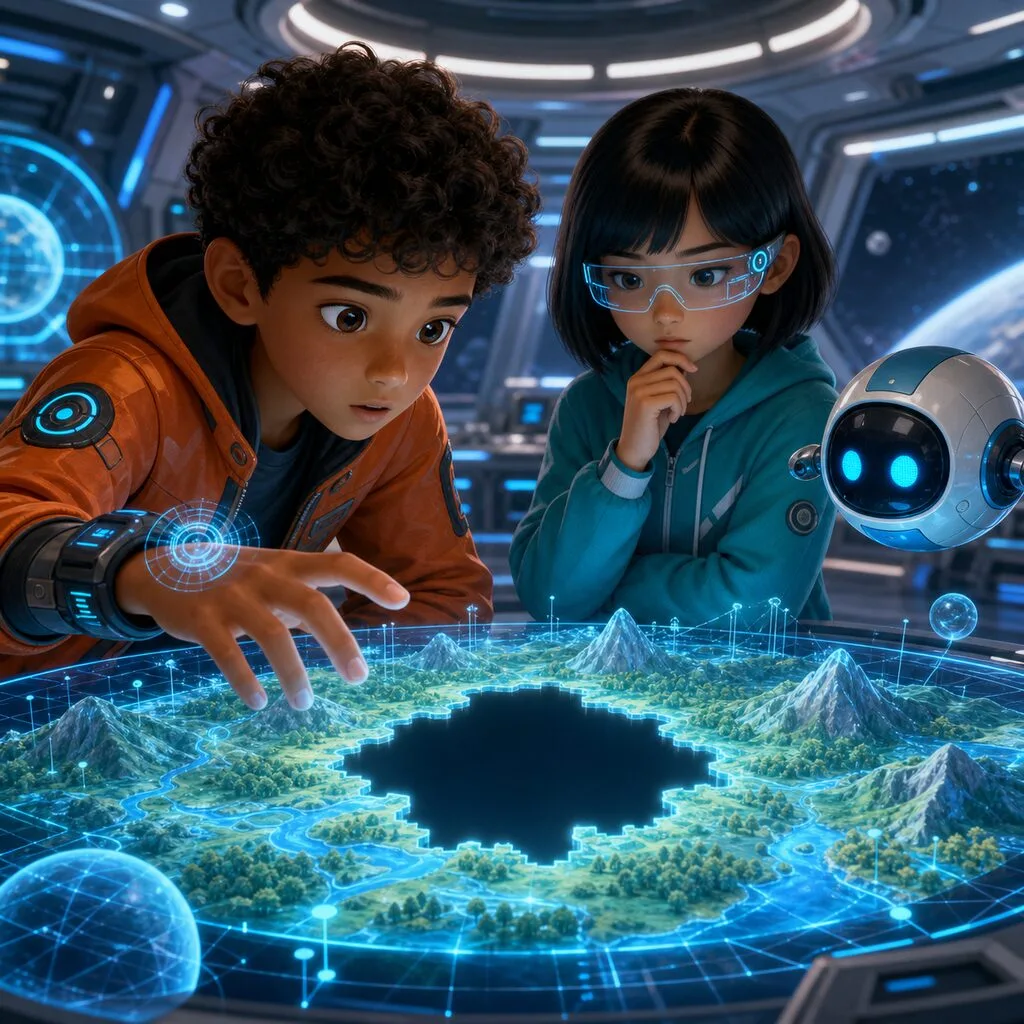
In the analysis room on the research station, a blank gap suddenly appeared on the large holographic map. Robo leaned in so close that his orange smart jacket reflected in it. Ami adjusted her small augmented-reality glasses, and Pip’s blue LED eyes blinked.
“That’s strange,” Ami said quietly. “Something is missing here.”
Pip spun in the air, and his tiny side fins trembled softly. “Confirmed: the missing section is not random. The edges have a repeating pattern.”
Robo smiled. One idea after another was already bouncing around in his head. “What if it’s a secret route to Niva-7? That’s exactly how real adventures begin.”
Ami studied the empty space a little longer. The pattern around its edges really was odd. It was not broken. Nor was it completely empty. It looked as though someone had hidden something on purpose.
The team examined old game records that linked the signal from the first episode to a map from an old educational game. On the monitor, the gap in the data shimmered like a quiet star at the centre of the map.
“If we fill something in there,” Robo said thoughtfully, “we might be able to move forward.”
“Maybe,” Ami replied, “but if we fill it in wrongly, we could change the whole record.”
Pip quickly connected a small comparison panel. “The records do not match. The missing numbers have a precisely defined place. That means the gap is important.”
For a moment, the room was silent. Then Robo reached out and tried to enter his own guess into the holographic record. The light on the table flashed red, and a brief warning sounded.
“Warning,” Ami read aloud. “An incorrect action may lock part of the map.”
The boy pulled his hand back at once. “Okay, so it’s probably not that simple.”
“Probably not,” his friend said gently, without blame. “And that’s why we need to find out what has been verified and what has not.”
A moment later, the door opened and Captain Lyra entered the room. In her dark-blue uniform, she seemed calm and steady, as though she knew exactly what the children had just realised.
“I heard the system warning,” she said. “Show me what you found.”
Robo quickly explained the blank section, the repeating pattern, and his suspicion that it might lead to Niva-7. Ami added her observation about the edges, and Pip precisely showed the differences in the numbers.
Captain Lyra nodded and clasped her hands behind her back. “Archive data must not be filled in by guessing. Not everything that is missing is a mistake. And not everything that looks like a clue is ready to be saved.”
“So we can’t do anything with it?” Robo asked disappointedly.
“You can,” she replied calmly. “But carefully. You will use the station’s old archive database, under my supervision. You will compare exact data, not make guesses.”
Then she added something that surprised the children: “Even adults sometimes need a young perspective. Sometimes you notice a mistaken assumption before we do.”
Ami smiled softly. Robo rubbed the back of his neck, a little embarrassed. It was not pleasant to hear that he had rushed, but Lyra did not say it harshly. Instead, she showed him that a mistake is not the end if you learn from it.
Later, they moved to the archive data room. It was darker than the analysis room, but it was not cold. The old terminal glowed with warm white light, and small control icons drifted slowly across the walls. The database looked old, but it worked reliably.
When Things Start to Change
“I’m connecting the comparison key,” Pip announced. His voice sounded pleased, as though he had just found the most important piece of the puzzle.
Layers of old records opened on the screen. Some were marked with notes about repairs. Others bore small symbols showing that different teams had edited them long ago.
Ami leaned closer. “Here’s the pattern. Look, the edge of the empty section matches this line.”
“And here,” Pip added, “is a note: adjusted according to an older navigation network.”
Robo was quiet for a moment. Then the pieces in his mind began to fit together.
“Wait,” he said slowly. “That means Niva-7 was not simply a planet lost by chance. Maybe it was part of a larger network of planned routes.”
As if in confirmation, the database displayed a new row of symbols. Beside them appeared an archived navigation pattern that almost perfectly matched the signal from the old game. The hologram gave a soft beep, as though it were saying: yes, this is correct.
The children exchanged looks. This was no longer an ordinary riddle. It was a map that someone had deliberately altered so that it would not reveal more than was safe.
“So the gap is actually a safeguard?” Ami asked.
“Exactly,” Captain Lyra replied. She had been listening quietly beside the terminal. “Someone did not want an incomplete route to spread any further. That is why the section was separated from the rest of the records.”
This was an important new discovery. The empty place on the map did not mean that something had been lost forever. It meant that someone had once considered the information too sensitive, or too incomplete, to share without supervision.
Robo leaned back in his chair. “So if we just wrote something of our own there, we could damage the whole system.”
“Yes,” Ami nodded. “And that would be bad for the other signals too.”
Pip vibrated with excitement. “Proposed inaccurate edit: unsuitable. Proposed precise edit: possible, but only if unverified data is clearly marked.”
The boy let out a breath. “You can be precise without using unnecessary words.”
“That is my specialty,” the little robot replied. His LED eyes blinked as though he did not understand why everyone was smiling, but he was glad that they were.
Meanwhile, Ami continued studying the patterns. She spotted something the others had missed at first. On the edge of the empty section was one more faint mark, almost hidden beneath a layer of old data.
“Look over here,” she called.
The hologram showed that the signal from the game exactly matched one archived navigation pattern. It was not a complete plan, but rather the opening piece of a wider network of old routes. It was clear that Niva-7 had once been only one point on a much larger map.
Robo was suddenly excited, but this time he did not rush. First he looked at Ami. Then at Pip. Only then did he turn to Captain Lyra.
“We can only be certain of what we have verified,” he said. “Not of what we merely think.”
Lyra nodded with approval. “That is exactly the right attitude.”
It was clear that the whole section was still missing. But now they knew what not to do with it. They would not fill it in by guessing. They would not turn the map into something that could mislead the next team. Instead, they would mark it as a protected place that must remain untouched.
“Can we save it safely?” Ami asked.
“We can,” Pip said, opening several options for marking unverified data on the screen. “Option one: protected section. Option two: verify later. Option three: link only the confirmed parts of the signal.”
An Important Moment
Captain Lyra smiled. “Choose the one that will not damage anything.”
So they chose the safe label together. The missing section remained untouched, but clear to see. The map did not break, lock, or lose the clue. On the contrary, after the verified data was saved, a quiet tone sounded in the archive.
Suddenly, a new, faint signal appeared at the bottom of the screen. It was not strong, but it was clear. It had opened only because the team had not blindly overwritten the map.
“Look!” Ami cried.
Another part of the old route network lit up on the hologram. It was hidden deeper in the database, as though it had been waiting for someone to uncover it in the right way. This new direction did not yet reveal Niva-7’s exact location, but it was a clear step forward.
Robo stared at it with a spark in his eyes. “Now that really is a new clue.”
“And this time, without guessing,” Ami reminded him, though there was joy in her voice.
Pip spun in the air and nearly bumped into a small light frame. “My precise data saved the clue. I rate this result as highly satisfying.”
The boy laughed. “Sure, Pip. And I rate it a success that I didn’t try to go too fast this time.”
Captain Lyra watched them with quiet approval. “Today, you did not make only a technical decision,” she said. “You also made a good team decision. That is often even more important.”
Peace settled over the room. The new signal shone like a thin blue path disappearing into the deeper layers of the archive. There was another mystery there, another part of the network, and perhaps an answer to who had separated Niva-7’s navigation data from the other records, and why.
For now, though, they did not know.
And that was all right.
Next time, they would know where to continue.