
Robo and the Lost Planet, Part 8: The Echo Key

Robo, Ami, and Pip decode a mysterious echo that leads them to a hidden archive and new coordinates beyond the station maps.
Robo and the Lost Planet, Part 8: The Echo Key
The Story Begins
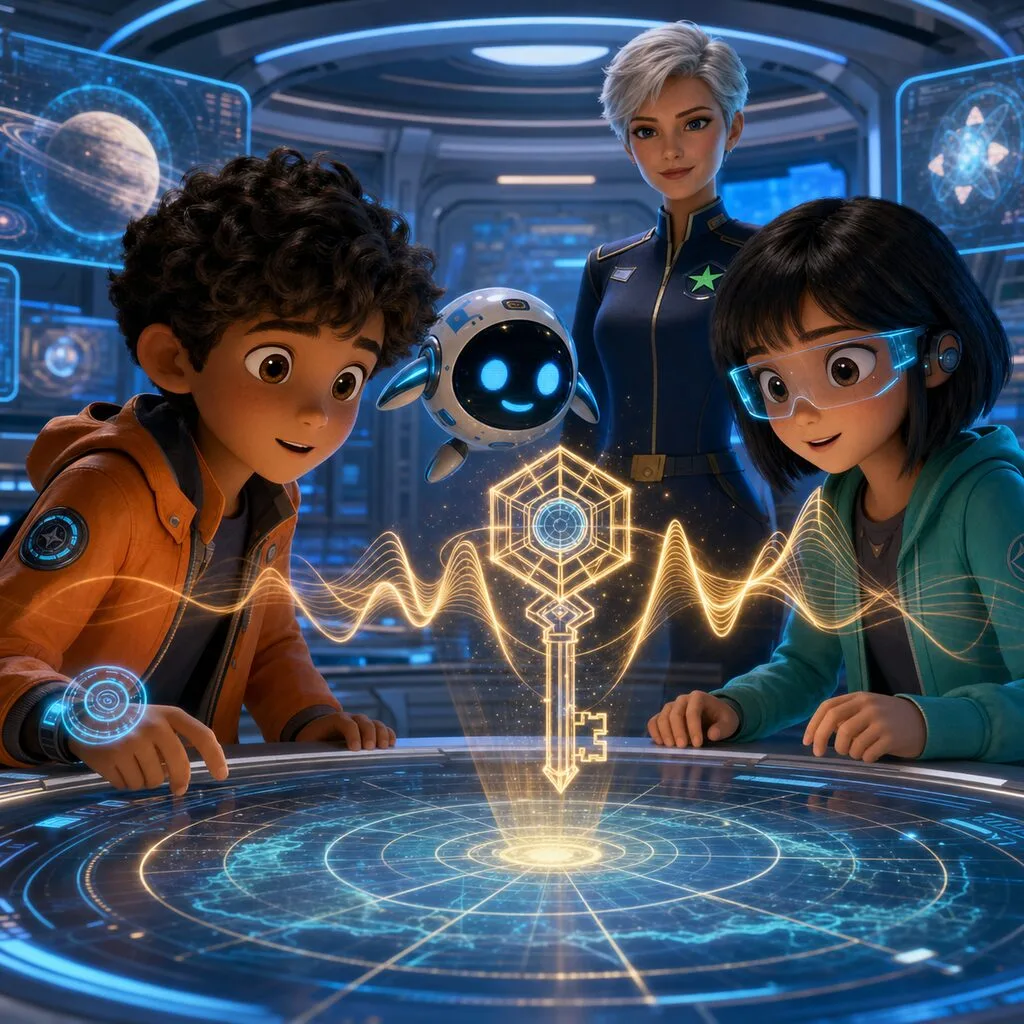
The shared games room on the research station only seemed quiet. A hologram from an old educational game rippled gently above the table, while blue lights on the walls pulsed like the steady breathing of a machine. Robo leaned forward, his dark curls almost brushing the edge of the projection. Tiny reflections gleamed on his orange vest. Ami stood beside him, wearing small augmented-reality glasses and holding a notepad. Pip hovered between them, a white-and-blue sphere with tiny side fins and glowing eyes.
“Let’s find out what this old game is hiding,” Robo said eagerly. “Maybe it has another clue to Niva-7.”
Ami smiled, though she was already drawing little lines in the air with one finger. “First, let’s notice what has changed. The game is the same as before, but it has added a new sound mode.”
Pip gave a short beep. A strange tone sounded from the speaker. Then came an echo. It was no ordinary echo. It returned only after a pause, as if searching for the right answer.
Robo pressed his lips together. “That’s strange. It reacts too late.”
“Not too late,” Ami corrected him. “It’s waiting for something precise.”
A signal appeared on the screen as three coloured bars. The game asked the team to compare it with the station’s real data. Beside the projection, a table opened with records of tones, times, and directions. It was like a small logic puzzle, only much more important.
Robo tried the first combination. “This must be it.”
Only a faint error message sounded. The blue echo did not light up.
“Let’s try another one,” Ami suggested calmly.
He smiled. “I can go faster, too. We just have to guess and try.”
Ami folded her arms. “But if we guess, we waste time. And perhaps the clue as well.”
Pip floated higher and projected three small circles, each a different colour. Suddenly, he produced a series of tones similar to the first signal, but not quite the same. The panel displayed the result: only one of the three layers matched.
“See?” Pip said in his cheerful synthetic voice. “One layer correct. Two incorrect. Success rate low.”
Robo laughed. “Your numbers are always so straightforward.”
“That’s useful,” Ami said. “And Pip is right. We need to compare everything carefully.”
After a while, they moved closer to the large projection wall. Station records lit up across it. Tone, time, direction. Tone, time, direction. Everything was written in a long line and looked simple—until someone tried to find the right pattern.
Robo fell silent. Although he wanted to leap straight to the answer, he watched Ami sort the data with care. She did not move quickly, but she was precise. She compared every record with the one before it, marked those that repeated too closely, and finally pointed out a tiny difference in one old record.
“Here,” she said quietly. “This signal was corrected later. If we use it, the echo won’t return properly.”
“But the difference is tiny,” Robo objected.
“Tiny details are exactly what matter,” she replied.
Pip moved closer to the screen, and his LED eyes blinked for a moment. “Confirmed. Difference small. Meaning large.”
The boy nodded. This time, he said nothing. He simply stood beside Ami and let her lead the comparison. Together, they made a new sequence. The tone matched. The timing fit. The direction was correct. Then the echo returned—clear, pure, and blue.
When Things Start to Change
A circle of light sprang from deep within the game. “Excellent,” said the system. “Proceed to the archive.”
The children looked at one another in surprise.
“The archive?” Robo blurted out. “So it wasn’t just a game.”
Ami already had another panel ready. A map of the research station lit up on it. A blue dot pulsed near an older section of the building. The echo was leading them straight there.
As they walked through the corridor, they could hear only their footsteps and the station’s soft hum. At the archive section, large circular doors with a light-lock stood before them. Red indicator lights glowed calmly but refused to yield. A short message appeared on the display: Access only after a safety test.
Captain Lira stood before the doors. She had short silver hair, a dark-blue uniform, and a green star emblem on her chest. Her voice was calm but firm.
“I see you followed the right clue,” she said. “The archive does not open quickly. It opens safely.”
Robo studied the doors. “We can handle it.”
“I know,” the captain replied. “But only if you proceed calmly and safely.”
Ami nodded. “We’ll be careful.”
Pip spun in the air. “Observation confirmed.”
Captain Lira handed them an access panel, but it did not open the lock directly. Instead, it started three logic tasks to check the data. Three windows lit up on the wall.
The first task was to arrange the signals by time.
The second was to identify which records were older and which had been corrected.
The third was to find the safe pattern repeated in all the correct data.
“It’s like a little test of patience,” Ami remarked.
“And attention,” Pip added.
“And my least favourite thing: going slowly,” Robo muttered, though he was already smiling.
They completed the first row quickly. The second was harder. Some data had the same time but a different direction. Others looked newer, but were really only rewritten versions of older records. Ami noticed an inconspicuous mark on one of them—a small triangle in the corner of the data field.
“This is the corrected version,” she explained. “And that one is the original record.”
Robo leaned closer. “If we hadn’t noticed that, we would have gone in the wrong direction.”
“Exactly,” she said.
In the third task, a safety pattern appeared. It repeated in every correct record, but only when the records were read in layers. The tone was on top, the time in the middle, and the direction at the bottom. Pip quickly compared all three layers and brightened. “Matching pattern found! Matching pattern found!”
The archive doors opened with a deep, quiet hum.
Inside was a room filled with holographic shelves and old records. The light was soft and blue-white, and everything looked carefully preserved. At the centre stood the main terminal. After their success, a new data layer lit up on it. It was older than the other records and had been waiting for someone to read it correctly.
Robo held his breath. A name appeared on the screen: Niva-7.
“So it really isn’t just a legend,” he said quietly.
Ami leaned closer. “Look at the date. This is an old project. An educational project.”
A note appeared on the monitor: Niva-7 was included in a programme of exploration and learning. Not as a myth. As a destination.
“That means…” Robo began.
“That someone knew about it long before we did,” Ami finished.
Meanwhile, Pip projected another section of the record. Some lines had faded, while others were newer. The data was arranged in several layers, and anyone reading it too quickly would see only chaos. But anyone who moved slowly could find order. One layer contained a safety trace. Another held a note about a strange coordinate pattern. The third warned that the signal used several data layers and could not be understood at a single glance.
An Important Moment
Captain Lira came closer to the terminal. “This archive is sensitive. That is why it responds only to the correct order and verified data. Not to quick shortcuts.”
Robo looked at Ami. “You were right.”
The girl smiled. “And you were right that we had to keep going. Without that, we would never have made it here.”
The boy blushed a little. It felt good to hear that his ideas mattered, too. But this time, he understood that a good idea still had to be checked.
Pip suddenly lit up. “New match. The echo and the safety pattern are identical.”
A symbolic key appeared on the screen—not a metal object, but a geometric combination of light and tones. The Echo Key. When the pattern closed, a hidden map opened at the centre of the terminal. Exact coordinates lit up on it. They were not ordinary points on familiar maps. They lay farther out, in an area with no name in the station atlas.
“That’s it,” Ami whispered.
“Exact coordinates beyond the usual maps,” Pip added, as if reading from a technical manual.
Robo quickly memorised the coordinates. He no longer wanted to skip anything. This time, he watched carefully so that nothing would escape him. They checked the coordinates once, then again. Only when the final line appeared on the screen—Coordinates saved—did he relax.
Captain Lira nodded. “You worked well. You have found another clue. But this is only the beginning.”
The children stepped out onto the viewing deck near the archive. Stars glowed beyond the glass, and the station turned slowly through silent space. The new coordinates shone on the hologram before them. They looked like a key to something hidden and important.
Robo leaned on the railing and breathed out. “You know what? This time, I really learned to slow down.”
Ami looked at him with a smile. “And I learned to trust your ideas before I measure every part of them.”
Pip spun in the air. “Team balance has improved by twenty-six percent.”
“That’s a lot,” Robo laughed.
“That is precise,” the little robot replied.
The echo sounded once more, soft and clear, as if saying goodbye. But this time, it no longer sounded like an accident. It sounded like an invitation. Like a carefully planned message from a layer of data that was still waiting somewhere farther away.
Captain Lira stepped beside them. “You have new coordinates. Tomorrow, we can learn more. For today, that is enough.”
And so the episode ended quietly, but not finally. The team had gained the Echo Key and an exact place to visit next. They had discovered that Niva-7 had once been an important part of an educational project. Yet they still did not know who designed the signal or why it was returning now. One thing was certain: when Robo, Ami, and Pip relied on one another and checked every piece of data, they could find even a clue hidden deep within a quiet echo.