
The House at the Edge of the Map, Part 5: The Door to the Rain

A mysterious door opens onto a rain-soaked schoolyard from the past, where Nina, Oliver, and Mia find a forgotten face.
The House at the Edge of the Map, Part 5: The Door to the Rain
The Story Begins
Nina held the old map so tightly that the paper crumpled at the edge. Before them stood the house at the edge of the map, narrow and tall, with a bluish light in an upstairs window. Mist brushed against its walls, but today it smelled neither of wet grass nor smoky chimneys. The air smelled of rain.
“Don’t forget the last day,” Mia whispered.
It was not a new sentence. They had heard it the evening before on the stairs, when a quiet voice had risen from the darkness below them. Since then, none of them had been able to get it out of their heads.
Oliver pulled his grandfather’s old brass compass from beneath his green hoodie. The needle spun right, then left, and finally stopped, pointing straight at the house’s door.
“That isn’t north,” he said.
“I can see that,” Nina replied, tucking her pencil more firmly behind her ear. “But look at the map.”
On the paper, the narrow lane leading to the house had shifted. It was no longer drawn exactly where Nina had last seen it. Now it curved gently around the old school and ended at a small dark rectangle marking an entrance.
Oliver frowned. “Maps don’t move by themselves.”
“Maybe ordinary ones don’t,” Mia said.
The girl with curly black hair stared at the house. Her yellow scarf stirred in the faint wind. “By the door, it feels heavy. Not dangerous. More like… when you remember something sad and don’t want to remember it alone.”
Nina did not answer at once. They knew the house at the edge of the map well enough to know that Mia never said things like that without a reason.
“We’ll go together,” she decided at last. “And no one opens anything until we’ve all had a good look.”
“A sensible plan,” Oliver said, nodding. “And I have a flashlight, just in case.”
“It’s still light,” Mia pointed out.
The boy smiled. “A flashlight is like a snack. You don’t take one because you’re sure you’ll eat it. You take it just in case.”
The house door opened before anyone touched it.
Inside, a narrow entrance hall with old wooden panelling greeted them. The floor creaked softly, but not angrily. It was more as though the house remembered that it had not had visitors for a long time. The air was colder than outside and smelled of old paper, wood, and wet coats.
At the end of the hall stood a door that had not been there before.
The dark wood was almost black. Five drops of water gleamed on the metal handle.
Nina crouched beside it. “The drops are only on the handle,” she said quietly. “There’s nothing beneath them. No water running down, no wet wood.”
Oliver shone his flashlight at the door, though its light was hardly needed in the hall. “Maybe there’s a cold wall behind it. Moisture can collect on metal.”
“But then the hinges would be wet too,” Nina objected.
He reached out and carefully touched the handle with the tip of one finger. He pulled his hand back at once.
“All right,” he muttered. “That really is very cold water.”
Mia stepped closer but did not touch the handle. First she closed her eyes, as though listening to something far away behind the wall.
“These doors aren’t waiting to frighten us,” she said. “They’re waiting for us to look properly.”
Nina opened her notebook. On a blank page, she sketched the rectangle of the door, the five drops, and their exact arrangement. Then she looked up at her friends.
When Things Start to Change
“Together?”
Oliver gripped the handle. Nina placed her palm on the wood beside his hand. Mia touched both their wrists.
The handle moved.
A rush of cold air burst from the doorway. It did not put out the flashlight or tug at their clothes; it simply carried the smell of wet asphalt, school desks, and rain striking dust.
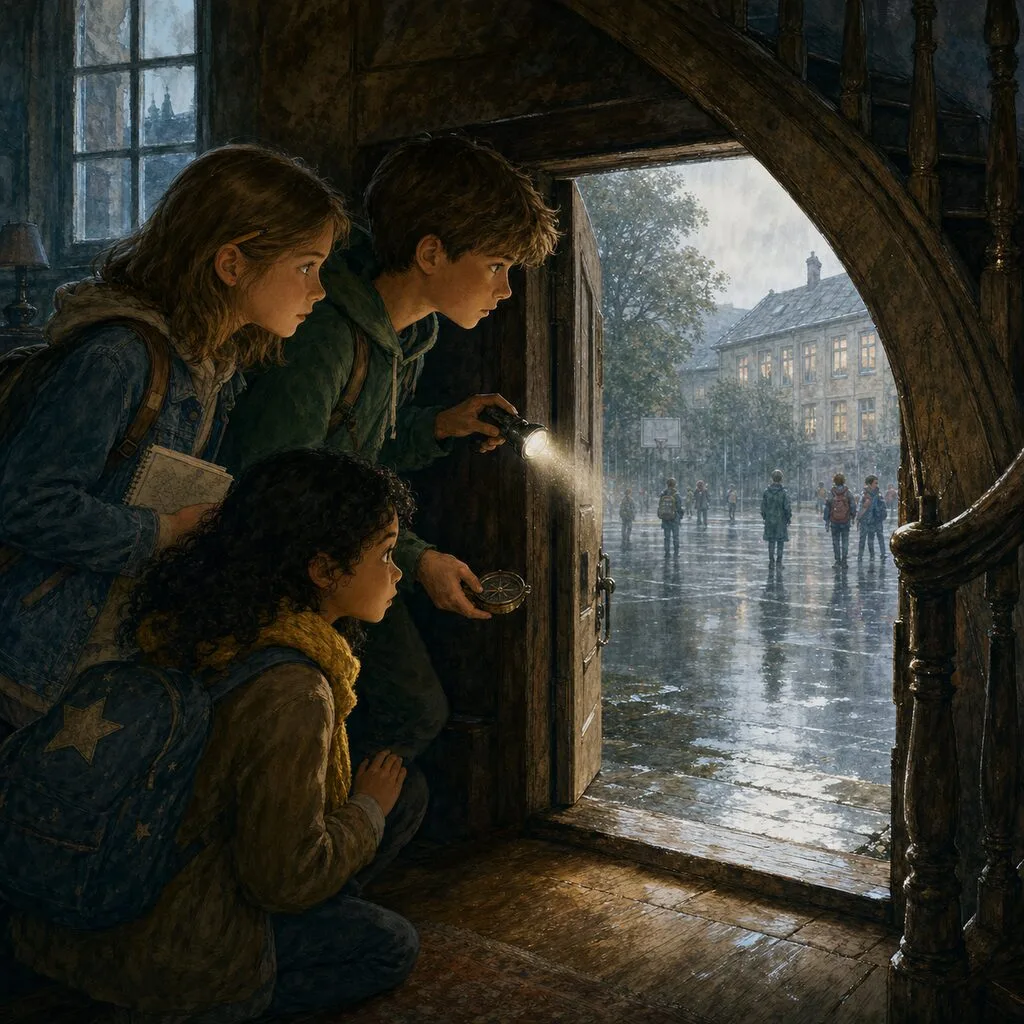
Beyond the door was no room.
There lay the schoolyard.
The paving stones shone beneath a fine rain. By the fence stood an old tree, smaller than it was now, with thinner branches and a crooked bench beneath its trunk. The school building had windows with dark frames. One stood slightly open.
Somewhere, a school bell rang.
Its sound was distant and strangely soft, as though it were ringing from the past.
“That’s our yard,” Nina breathed.
“Not quite our yard,” Oliver corrected her. He looked at the tree, then at the building. “Look at the roof. It doesn’t have the new gutters yet. And that bench disappeared when they rebuilt the fence.”
Nina drew quickly. She captured the window, the bench, the tree, and the direction of the puddles on the paving stones. Raindrops landed on her paper but did not remain there. It was as if it rained only in the view before them.
Oliver held the compass out in front of him. The needle stopped spinning and pointed towards the schoolyard.
“Ah,” he said slowly. “The compass isn’t looking for north. It’s looking for the place this clue belongs.”
“So we’re in a memory?” Nina asked.
“I don’t know how we could prove that technically,” he admitted. “But an ordinary corridor definitely doesn’t lead to a yard that looked different years ago.”
Mia looked towards the open window. Behind the glass hung a pale curtain, barely stirring.
“Someone is missing there,” she said.
Oliver looked around. “Where?”
“I don’t know. I can only feel it. As if someone once stood at that window, and then people stopped waiting for them.”
Just then, a rectangle appeared on the wall beside the window. At first, it looked like a reflection of wet light. A moment later, the children could make out the frame of an old photograph.
A class photograph hung there.
The children in it stood in three rows in front of the school. Some smiled; others squinted into the light. One boy held a notebook, and a girl at the front had a large plaster on her knee. Above them was a caption, only slightly blurred by the rain: 5.B.
On the right side of the photograph, one face was unclear.
It did not look like a black smudge or a hole. It looked more like an image someone had wiped with a wet cloth. The outline of hair appeared and vanished. Where the eyes should have been, something gleamed, then dissolved again into grey water.
Nina stepped closer. “I have to copy it before it changes.”
“Don’t go too close,” Oliver warned. “The light from the window is moving. Maybe it’s only a reflection.”
“A reflection doesn’t have a sleeve,” Nina said, pointing at the edge of the blurred figure. “Here. There’s a blue sleeve beside it. Or part of a jacket.”
Mia stood a step farther back. Puddles from the yard reflected in her warm brown eyes.
“It isn’t a coincidence,” she said very quietly. “That face doesn’t look as if the rain erased it. It looks as if no one ever looked at it properly.”
An Important Moment
Oliver wanted to object, but instead he raised the flashlight. He did not shine it directly at the photograph, only slightly to one side, changing the angle of the light.
The blurred face moved.
Not literally. The paper remained on the wall. But the grey patch stretched into a clearer outline of a cheek, and for a moment the corner of a mouth appeared. Then everything blurred again.
“The photograph reacts to light,” Oliver said. “And perhaps to the angle we look at it from.”
“Then let’s not look at it only as evidence,” Mia said. “Maybe it’s someone’s memory.”
Nina slowed down. Her pencil hovered above the page. She wanted to capture every detail, every line, every shadow. But then she noticed that the faster she drew, the less she understood what she was seeing.
She closed her notebook.
“All right,” she said. “First we look. Then I’ll draw.”
The three friends stood silently before the photograph. Rain murmured on the paving stones, and the curtain in the open window stirred.
Gradually, more details appeared. A wet school umbrella lay at the feet of the children in the photograph. In the background, behind the tree and the corner of the building, a small drawn umbrella symbol appeared. It was not part of the original photograph. It had thin black curved ribs and a crooked handle, as though someone had added it in pencil.
Nina gasped. “It’s by the old school. Exactly where the lane shifted on the map.”
Oliver lowered the compass over the photograph. The needle trembled, then pointed at the tiny symbol.
“That’s not just a mark,” he said. “The compass reads it as a direction.”
Mia hugged the strap of her backpack with its star-shaped patch. “Maybe the umbrella sheltered someone. Or maybe someone waited beneath it.”
“For whom?” Nina asked.
No one answered. At that very moment, the blurred face disappeared again.
The rain in the yard thickened. It was not a storm, only a grey curtain through which the edges of things began to vanish. The tree dissolved into soft lines. The bench seemed to retreat farther away. Even the door through which they had entered disappeared behind the stream of water.
“It’s closing,” Oliver said.
This time, his voice sounded less certain.
Nina opened her notebook and pointed to her sketch. “The door was behind us, a little to the left of the tree. If we stay close to the fence, we should find it.”
“But things can shift in a memory,” Oliver warned. Then he looked at the compass and pressed his lips together. “Wait. The handle. The cold water on it. The needle behaved strangely until we touched it.”
He pulled the small flashlight from his pocket and shone it on the wet paving stones. Among the ordinary raindrops, a narrow line of pale light appeared. It ran beside the fence, across a puddle, and on into the grey veil.
“It isn’t north,” Oliver said. “It’s the way back.”
Mia took Nina’s hand. With her other hand, she touched Oliver’s sleeve.
“Slowly,” she said. “If we run, we’ll see only rain. Let’s hold on to what we already know.”
They passed the tree. Nina compared every branch with the sketch she had managed to make. Oliver watched the line of light and the compass. Mia kept them close together, so that none of them could be lost by even a single step.
A moment later, a dark rectangle appeared in the grey curtain.
What Comes Next
The door.
Five cold drops gleamed on its handle.
“There are still five,” Nina whispered.
“Then let’s not spoil them,” Oliver said, though he smiled nervously.
Together, they laid their hands on the metal. Cold shot up to their elbows. Then the door opened, and the rain-soaked yard vanished like a picture in a closed book.
They stood once more in the house’s entrance hall.
Behind them was silence. No rain, no bell, only the faint crackling of wood in the walls. All three had dry shoes. But a tiny drop of water clung to Nina’s fingers.
The door slowly closed.
The old map lay on a table by the wall. Nina approached it as though she feared it might crumble beneath her touch. The paper was warm and dry. Yet beside the drawing of the old school, a new detail had appeared: a small black umbrella with a crooked handle.
Carefully, she traced it into her notebook with her pencil.
“The door really didn’t lead to another room,” Oliver said. The compass pointed north again, but its brass rim was cold. “It led into one day. Maybe only a few minutes of it.”
Mia looked at the closed door. “And that face wasn’t frightening.”
“No,” Nina agreed.
“It was forgotten,” Mia added. “Sometimes that’s almost just as sad.”
Oliver placed the compass on the map. “Then we’ll find out who it belongs to. Old class photographs might be at the school. Or in the library. Mrs Urbanová may know where to look.”
Nina smiled, though a faint shiver still ran along her back. “Next time, we won’t return to that photograph only to find a name. First, we’ll find out what happened on that last day.”
Mia nodded. “And we’ll go together.”
When they left the house, the mist was already thinning. Behind them, one cold drop remained on the metal handle. It did not fall, even when the door closed softly.
On the map beside the old school, a little umbrella gleamed, as though it were waiting to reveal who had once stood beneath it.
To be continued…