
The House at the Edge of the Map, Part 6: The Boy in the Photograph

A faded class photograph reveals a boy everyone has forgotten—and a mysterious S appears at the torn edge of Nina’s map.
The House at the Edge of the Map, Part 6: The Boy in the Photograph
The Story Begins
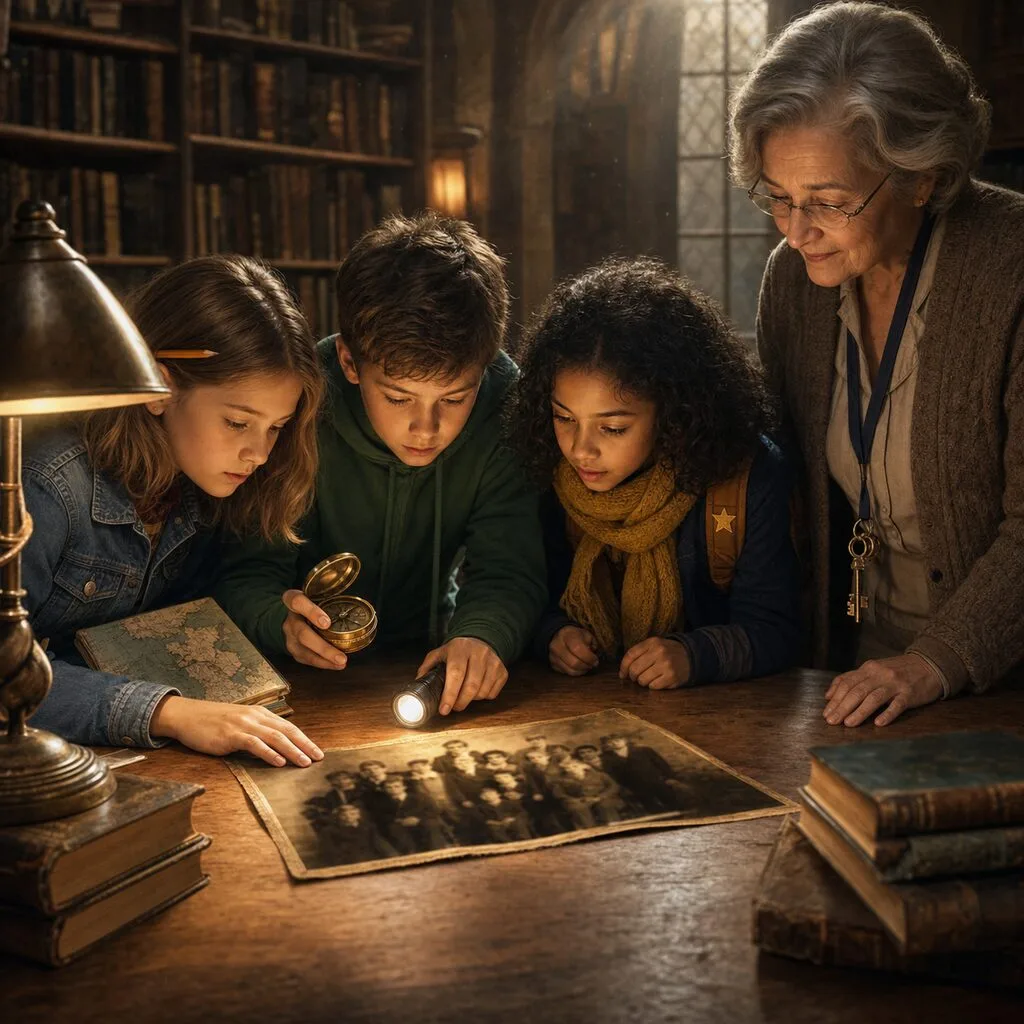
Nina placed the old photograph precisely in the circle of light beneath the lamp. The lamp stood on the lowest table in the school library, and its yellow glass was scored with tiny scratches. Beyond the tall windows, rain streamed down the panes. Inside, the air smelled of wood, dust, and the pages of books no one had opened for years.
“This is better than the hallway,” Oliver said, taking out his small flashlight. “At least here we know where the light is coming from.”
“And do we know where to hide if the photograph starts singing?” Mia asked.
Oliver looked at her. “Photographs do not sing.”
“That was a joke,” Mia said calmly. “A weak one, I admit.”
Nina smiled, although her fingers tightened around the edge of her notebook of maps. The photograph they had found after the rain near the house at the edge of the map lay between them. It was small, creased, and softened at the corners by dampness. It showed a classroom full of children at their desks. Most of the faces were gray, but still recognizable. Only the boy in the back row remained blurred, as if someone had tried to rub his likeness away with an eraser.
Under the lamp, a thin strip of light gleamed across the paper.
“Look,” Nina whispered.
At the left edge of the photograph, a corner of the room appeared. Before, there had only been a gray smudge. Now they could see part of a window, a strip of darker wall, and two desks set at an angle behind one another.
Nina pulled the pencil from behind her ear and began to draw.
“That is not an ordinary corner,” she said. “The desks are not arranged in rows. At least, not entirely. The back one is turned toward the window.”
Oliver bent his head almost to the table. “Maybe the photograph is damaged. When paper buckles, things can look crooked.”
“No,” Mia said. Her warm brown eyes were fixed on the blurred boy. “He is standing beside that turned desk. But he is not looking at the camera.”
For a moment, the library seemed colder. Not unpleasantly so, more like when someone opens a door onto an empty hallway. Mia pulled her yellow scarf closer around her neck.
“Where is he looking?” Oliver asked.
The girl was silent for a moment. “As if he is waiting for someone to call him.”
Oliver swept the flashlight across the photograph. The cone of white light moved over the paper, but the boy’s face did not grow any clearer. When he switched it off, however, and only the lamp’s soft light remained, the blurred features shifted slightly.
Nina saw the thin outline of an ear and the line of a cheek.
Oliver saw something entirely different.
“There is something wrong in the background,” he said suddenly. “Behind them. On the noticeboard.”
“What is wrong?”
The boy pointed with his fingernail to a spot above the children’s heads. “That noticeboard has a green frame. But everything in the photograph is old. The desks, the windows, the cabinet. Green plastic frames were not used at school until much later. At least, that is what the photographs in the hallway show.”
Mia leaned closer. “I do not see a noticeboard. I see a door.”
“It cannot be a door,” Oliver objected. “Look, those two pale lines are drawing pins.”
“Or a handle and the edge of the glass,” Mia said.
Nina carefully took the photograph in her hands. The image changed again. By the wall appeared the faint outline of four desks and a narrow passage between them. No door, no noticeboard. Only a space that reminded her of a floor plan.
When Things Start to Change
“We each see something different,” she said.
Oliver folded his arms. “That is impossible. A piece of paper cannot show three different things at once.”
“Maybe it is not showing three things,” Mia suggested. “Maybe it is showing the one we need to find.”
“Or the one we are inventing,” Oliver replied, more sharply than he had meant to.
The silence after his words was not frightening. It was simply heavy. Mia lowered her eyes, and Nina stopped drawing. Then the photograph trembled ever so slightly in the lamplight. The paper itself did not move. Only the yellow reflection on its surface rippled for a moment, like water.
Oliver went pale.
“All right,” he said after a while. “I did not imagine that.”
“Neither did we,” Nina replied.
Just then, footsteps sounded between the shelves. Mrs Urbanová appeared with a cart full of books. She wore silver glasses on her nose, and keys swayed softly on a ribbon pinned to her sweater.
“I hope you have not decided to read forbidden books in the dark,” she said in a voice that was strict but kind.
Oliver quickly covered the photograph with his hand. Then he realized that this made him look even more suspicious and pulled it away.
Mrs Urbanová stopped.
Her smile vanished, but she did not look angry. She looked surprised, as if she had spotted on the table something that ought to have remained only a memory.
“Where did you get that?” she asked quietly.
Nina told the truth. She explained that they had found the photograph near the house at the edge of the map, in wet grass beside an old wall. She did not mention everything: the light in the empty window, the quiet footsteps in the hallway, or the way the house had appeared where the map showed no street at all. Mrs Urbanová was listening very closely already.
When Nina had finished, the librarian pulled up a chair. She did not pick up the photograph at once. First, she adjusted her glasses and studied the corners of the desks.
“I know this classroom,” she said.
Mia lifted her head. “Were you there?”
“Not as a pupil. I was a young library assistant then, and sometimes I carried books to teachers in their classrooms.” Her finger paused just above the photograph. “These desks stood in the old classroom at the end of the west corridor. Today, it is an art-supplies storeroom.”
Oliver pointed at the green detail. “And this?”
Mrs Urbanová frowned. “That was not a noticeboard. It was a glass panel in the door. It had a green frame, but not a plastic one. A metal one. They replaced it later.”
Oliver opened his mouth, but said nothing. Mia gave him only a brief look, without a triumphant smile.
“I should show you something,” the librarian continued. “If you handle it carefully.”
The keys on her ribbon chimed as she crossed to the narrow cabinet at the end of the library. Its lower section was locked. Behind the frosted glass lay large albums, some wrapped in gray paper. Mrs Urbanová took out one covered in dark blue cloth. On its spine, they could barely make out the words: School – Years 19…
She placed it on the table with both hands.
“This paper is older than all of you put together,” she said. “So: no greasy fingers, no bending pages, and Oliver is not to shine his flashlight on anything unless it is truly necessary.”
“Was that aimed at me?” Oliver asked.
“Very precisely,” Mrs Urbanová replied.
An Important Moment
They turned the pages slowly. There were photographs from school trips, sports days, and celebrations where children held paper flowers. Later came class photographs. Beneath each one, a date and class were written in ink that had faded brown.
Nina noticed the number before the others did.
“5.B,” she read.
There were two photographs on the page. In the first, children stood in front of the school beneath a tall lime tree. In the second, they sat at desks in a classroom. The second looked so much like their blurred photograph that Oliver’s compass slipped from his hand and clinked softly against the wooden table.
“That is the room,” Nina breathed. “The window is in the same place. And that turned desk… it is there too.”
In the album photograph, a boy sat at the turned desk, wearing a shirt with a small dark badge near the collar. His face was unclear, but not blurred. His head was turned to one side, as though he had just looked toward something by the door.
Oliver brought Mrs Urbanová’s glasses closer to the page without touching it. “That badge. It is the same as on our photograph. A little square with a line across the middle.”
Mia nodded. “That is why Nina saw him by the desk. And you saw the door.”
At the bottom of the page were names. Most could be read: Zuzana, Erik, Hana, Roman. One name, however, was damaged. The corner of the paper was worn away, as if fingers had rubbed across it for years. Only a few letters remained.
Samue…
Mrs Urbanová removed her glasses. Holding them in one hand, she stared at the fragment of the name for a long time.
“Samuel,” she said at last. Her voice was quiet but certain.
All three children looked at the boy by the turned desk.
“Do you remember him?” Mia asked carefully.
The librarian drew breath. “I remember seeing that name on a list. And I remember that once he left a returned book on the counter without a slip. There was a bookmark inside it with a star drawn on it.” For a moment, she smiled, then shook her head. “It is strange how little a person has left. I do not know what his eyes looked like. I do not know whether he lived near the school. I do not even know why there is no surname beside his name.”
“Maybe the page was damaged by accident,” Oliver said, though without his usual certainty.
“Maybe,” Mrs Urbanová agreed. “Old records were moved from one office to another. Some were lost, others copied inaccurately. And some classes are remembered only because someone else told us about them.”
Nina placed her own sketch beside the album. The lines of the desks matched. Near the back wall, though, she had drawn a small empty space that could not be seen clearly in the album photograph.
“Something is missing here,” she said. “But I do not know what.”
Oliver stared at the blurred photograph beneath the lamp. “I wanted one clear piece of proof. A name, a date, an exact answer. But instead, each of us got a different piece.”
“That does not have to be a mistake,” Mia said. “Sometimes people remember a room, sometimes a badge. And sometimes only that someone was waiting alone.”
The boy turned the old brass compass slowly between his fingers. The needle trembled for a moment, then settled. “If everyone saw him a little differently, maybe that is why his face cannot stay the same in the photograph.”
What Comes Next
Mrs Urbanová closed the album only halfway, so as not to cover the fragment of the name. “Samuel was in that class. We know that. We also know that he was gradually forgotten more than anyone should have been. The rest, we do not know yet.”
Mia looked at the blurred boy. She no longer felt the cold in the library. The photograph was no longer giving back fear. It was sadness that someone had finally stopped overlooking.
Nina took out the old town map. She kept it folded in a cover at the bottom of her notebook, and its edges were as delicate as dry leaves. When she spread it beside the album, the photograph slid lightly across the table. It stopped at the very edge of the map, where the paper had torn long ago.
A dark line appeared beneath its corner.
Nina bent so close that her hair touched the table.
“It is not a line,” she said.
The lamp’s yellow light trembled. On the edge of the map, beside the unnamed place, a small letter S appeared for a few seconds. It was not written in ink. It looked as if the paper had pressed it out from its other side.
Oliver no longer said that it had to have a simple explanation. Instead, he quietly slipped his compass into his pocket.
“We have not searched for that place yet,” Nina observed.
Mia moved her finger just above the letter without touching it. “Maybe there is no answer there. Maybe there is another memory.”
Mrs Urbanová left the album open at the name Samue… and smiled at the children over her silver glasses.
“Then you will need a map, courage, and someone who notices even things that cannot be proved straight away.”
Outside the window, the rain was slowly easing. On the table lay the photograph, the open album, and the map with the letter S. The boy in the back row no longer looked like a nameless shadow. He was still blurred, still distant, but for the first time in their story, he had a direction.
To be continued…