
The House at the Edge of the Map, Part 12: The House That Found Its Way

A mysterious house returns to the school gate, asking Nina and her friends to give a forgotten name its rightful place.
The House at the Edge of the Map, Part 12: The House That Found Its Way
The Story Begins
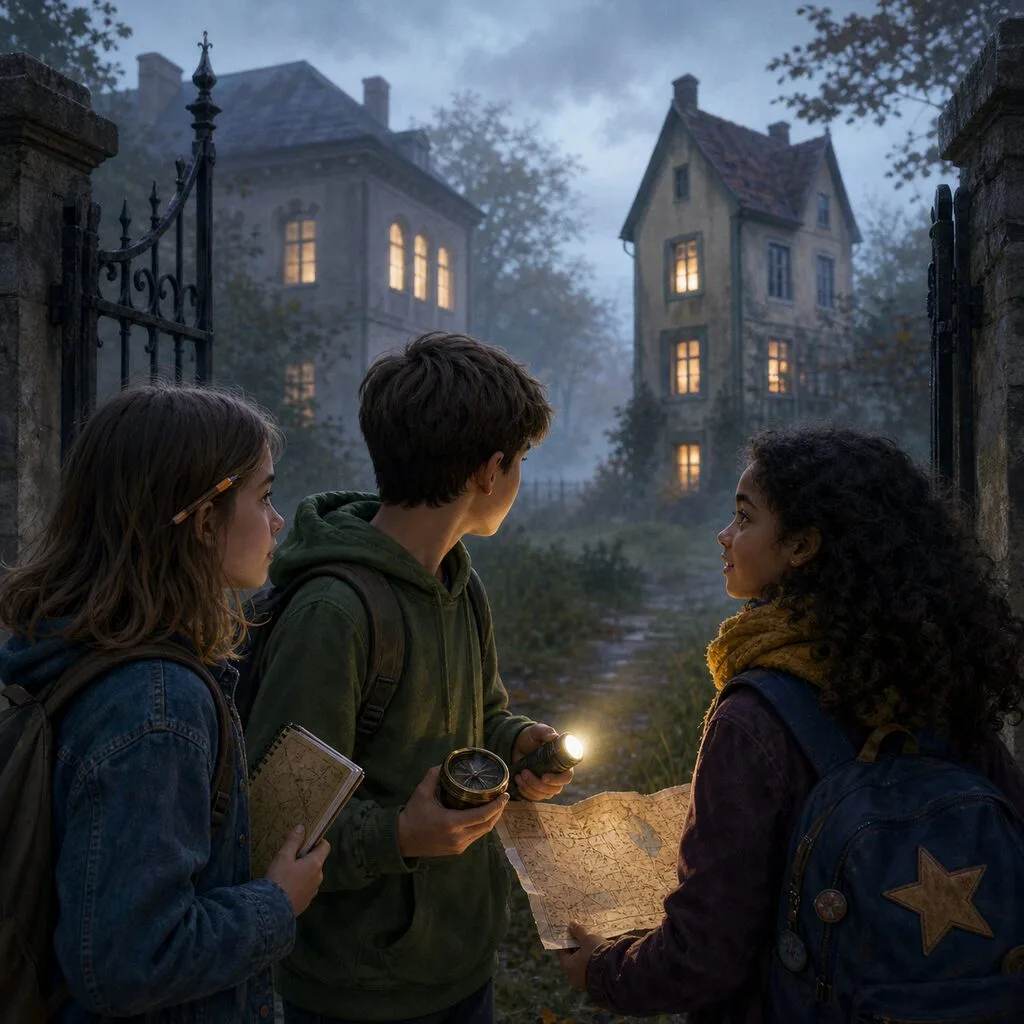
Fog lay low in front of the school, as if it did not want to leave the wet grass or the empty path. Nina stood by the gate with her map notebook tucked under her arm and stared at the dark windows of the building. Behind one of them, a light flickered.
“Mrs Urbanová is already waiting,” Oliver said. In his green hoodie, he looked a little bigger than usual, perhaps because he was gripping both his flashlight and the brass compass that had belonged to his grandfather. “I don’t think there’s any point standing here and measuring the fog with our eyes.”
“I’m not measuring it,” Nina objected. “I’m watching where it rises from. It’s thicker near the gym.”
Mia pulled her yellow scarf higher around her neck. Her backpack, with its star patch, swayed softly against her back. “And it’s quieter near the gate,” she added. “As if something were waiting.”
Oliver tried to smile. “Fog doesn’t wait. Fog is water.”
“Water can wait for a while too,” Mia said calmly.
The school door opened before he could reply. Mrs Urbanová stood in the doorway in a grey sweater. Her silver glasses gleamed in the corridor light, and the keys on her ribbon jingled softly as she stepped forward.
“Come inside,” she said. “It won’t be good to stand outside for long today.”
Only one desk lamp was lit in the library. Its yellow light fell across a large table between the empty desks. An old map of the town lay on the table. New streets, dots, doors, and even whole rooms had once appeared on it. Now it looked almost ordinary: worn paper, faded edges, a few familiar names.
Almost.
Near the bottom edge, a thin grey line was being drawn. It was not straight. It led from the school building towards the picture of a narrow house that had appeared on the map so often that they all recognised it even without a name.
The house at the edge of the map was drawn so close to the school this time that Nina held her breath.
“It used to be farther away,” she whispered. She leaned over the paper. The pencil behind her ear caught in her hair. “It was always beyond the last street. Now it’s by our gate.”
Mrs Urbanová placed a hand on the table. “I think that today it is no longer looking for somewhere to take you.”
Oliver raised his eyebrows. “Then what is it doing?”
The librarian looked at the drawing of the house for a moment. “Maybe it is showing you where the last thing you found belongs.”
“Samuel Horský,” Mia said.
His name sounded clear in the library. There was nothing frightening in it. Only something that had gone unspoken for too long.
Mrs Urbanová nodded. “That’s right. Samuel Horský.”
A shadow stretched from the lamp across a shelf full of books. Nina glanced towards the door. The corridor beyond it was darker than before.
“Do we have to go somewhere?” she asked.
“First, to the old classroom near the library,” Mrs Urbanová replied. “I have something there that you should see.”
When they stepped into the corridor, Nina stopped just outside the door. A faint clock tick came from the far end. The fluorescent light above them did not work, and the library light remained behind them like a small, safe island.
Oliver took out his flashlight at once. “Don’t worry, this one has fresh batteries. It shines for about a hundred metres. Well, maybe eighty, but that’s still plenty.”
When Things Start to Change
The girl did not smile. Her fingers tightened around the edge of her notebook.
Mia noticed first. “Nina?”
“Nothing,” Nina replied too quickly.
The boy aimed the light ahead. Its beam skipped over the noticeboard, classroom doors, and an old display case filled with trophies from sports competitions. “Look: corridor. Floor. Doors. Completely normal things.”
“I know,” Nina said. Then she took a breath, keeping her eyes on the dark end of the corridor. “It’s just… I don’t like it when I can’t see what is ahead of us. Especially when it matters. And today it’s dark everywhere.”
Oliver slowly lowered the flashlight.
Mia moved closer to her friend. “You don’t have to go alone.”
“I don’t want to hold you up.”
“You’d hold us up if you decided to inspect every cupboard,” Oliver remarked. “But saying you’re scared isn’t holding us up.”
Nina looked at him. “Was that an attempt at a joke?”
“A very gentle one. I didn’t want to spoil it.”
The corner of her mouth lifted after all.
“You’ll walk between us,” Mia decided. “Oliver will shine the light ahead. I’ll tell you where we are. It’s better when a place has a name.”
Nina nodded. “All right. But don’t speak too quietly.”
“I can do that,” Mia assured her.
They walked slowly. The flashlight painted a bright strip across the floor, and their footsteps sounded soft because the old linoleum buckled in places. Mia named things as calmly as if she were leading them through a familiar map.
“Now we’re passing the window to the yard. In three steps, there’ll be the storeroom door. And here’s the noticeboard where the paper-collection poster hung.”
“That poster has been there since September,” Oliver muttered.
“That’s exactly why we know it,” she replied.
At the end of the corridor, Mrs Urbanová unlocked the classroom. The air inside smelled of dust, wood, and chalk. Desks stood in rows, although no lessons had been held there for years. Faded marks on the wall near the window showed where old pictures had once hung.
The librarian opened the drawer of the teacher’s desk and took out a flat cardboard box. She set it on the nearest desk.
“I found it many years ago,” she said. “Back then, I wasn’t a librarian yet. I was only a young assistant, and I thought old things would be solved by old people.”
She took a yellowed card from the box. The names of pupils were written on it in neat blue ink. Some letters had already blurred, but most could still be read.
Oliver leaned closer. “Is that a class list?”
“Yes. From the class that used this room many years ago.” Mrs Urbanová ran her finger along the last line. “Samuel’s name was once on it. Later, it disappeared. During the moving of papers, during repairs, among all the things people explained away by saying they were unimportant.”
Nina noticed an empty space between two names. A faint imprint remained on the card, as if something had once been written there and then carefully erased.
“It should not have happened,” Mrs Urbanová said quietly. “But sometimes knowing isn’t enough. It has to be put right too, at least a little.”
Mia opened her backpack and took out a small yellow ribbon. “Can we make a place for him?”
The librarian looked at her. “I think that is what the house has wanted from you all along.”
An Important Moment
They placed a clean sheet of paper on a desk. Nina took the pencil, but at first its tip stopped just above the page.
“You write it,” Oliver said. “Your writing is the straightest. Even the arrows on your maps look as if they have school reports.”
“That makes no sense,” she objected, but the pencil was already moving.
The letters appeared slowly and carefully.
Samuel Horský.
Nina checked every diacritic, every long vowel, and every space. Then she set the pencil beside the paper.
Mia laid the yellow ribbon beside the name. It was not large, only a narrow strip of cloth she had carried in her backpack since a school performance. “We don’t need to say much,” she said. “Some names disappear only because nobody leaves a place for them. This is his place.”
Silence settled over the classroom. It was not unpleasant. Outside the window, the wind rustled in dry branches, and somewhere in the building the heating clicked.
Oliver held the card with the names. He looked at the empty line for a long time. Then he took a small ruler from his pocket, straightened the paper’s edge, and carefully placed the new card among the other names in the box.
“No secret button, no hidden compartment,” he said, more to himself than to the others. “Just the right place.”
Mrs Urbanová smiled sadly. “Even adults sometimes need someone to remind them of simple things.”
Just then, a soft rustling came from the corridor. Not footsteps, not wind. More like the sound of paper bending.
The map in the library.
All four of them ran back. This time, Nina did not go last. She still stayed between her friends, but she no longer had to watch only the flashlight beam. She knew where the noticeboard, the window, and the storeroom were. The corridor had its places, and the places had their names.
On the table, the old map was moving although no one stood beside it. The grey line lengthened all the way beyond the edge of the paper. The drawing of the house shifted towards the school gate, and beside it appeared a small sign: open doors.
“That isn’t an invitation to another mystery,” Nina said quickly. “Look. The line doesn’t go any farther. It leads from the school to the house, and then back.”
Oliver held the compass to the map. Its needle did not move. “So the house doesn’t want us to find something new.”
“Maybe it wants to see that we did it,” Mia whispered.
Outside, the fog was thicker, but the narrow house could be seen within it by the gate. It did not stand as solidly as an ordinary building. Its roof blended into the white air, and its walls were pale as an old photograph. Yet warm light glowed in its windows, golden and calm.
Nina stopped on the steps. Her breathing quickened, but the hand holding the map no longer trembled.
“It’s closer than before,” she said.
“But it doesn’t look as if it wants to swallow us in fog,” Oliver remarked. “Which is good. Being swallowed by fog isn’t in my plans for this evening.”
Mia laughed softly. Then she looked at the house. “It doesn’t feel abandoned now.”
They stopped at the gate. Mrs Urbanová remained a step behind them, but she did not leave. The warm light from the house fell across the map. The mysterious marks that had guided them through the school and town for months began to fade.
What Comes Next
First, the black dot by the old clock tower disappeared. Then the line leading to the locked storeroom vanished. Later, the small key symbol that had once led them to the attic faded away. Each clue left quietly, without sparks or any grand gesture.
At last, only a simple plan remained: school, path, gate, house, and the same way back.
Oliver frowned, as if he wanted to protest. “Is that all?”
No one answered him at once.
The boy looked at the compass, then at the ordinary paper in Nina’s hands. “Actually… I suppose it is. Not everything needs one last hiding place. Sometimes it’s right when there’s nothing left to solve.”
Mrs Urbanová nodded. “Once Samuel is known about here, at the school, the house no longer has to hold his story alone.”
In the highest window of the house, the light brightened a little. For a moment, the reflection of the school building glimmered in it. Then the fog passed between them like a soft curtain.
The house did not disappear all at once. First its steps vanished, then the fence, and finally the roof. One warm window was the last thing to remain. Soon that too became only a small point of light and blended into the evening.
Nina breathed out slowly. “I thought I would be sad when it stopped appearing.”
“Are you?” Mia asked.
“A little. But not the way you feel when something is lost. More like when a book goes back onto the right shelf.”
Oliver nodded approvingly. “That’s a surprisingly precise comparison from someone who is always correcting me when I read a map wrong.”
“You don’t read it wrong. You read it too quickly.”
When they returned to the classroom, Mrs Urbanová placed the paper bearing Samuel’s name in a small glass display case by the door. Beside it, she set the class list card and the yellow ribbon. It was not a grand memorial. Just a neat corner that anyone passing by could notice.
“Tomorrow I’ll put a short note here,” the librarian said. “And I’ll ask the headmistress to keep Samuel’s name in the school archive. Where it belongs.”
The map no longer moved. Nina folded it along its old creases. The paper rustled ordinarily, like a worksheet after class.
At the front door, Oliver switched off his flashlight. The corridor was not completely dark, because streetlamp light shone through the glass. This time, it was enough.
“I couldn’t have done this alone today,” Nina admitted as they stepped outside. “Well, perhaps I could have managed somehow. But it would have been worse.”
Mia took her arm. “That’s why you don’t go alone.”
Oliver slipped the compass into his pocket. “And that’s why every expedition needs at least three members. One holds the map, one holds the light, and the third keeps watch when the first two start acting too clever.”
“Who was acting too clever?” Mia asked.
“I won’t name names,” he replied, though he glanced at himself.
Mrs Urbanová waved to them from the doorway. The school remained quiet behind her, but it no longer felt empty. In one display case lay a name that had finally returned among the others.
The children set off home together. Fog hung over the gate, but the path beneath their feet was clear and familiar. Nina carried the folded map safely in her notebook. It was no longer a doorway to another mystery. It was simply paper that knew the way there and back.