
The House at the Edge of the Map, Part 11: The Name on the School Desk

A forgotten name carved into an old school desk may hold the key to the mysterious classroom on Nina’s map.
The House at the Edge of the Map, Part 11: The Name on the School Desk
The Story Begins
Dust in the school storeroom smelled of old wood, wet coats, and forgotten exercise books. Nina stood by the door with her hand on the switch, but when she pressed it, the light flickered weakly once and then remained yellow and tired.
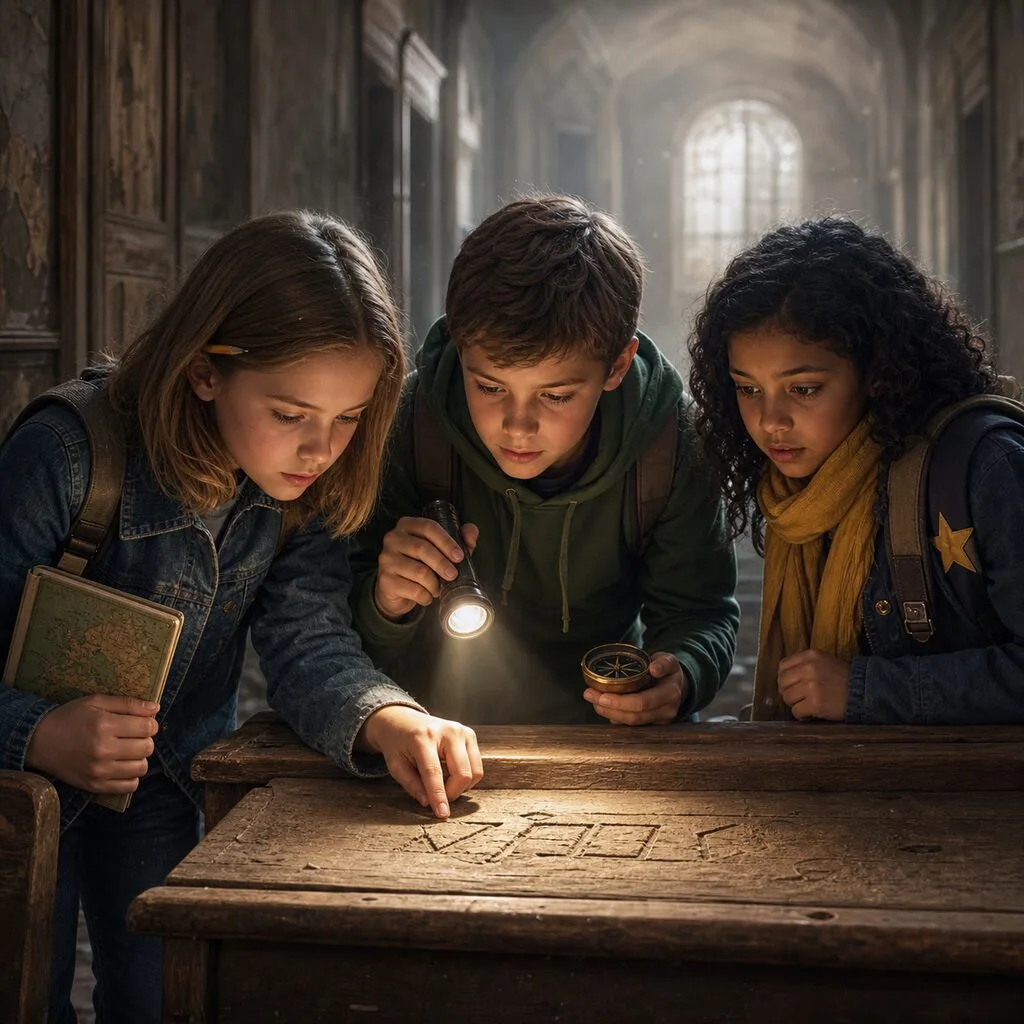
“This is exactly the sort of room that ought to have at least one window,” Oliver muttered. In his green hoodie, he held the little flashlight that had belonged to his grandfather, though he did not need it yet.
Mia looked over her shoulder. Her yellow scarf had caught on the strap of her backpack with its star patch. “It does have a window. It’s just behind three shelves and a box marked Christmas Decorations 2009.”
They had come because the staff-room attendant had mentioned that furniture from the old part of the school had once been moved into the storeroom. After Samuel’s place had been missing from the classroom plan yesterday, Nina could not shake the feeling that the map and the school were pointing to the same thing.
Among overturned chairs, maps rolled into tubes, and boxes full of textbooks, they found a school desk. It was lower than the ones in their classroom, with dark wood and cast-iron legs. One side of its top was scratched, as if someone had slid a ruler across it for years.
“This probably doesn’t belong here,” Nina said. She took the pencil from behind her ear and opened her small notebook with the map. “Look. Near the old classroom, there’s a mark on the map that looks like a rectangle.”
Oliver knelt down. “A rectangle could mean anything. A door, a table, a cupboard…”
“Or a school desk,” Mia added softly.
Nina ran her hand over the dusty top. Thin, dark lines appeared beneath her fingers. At first she could make out the letter S. Then A. A moment later, all three of them were reading the name that emerged from the wood like a sentence revealed beneath an eraser.
SAMUEL HORSKÝ.
Nothing moved in the storeroom. That was exactly why Nina shivered. The corridor outside the door, where someone had passed a moment earlier, suddenly fell silent. Even the old pipes above them did not creak.
Oliver bent closer to the desk top. “These marks are old. Look, they’re worn smooth. Someone carved this a long time ago, maybe when the desk was still in a classroom.”
“So Samuel was real,” Mia said.
“He was,” Nina said, though the word felt heavier than she had expected. Then she drew a breath. “And I think I know where to look next.”
The room near the staff room was warmer, but the paper in the old cabinets smelled dry and slightly musty. The staff-room attendant let them look through a few albums, as long as they returned them to exactly the right place and did not turn them into a detective board.
“That last part was mostly for you,” Mia remarked as Oliver laid his flashlight, compass, ruler, and three pencils arranged by length on the table.
“A detective board needs at least some string,” he replied seriously. “And I don’t have any.”
The thickest album had a cracked blue cover. On the first page were written the class name and a year that seemed impossibly long ago. Oliver turned the pages carefully, as if they might be offended if he touched them too quickly.
At last, he stopped.
“Here.”
At the edge of the page, Samuel Horský was written in tiny ink letters. Beside the name ran a faded line that stopped abruptly. Beyond it was an empty space, as if someone had meant to finish a sentence and then changed their mind.
When Things Start to Change
Nina noticed a drawing in the corner. It was a simple classroom plan: two rows of desks, the teacher’s desk, a window, and a door. One desk by the back wall was marked with a small cross.
“Right there,” she said, opening her notebook. “That’s what the room looked like on the map before it began to disappear.”
Meanwhile, Mia was reading the tiny notes beneath the list of names. She had to lean so close that her curls touched the paper.
“There’s something here about the end of the year,” she whispered. “It says: Prepare for Samuel…” She stopped. The final words were smudged. “…recognition for help with… No, I can’t read any further.”
Oliver frowned. “If he was meant to receive recognition, there must have been something specific. A certificate, a card, an entry in the album. Things like that don’t just vanish.”
“Sometimes they do,” Mia said. “When nobody looks for them.”
For a moment, Nina stared at the empty space beside Samuel’s name. Yesterday, the darkness in the old classroom had frightened her badly. She did not want to talk about it, because she felt that saying it aloud would mean she had to stop going on. But now she said, “I’m a little afraid the map will show us something we won’t be able to fix. But I don’t want to go there alone.”
Oliver closed the album at once. “Then you won’t go alone.”
Mia smiled. “And not in the dark. At least not on purpose.”
They found Mrs Urbanová in the corridor near the library. She was stacking books on a trolley, and her silver glasses gleamed in the light from the tall windows. The keys on the ribbon at her side jingled when she turned.
“If you’re looking for adventure stories, I’ve put them back on the proper shelves,” she said. “Which means you should be able to find them without my help this time.”
Oliver lifted the album. “We’re looking for someone from this book instead.”
When he said the name Samuel Horský, Mrs Urbanová stopped stacking the books. One thin volume remained in her hand, open exactly in the middle.
“Where did you find that name?” she asked.
Her voice was not strict. It sounded tired, as if she had pulled it from a very distant place.
Nina showed her the photograph of the school desk that she had managed to take on her phone. “In the storeroom. It’s carved into it.”
Mrs Urbanová did not take the phone. She only looked at the image for a long time. Then she gripped her keys so tightly that they jingled.
“Sometimes it’s better not to open old things,” she said.
“Better for whom?” Mia asked gently.
The librarian looked at her. There was something surprised in her face, but sad as well.
Oliver pointed to the open album. “There’s a missing entry beside his name. And on the classroom plan, a desk is marked with a cross. That can’t be a coincidence.”
“No,” Mrs Urbanová said. “It isn’t a coincidence.”
For a moment, it seemed as though she might leave. She was already holding the library key between her fingers. In the end, though, she opened the door and said quietly, “Come inside. Not here in the corridor.”
At the back of the library stood a round table with a vase of dry branches on it. Grey clouds moved past the window. Mrs Urbanová placed the album in front of her, but did not open it for a long time.
“Back then, I wasn’t a librarian,” she began. “I helped in that classroom. I stood in for the teacher, carried exercise books, and prepared the notice board. Samuel used to sit at the back by the window.”
An Important Moment
Nina quickly sketched the desk plan. “At the one marked with a cross?”
The librarian nodded. “That one. He wasn’t the loudest. People often thought that if he was quiet, he didn’t know the answer. But he watched first. Then he noticed things that others missed.”
“Like Nina,” Mia said.
Nina lowered her eyes to the notebook, but did not put down her pencil.
Mrs Urbanová smiled faintly. “One day, Samuel found an old plan of the school. He noticed that one classroom was missing from it. The very one where he sat. He joked that perhaps the room had taken offence.”
Oliver stopped fiddling with his compass. “What happened after that?”
“Later, the classroom was closed for repairs. Everything was moved quickly. Desks, notice boards, albums. At the end of the year, Samuel was meant to receive a small recognition for helping with a school project. We wanted to put a card in the album and pin his drawing of the school plan to the notice board.”
“But it didn’t happen,” Mia added.
Mrs Urbanová took off her glasses and rubbed her eyes. “No. I promised him I wouldn’t forget. Then came confusion, a new class, new duties. The card was lost. The notice board was taken down. And when I remembered later, it seemed too late. As if I had no right to say his name when I had not kept my promise.”
Oliver drew a breath, ready to ask another question. But then he remained silent.
Mia placed her hand on the edge of the album, not on Mrs Urbanová’s hand, only close to it. “Just because you were silent doesn’t mean you forgot.”
The librarian looked at her. Something glistened in her eyes. It was not a tear, not yet.
“No,” she said. “I haven’t forgotten a single day.”
After school, they returned to the old classroom, which appeared only when the map lay open on the table in the back corridor. The door stood ajar. Beyond it waited cold air, the smell of wood, and a quiet light that came from no lamp.
They could not bring the desk from the storeroom inside, but at Oliver’s urgent request, the janitor had at least moved it to the door of the old part of the building. When the children entered now, the desk was already standing in the place marked with a cross on the classroom plan.
Nina stopped on the threshold. “I still don’t like this,” she admitted. “But I’m glad you’re here.”
“We don’t like it either,” Oliver said. “But we have a flashlight, a compass, and Mrs Urbanová. That’s quite good equipment.”
“And a scarf,” Mia added. “It can be used for anything.”
Mrs Urbanová gave a short laugh. It sounded fragile, but the room immediately felt a little warmer.
The map on the wall was taut with countless thin lines. The house at its distant edge showed through a soft mist. Nina stepped closer and pointed to the almost invisible name near the old classroom.
“I think it’s waiting for a name,” she said.
She spoke it first, carefully and clearly. “Samuel Horský.”
Oliver joined her. “Samuel Horský.”
Mia said the name so gently, as if she were returning it to where it belonged. “Samuel Horský.”
Mrs Urbanová remained silent. Her keys hung at her side without a single jingle. Then she placed her hand on the old desk top.
“Samuel Horský,” she said more firmly than she had spoken all day. “I remember you. And I’m sorry I didn’t say it sooner.”
What Comes Next
At that moment, the light near the map changed. It did not grow brighter, only calmer. The cold clinging to the walls slowly eased. The lines on the map began to disappear, one by one, until mostly the road leading to the house at the edge of the map remained.
Oliver stepped up to the desk. “The wood is still cold,” he observed. “But it isn’t that unpleasant kind of cold anymore.”
“Maybe it doesn’t have to hold everything on its own anymore,” Mia said.
The next morning, they met by the map again. Mrs Urbanová brought clean, sturdy paper, an old class photograph, and a small box of blue cards. Oliver carefully copied the sentence they had managed to decipher from the album: Samuel Horský – recognition for attentive help with the school project and for a plan that noticed even what was missing.
“Isn’t that too long?” he asked.
“No,” Nina replied. “There’s room in it for him and for what he did.”
In smaller letters beneath the sentence, Mia added: We remember.
Mrs Urbanová held the card between her fingers for a long time. Then she slipped it into the album, in the empty place beside Samuel’s name.
On the map remained the house, the road, and a small place near the old classroom. Nina wrote Samuel Horský there in pencil. This time, the writing did not blur or disappear.
For a while, they were all silent. The house at the edge of the map looked calmer than before, its two windows shining with a soft blue light.
Then a thin new mark appeared in the lower corner of the map. It was neither a street nor a room. It looked like a small, empty frame, ready for something that had yet to come.
Oliver leaned closer. “That’ll be the final clue, won’t it?”
Nina closed her notebook, but this time she did not try to pretend she was unafraid. She looked at her friends, then at Mrs Urbanová, and finally at the house in the mist.
“Probably,” she said. “And I think it will be important for the others to hear Samuel’s name too.”
To be continued…