
The Unnumbered Corridor, Part 7: The Map Behind the Wallpaper

A peeling strip of wallpaper reveals an old plan—and a passage that appears only when the lights go out.
The Unnumbered Corridor, Part 7: The Map Behind the Wallpaper
The Story Begins
On Monday afternoon, the old stairwell seemed more ordinary than usual. From the ground floor came the bang of the front door, someone upstairs was running water, and the bulb above the landing cast a soft yellow glow on the walls.
Still, Nora stopped so suddenly that Ben almost bumped into her.
“What is it?” he whispered.
She pointed to the corner of the wallpaper near the last step. The faded pattern of green leaves was peeling away from the wall there. It was not a large piece, only a narrow strip, curled at the end like a dry leaf.
“That wasn’t there yesterday,” Nora said.
Filip adjusted the flashlight clipped to his belt, although the corridor was lit. “Maybe it was. You just didn’t notice. Old glue, damp, a draft… buildings have plenty of boring ways to fall apart.”
“This place is never boring,” Ben objected. At once, he looked around to see whether anyone had heard him. “And it’s always somehow quieter here. Even when the lift is humming outside.”
Nora had already taken out her small paper notebook. Their phones lost signal in the unnumbered corridor anyway, so she wrote down everything important in pencil. On a clean page, she sketched the stairwell, the window opposite it, and the corner of the wallpaper.
“Third floor, old stairs, wall beside the bricked-up section,” she said quietly. “The wallpaper is peeling about twelve centimetres above the skirting board.”
“About?” Filip raised an eyebrow.
Nora took a short metal ruler from her pocket. “Twelve and a half.”
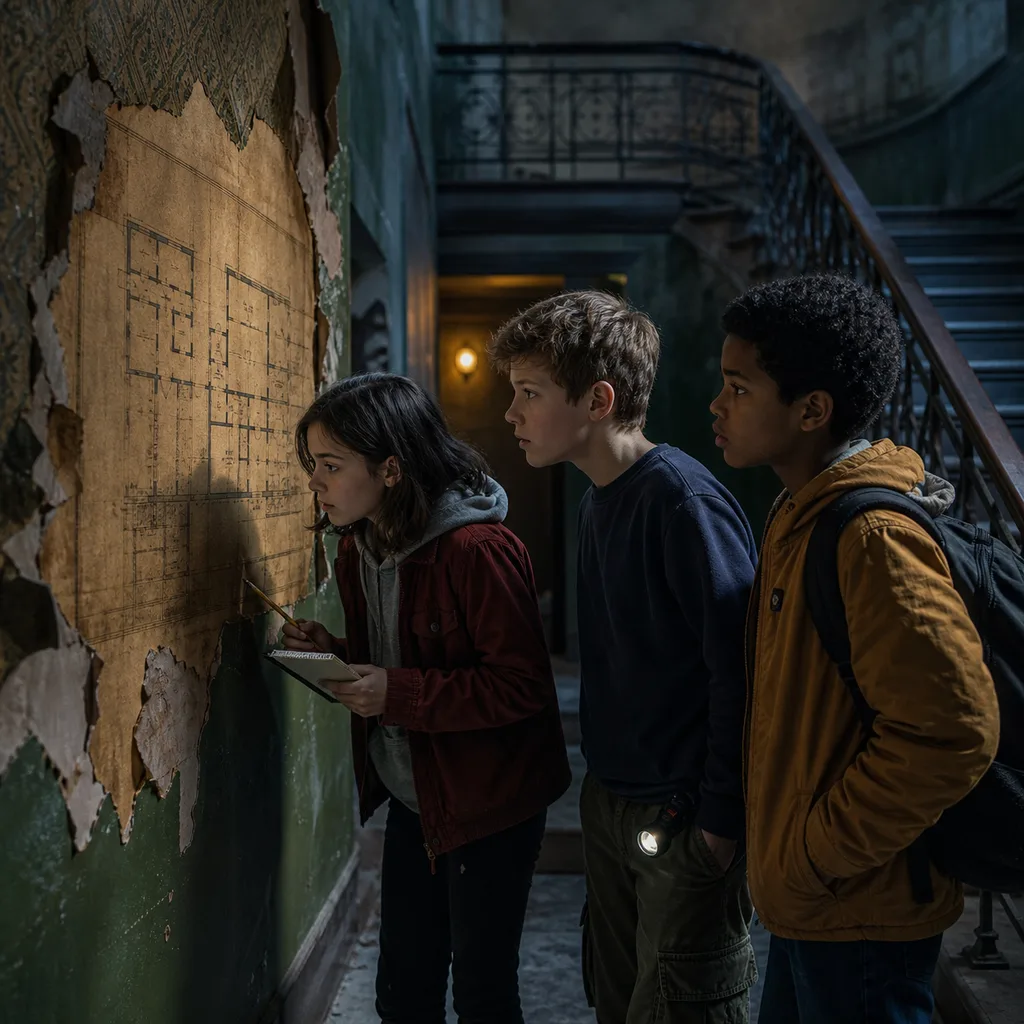
Ben smiled, but only for a moment. Then he noticed something beneath the curled corner. It was not the grey plaster he had expected. Between the wall and the wallpaper, a dull yellowed sheet of paper showed through.
“That’s not the wall,” he breathed.
Filip stepped closer. “All right. Nobody pulls off anything large. If it’s an old document, it could fall apart.”
From his school bag, he took a thin plastic bookmark, the sort he used in technical books. Very carefully, he slid it beneath the peeled edge. The wallpaper rustled. The sound was faint, but in the empty stairwell it seemed far too clear.
Beneath it, a dark, straight line appeared.
All three of them fell silent for a moment.
“That looks like a plan,” Nora said.
Filip did not answer. He gently lifted another small piece, only enough to keep the paper from tearing. Thin black lines, little squares and several faded marks appeared on the yellow surface. One part of the drawing ran exactly along the wall beside them.
Nora crouched down. “Wait. Here’s the stairwell. Do you see those two parallel lines?”
“I do,” Filip said with a nod. “And this must be the corridor. The width matches almost exactly.”
Ben leaned over his shoulder. “The unnumbered corridor?”
There was no number written on the plan. Only a narrow strip between rooms, as if someone had drawn it and then forgotten to name it. It led from the old stairwell into a part of the building that did not exist on today’s floor plan at all.
Nora followed the lines with her eyes. They were fine, damaged in places by damp, but still readable. Beside the stairwell, she found a small arrow. It pointed towards the space behind the wall, now bricked up.
“So it wasn’t a separate corridor,” she said. “It was part of a larger wing of the building.”
Filip measured the distance with his eyes, then walked a few steps to the end of the corridor and back. “If this plan is right, another flight of stairs once continued behind today’s wall. And beyond it were rooms. Not one. At least three.”
When Things Start to Change
“The lost wing,” Ben whispered.
Nora looked up. “Did Mrs Richterová call it that?”
The boy was quiet for a moment. He had a good memory for things adults said as if in passing. Especially the things they immediately pretended they had not said at all.
“Last week,” he nodded. “When we helped her with her shopping. She said, ‘This building used to have more doors than people who remember them.’ And then…”—he frowned—“‘The wing by the old stairwell went quiet before the others.’ That’s exactly how she said it.”
Filip looked at the plan again. “Went quiet? That could mean they closed it off during the renovation.”
“Or that something stopped making sounds there,” Ben added.
“Please don’t start with the second explanation,” Filip said, though he did not sound entirely convinced himself.
Something moved softly behind the wallpaper.
It was not a bang or a scratch. More like a brief, dry rustle, as if someone were turning a very old page in a book.
Ben took a step back. Nora did too, though she tried not to show it. Only Filip stayed by the wall, but he quickly pulled away the plastic bookmark.
“Maybe the paper shifted,” he explained quickly. “When we lifted the wallpaper.”
“Paper doesn’t move by itself against a wall,” Nora said.
“Damp, air, a change in temperature.”
“And a secret army of tiny building gnomes,” Ben added. He gave a nervous smile. “Sorry. Bad joke.”
Nora moved closer again. Now she noticed something she had missed before. The plan did not end in a torn edge. Near the bricked-up wall, it had been cut so neatly that a chill ran down her back.
A rectangle of paper was missing. It was about the size of an adult’s palm.
“Look,” she said, pointing at the empty space with her pencil without touching it. “This isn’t damage. Someone cut it out.”
Filip bent down. “But why would someone paste a plan behind wallpaper, then remove the one part that leads here?”
“So nobody would know what was behind the wall,” Ben answered.
For a moment, not even the water from the flat upstairs could be heard. Only the old bulb buzzed softly.
Nora opened her notebook to a fresh double page. Carefully, she copied the corridor, the stairwell and the empty space. At the missing rectangle, she added a little hatching. Beside it, she wrote: cut out on purpose?
Meanwhile, Filip stepped up to the bricked-up wall. The bricks beneath the plaster formed an uneven rectangle, slightly darker than the rest of the corridor. He tapped it with his knuckles.
The first two taps sounded solid.
The third gave a hollow note.
The boy froze and tapped again, a little higher. The hollow sound came again. It was not loud, but it seemed to bounce from somewhere behind the wall and return late.
“It shouldn’t sound hollow,” he said.
“Couldn’t there just be a service shaft there?” Nora asked.
“Maybe. Old buildings have them. But this one would be too wide.” Filip rubbed his chin, as he did when something did not add up. “And besides, according to the plan, there used to be a corridor here. That isn’t a technical space.”
Ben stared at the hatching in Nora’s notebook. “Mrs Richterová said something else once, too. I don’t know whether it matters. She was talking about Klára.”
The other two turned to him.
“What did she say?” Nora asked.
“She said that Klára wrote down things other people did not want to lose. Names, stories, who each thing belonged to. And when the renovation came, she supposedly hid some memories where nobody would look for them.”
An Important Moment
“Behind wallpaper?” Filip suggested.
“Or behind a wall,” Ben said.
Just then, the light above them went out.
It was not completely silent, because the building around them was still alive. Somewhere, a pipe creaked. A dog barked below. But at the old stairwell, thick blue-grey darkness remained for several seconds.
Nora automatically gripped her notebook.
Filip clicked on his flashlight. Its narrow beam cut through the gloom and stopped on the bricked-up wall.
The lights came back on.
The bricks were gone.
In their place, a narrow opening showed in the wall. It had neither a door nor a handle. It led into a space where the ceiling could not be seen: only a few steps of dark floor, and a pale wall at the far end.
Ben swallowed. “That’s it, isn’t it?”
Nora noticed that the opening was exactly where the arrow ended on the plan. Her heart was beating fast, but she spoke calmly. “It isn’t the unnumbered corridor. It’s a connection to it. But it probably only appears when the lights go out.”
“Wonderful,” Filip said. “So walls have working hours now.”
“We’re not just going in there,” Nora decided.
The boys nodded. That mattered. It did not mean they were not afraid. It meant they did not have to pretend that fear did not exist.
They quickly divided the tasks. Filip would go first with the flashlight and watch the floor and ceiling. Nora would stay in the middle and record what they saw. Ben would go last, keeping an eye on the way back and the opening.
“If anything changes, we say so immediately,” Nora added. “And if anyone doesn’t like it, we turn back.”
“That’s a plan I approve of,” Ben said.
The passage was colder than the corridor. The air smelled of dust, old plaster and something metallic, perhaps rust. After only four steps, the old stairwell behind them already seemed farther away than it should have been.
Fortunately, the space did not continue far. Soon it opened into a narrow alcove, barely as wide as a small storage room. The left wall was bare brick. On the right, a strip of faded green paint remained.
Filip shone his light on the floor. “No holes. No loose boards. We can stand here.”
Nora, however, was looking higher up. On the wall, almost level with her shoulder, she found a thin mark made in dark-blue pencil. It was no bigger than a plate. It showed a rectangle with an arrow running through it, and beside it, a small letter K.
Beneath the symbol were a few barely readable words.
Filip moved the light closer. “I don’t want to boast, but my flashlight just saved history.”
Nora passed her finger just above the writing without touching it. “It says: Do not brick up completely. And beneath that… Look, Ben.”
The boy narrowed his eyes. Then his expression changed.
“‘Memories remain in the side step,’” he read slowly. “That’s what Mrs Richterová said. I thought she meant somewhere in a flat. But she said side step. Not side room.”
Nora took out her notebook and held it beside the mark to compare the drawing with the plan. The arrow on the wall pointed exactly to the cut-out rectangle on the map. The missing piece did not show an ordinary room. It showed this narrow passage and something beyond it.
“Someone removed it so nobody would know about the side step,” she said.
What Comes Next
Filip was silent for a long time. Then he lowered his flashlight. “All right. I take back half my explanations. This isn’t a random hollow space or a mistake from the repairs. Someone knew exactly what it was hiding.”
“And perhaps why it was hidden,” Ben added. “If Klára hid memories from the renovation… maybe she hid something of her own here too.”
A soft rustle sounded behind the wall.
All three turned.
Filip shone the flashlight into the corner of the alcove. Nothing moved there. Only a piece of peeled wallpaper lay near the floor, rolled into a thin tube. There was no way for wind to get in.
“Back?” Ben asked quietly.
Nora looked at the mark, then at the opening, through which they could still see the yellow light of the stairwell. She did not want to leave. At the same time, she knew that investigating for too long in a space that had appeared after the lights went out was not a good idea.
“Back,” she said. “We have proof. And we need to copy it before it disappears.”
They returned in the same order. As Ben passed through, he looked back once more, memorising the faded wall, the K mark and the exact number of steps. When Nora went through last, the light above the stairs flickered briefly.
The passage closed without a sound.
In place of the opening, there was once again a bricked-up wall. The plaster looked old, cracked and completely ordinary.
Only the wallpaper near the stairwell remained peeled away.
Nora sat on the steps and wrote down everything they had seen. She copied the entire plan more carefully than before. She marked the unnumbered corridor with a double line. She shaded the place by the wall in blue pencil and added a K in a small square in the corner.
“If there is one side step, there could be more,” Filip said. “In that lost wing, there might be alcoves, service spaces, old marks. Anything.”
Ben pulled the strap of his backpack higher onto his shoulder. “And perhaps more things Klára wrote down. If she wanted to preserve the stories of the people in the building, she had to put them somewhere.”
“We’ll look for the K mark,” Nora decided. “Not blindly. First, we’ll compare whatever old floor plans we can find with this one.”
Filip smiled. “That sounds almost like a normal investigation. Except for the corridor that appears only during a power cut.”
“Almost normal,” Ben agreed.
As they were about to leave, Nora noticed something by the skirting board. Where the wallpaper had peeled away, a tiny scrap of yellowed paper was stuck. It was no bigger than her fingernail.
She carefully lifted it out. On one side, it bore part of a black line. On the other, barely visible, were two letters: BO.
Nora slipped the scrap between the pages of her notebook.
Behind them, the old stairwell waited in silence. And somewhere beyond the bricked-up wall remained the side step, perhaps still leading farther on.
To be continued…