
The Unnumbered Corridor, Part 6: The Night the Numbers Went Dark

When every apartment number fades away, Nora, Filip, and Ben follow a glowing zero to a sealed-off secret in their old building.
The Unnumbered Corridor, Part 6: The Night the Numbers Went Dark
The Story Begins
The sun had long vanished behind the roofs of the neighbouring houses when Nora went out to take down a small bag of paper for recycling. Only one bulb was lit in the corridor. It gave off a yellow light and always buzzed a little, but today the buzz was uneven, as if the light could not decide whether to stay on.
Nora stopped by Mrs Richterová’s apartment door. During the day, the brass number 34 was bright and shiny. Now it looked dull. At first, she thought a shadow from the banister had fallen across it.
Then the number four slowly blurred.
It did not happen quickly. It did not fall off or go dark. Its edges simply faded, until only a darker patch remained on the door where it had been a moment before.
Nora dropped the bag to the floor.
“That’s impossible,” she whispered.
She pulled her small paper notebook from her jacket pocket. Her phone would not have helped anyway. There was never any signal in the Unnumbered Corridor, and Nora had learned long ago that a pencil was more reliable than any app.
She wrote: 20:47 — door 34, number disappeared. Light stayed on.
Two doors farther along, number 35 was still visible. But while she wrote it down, the three lost its shine and became such a faint grey that she could see it only from close up.
“Nora?” Filip’s voice called behind her. “Why are you standing by Mrs Richterová’s door? I hope you haven’t broken anything, because she can fix a person with one look.”
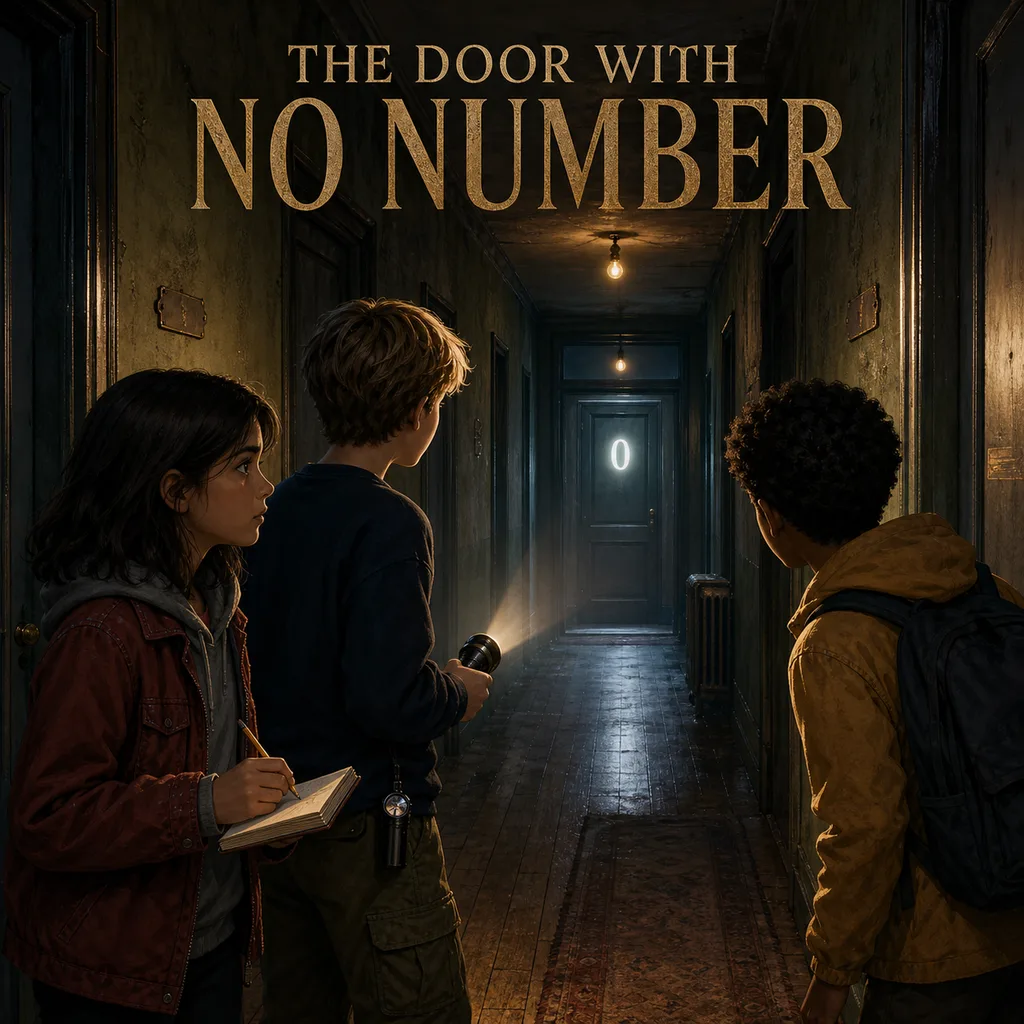
Filip came up the stairs with a torch clipped to his belt. Ben followed him, gripping the straps of his dark backpack.
“Look at the doors,” Nora said.
“Doors are boring enough without me looking at them,” Filip replied. Then he leaned closer. His smile froze. “Wait. Where’s thirty-five?”
Ben pointed to the far end of the corridor. “And twenty-nine isn’t there. Neither is thirty.”
All three looked around. The numbers above the peepholes, on brass plaques, and on old white signs were fading one after another. Some vanished slowly. Others disappeared all at once when the bulb above them flickered briefly.
Quiet footsteps sounded behind the apartment doors. Someone turned a key in a lock but did not open the door. One floor below, a woman’s voice whispered, “Is it happening again?”
“Again what?” Ben asked, although he knew no one could hear him.
Nora quickly flicked through her notebook. Beside older notes, she had drawn doors, arrows, and the times of brief blackouts. The Unnumbered Corridor had always appeared after the lights went out for a few seconds. Today, though, the light had not gone out completely.
“Maybe it’s another part of the same system,” she said.
Filip shrugged. “Or someone replaced the numbers with ones that react to heat. Old buildings are full of strange solutions.”
“And they all broke at the same time?” she asked.
The boy frowned. “All right. That would be strange even for an old building.”
Meanwhile, the number on the door opposite them disappeared too. The corridor suddenly looked emptier. Without numbers, the doors were only matching rectangles with peepholes, handles, and shadows beneath their thresholds.
Ben said quietly, “When people don’t know where they live, even ordinary doors start to frighten them.”
Nora nodded. “That’s why we mustn’t make any noise. We’ll just see what’s happening.”
They headed upstairs. On each floor, Nora wrote down which labels she could still see. Filip shone his torch, although the lights were still working. He claimed he wanted to compare the reflection on the metal numbers, but Ben knew he simply felt better with a light in his hand.
When Things Start to Change
On the top floor, the corridor turned around a corner. A week earlier, after a brief blackout, they had found a door there that had not been there during the day. This time, the doors remained where they belonged, but all of them were numberless.
All except one.
A small zero glowed on a narrow grey door near the end of the corridor.
It was neither brass nor plastic. It glimmered directly on the wood in a thin, pale circle, as if someone had drawn it with chalk that remembered light.
Filip stopped so sharply that his torch struck the buckle on his belt. “That definitely isn’t a normal apartment number.”
“Nobody lives here,” Ben said. His voice was quiet, but not frightened. “Did you notice that everyone avoids this place? Even the lady from fifty-two took the stairs, though she lives one floor below.”
A narrow dark strip ran beneath the door. Cold air streamed through it, stirring the ends of Nora’s hair against her cheek.
She wrote: Top floor. Door without nameplate. Zero. Cold.
“Zero could mean the basement,” Filip suggested. “But we’re upstairs. Or it could be a storeroom. Or a utility room.”
“But why is it the only one that’s glowing?” Ben asked.
No one had an answer.
Something clicked softly behind the wall.
All three fell silent.
A moment later, the sound came again. It was not loud. It sounded like a metal component slipping into the next position. Then there was silence once more.
Nora did not touch the handle. Instead, she pointed towards the stairs. “First, a plan. If the door closes, can we get back?”
“The stairs are clear,” Ben said after a quick glance. “We won’t use the lift.”
“And I’ll leave a wedge under the door,” Filip added. He took a small rubber wedge from his backpack, which he had carried ever since a basement door had once jammed. “Not because I’m expecting a monster. I just don’t like doors that do whatever they want.”
“That’s sensible,” Nora agreed.
Filip placed the wedge beside the threshold, took hold of the handle, and pressed it down slowly. The door was not locked. He opened it only a hand’s width.
Nothing leapt out from inside. There was no scream or scraping of claws. There was only a small room, barely wide enough for two people to stand side by side.
Old cables covered in grey fabric ran along the walls. Beneath them hung metal fuse boxes. Some bore faded labels: LIGHTS, BELLS, ORIENTATION. The air smelled of dust, cold metal, and something like wet cardboard.
“There, you see?” Filip said, too quickly. “Technical equipment. No mystery. Well… the mystery is why it still works.”
Nora stepped inside only after making sure the wedge held the door open. Ben stayed closest to the exit. It was not because he wanted to hide. He simply had the best view of both the corridor and the room.
Behind one metal box, Nora noticed the corner of a sheet of paper. The box did not sit quite flush against the wall. Someone had moved it recently and then carefully put it back. The dust around it had been wiped away in a neat semicircle.
“Someone comes here,” Ben said, pointing to the same spot.
Filip knelt down. “Maybe the caretaker.”
“The caretaker has no reason to hide paper behind fuse boxes,” Nora objected.
They did not move the box together. It was heavy, and they did not want to damage anything. But Filip shone his torch into the gap, and Nora carefully pulled out the paper caught there with two fingers.
An Important Moment
First, a map appeared.
It was old, printed on yellowed paper. The lines showed the building’s floor plan, but on the left they continued beyond the present-day wall. There, a long wing with several rooms had been drawn.
“That’s the lost wing,” Ben breathed. “Mrs Richterová said it was demolished during the renovation.”
A place marked 0 had been circled in red pencil on the map. Beside it were the words: ASSEMBLY POINT — ORIENTATION SIGNAL.
Filip leaned closer. “So the numbers on the doors weren’t just numbers. Look. This panel sends a signal into the corridors. When there was a blackout or a fault, the system probably switched to emergency mode. Maybe people were meant to find the right way by following the lights.”
“And the zero?” Nora asked.
Beneath the map, she found a second slip of paper. It was folded into quarters and a little torn at the edges. When she unfolded it, she saw delicate handwriting in blue ink.
Ben drew in a breath. “That handwriting… I saw it in Mrs Richterová’s old book. Beside the name Klára.”
Nora read aloud, very quietly:
“Zero is not nothing. It is the beginning of memory. A place where everything gathers, so that no one is forgotten. If the corridor goes dark again, look for what remains lit. — Klára”
In the little room, only the faint hum of the cables could be heard.
Nora copied the message into her notebook, letter by letter. Twice, she checked that she had not mistaken a word. Then she drew the zero exactly as it had glowed on the door.
“The building’s memory,” Ben said. “Maybe messages once came here. Names. Notes for the people who lived in that wing.”
Filip swept his light across the panels. One had tiny holes like those of an old speaker. “And maybe sounds, too. Do you remember the lift? That recording that played by itself?”
All three remembered the voice from the speaker. Ben had recognised it from Mrs Richterová’s stories, but at the time, no one had known why it had sounded in the lift.
Just then, the metal behind the back wall clicked again.
Once.
Then again, exactly three heartbeats later.
Filip raised a finger. “A relay. An old switch. Probably.”
“Probably?” Ben repeated.
“All right, it sounds as though someone is knocking from inside. But relays knock too. They just don’t have hands.”
Nora looked at the map. The clicking came from the direction of the lost wing. Behind the wall, there should now have been only a narrow gap between the buildings.
“We’re not opening anything else,” she decided. Her voice trembled a little, but her words were firm. “We have proof. We have a way back. That’s enough for now.”
Ben nodded with visible relief. “And the neighbours are already looking at us as if we were fixing the lift with a hammer.”
When they stepped into the corridor, two doors opposite them closed softly. An older man by the stairs stared at them but said nothing. Tension spread quickly, like when someone in class gets frightened by a wasp and, a moment later, everyone is pushing their chairs back.
Filip closed the utility room, but not before making sure the wedge had not caught beneath the threshold. The zero on the door glowed for a little longer. Then it faded.
“Do you think the system switched itself on?” Ben asked as they went downstairs.
“According to the plan, it could have,” Filip replied. “If it detects a fault, a blackout, or a bad connection.”
Nora stopped on the landing and added one final sentence beneath Klára’s message: Question: can someone switch it on deliberately?
What Comes Next
None of them read the question aloud.
Later that night, the numbers began to return. First on the ground floor, then on the first floor. They did not spring out of nowhere. They appeared faintly, like pencil marks someone had gone over with an eraser, and gradually grew stronger. By the time the clock in Nora’s room read 5:12, 34 was shining once more on Mrs Richterová’s door.
In the morning, the corridor was ordinary. The bulbs buzzed as always, the lift travelled wearily between floors, and someone carried a bag of pastries. Only Nora, Filip, and Ben looked at the numbers a little longer than everyone else.
Mrs Richterová stood by the mailboxes in a dark burgundy jumper. She held a large brass ring of keys in one hand. When she saw Nora’s open notebook, her gaze stopped at the drawn zero.
“You went upstairs,” she said.
It was not a question.
Nora nodded. “We found a utility room. And a map of a wing that no longer exists.”
Mrs Richterová slowly slipped one key back among the others. “This building once had more systems than it has now. People understood them because they needed them. Then came the renovation, and many things were bricked up. But not everything stopped working.”
“Do you know Klára?” Ben asked.
For a moment, the woman looked towards the stairs. “I knew a girl who believed that every name and every story was worth remembering.”
“She left us a message,” Nora said.
“I know,” Mrs Richterová replied so quietly that they were not sure she had truly said it. Then she gathered herself. “If you keep looking, don’t go alone. And don’t open doors simply because they call to you.”
Filip shifted his torch on his belt. “We have a plan.”
“That’s good,” Mrs Richterová said. For a moment, a sad but peaceful expression appeared in her eyes. “A plan comes in useful in an old building.”
She went towards the lift, and the children remained by the mailboxes. Nora opened her notebook to a clean page. She drew the lost wing from the map, the red circle, and a zero beside it.
At the bottom of the page, she wrote: The beginning of memory.
From the top floor came a distant click, almost too faint to hear.
This time, though, nobody ran upstairs. The three of them only looked at one another, and Nora closed her notebook firmly.
To be continued…