
Guardians of Jasnohrad, part 1: The Experiment That Went Wrong

During Science Day at Jasnohrad Primary School, the Prism unexpectedly flares, triggering a power cut and awakening strange abilities in Dávid, Nina, Samuel and Lea. Their involuntary efforts help clear an evacuation route and steady a falling decoration while adults coordinate the evacuation and safely lower the frame. Everyone is accounted for, emergency responders take custody of the Prism, and the exhausted children are told not to test their abilities outside supervised meetings. Later, they witness a brief outage near the Black Tower and a blue spark at its aerial. The headteacher records only what they saw, without assuming the tower caused the school accident, and forbids them to approach it. Privately, the Professor writes that he recognises the frequency from his past but has not told the children.
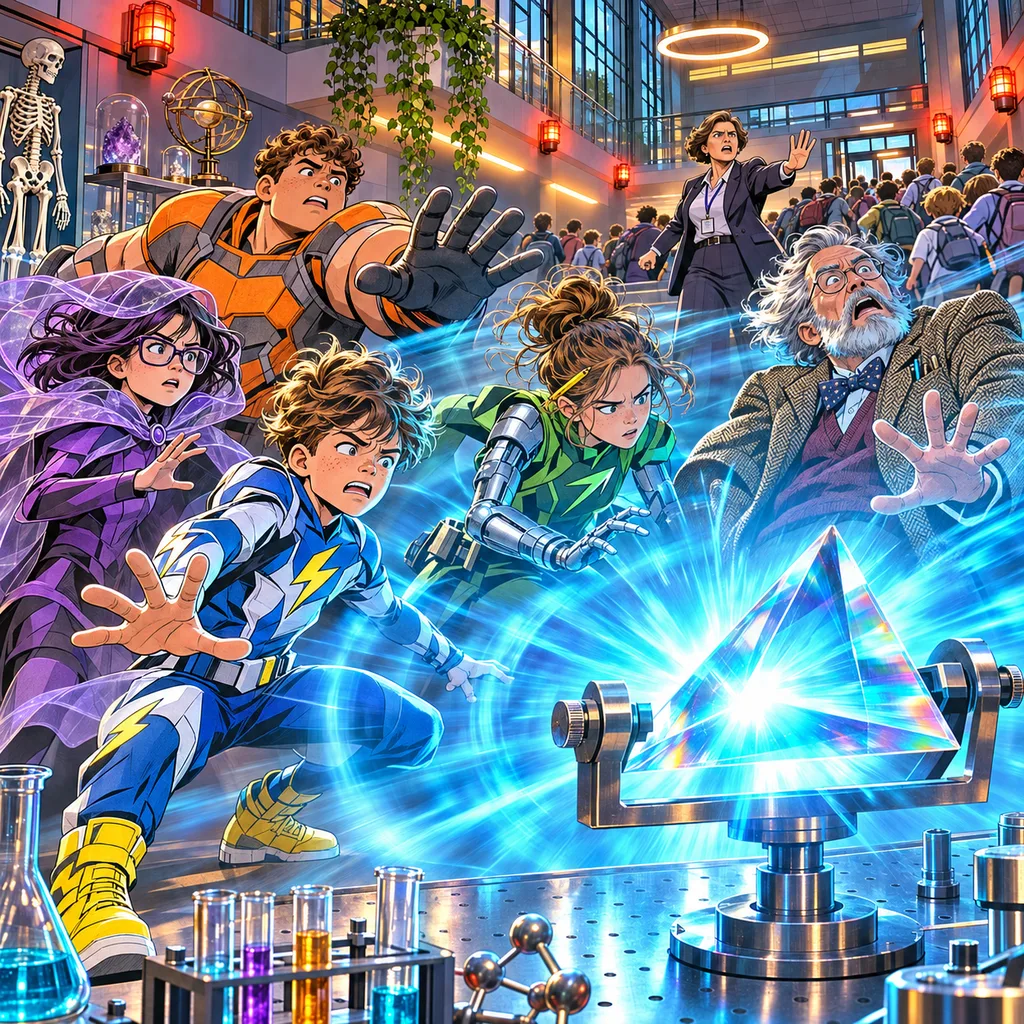
The Experiment That Went Wrong: During Science Day at Jasnohrad Primary School, the Prism unexpectedly flares, triggering a power cut and awakening strange abilities in Dávid, Nina, Samuel and Lea. Their involuntary efforts help clear an evacuation route and steady a falling decoration while adults coordinate the evacuation and safely lower the frame. Everyone is accounted for, emergency responders take custody of the Prism, and the exhausted children are told not to test their abilities outside supervised meetings. Later, they witness a brief outage near the Black Tower and a blue spark at its aerial. The headteacher records only what they saw, without assuming the tower caused the school accident, and forbids them to approach it. Privately, the Professor writes that he recognises the frequency from his past but has not told the children.
Guardians of Jasnohrad, part 1: The Experiment That Went Wrong
Science Day at Jasnohrad Primary School began as it did every year: with noise, the smell of glue, and a crowd of pupils squeezing towards the hall doors. Dávid Horváth arrived last, of course, with his shoelaces undone and the expression of someone who had only just missed being on time. Nina, Samuel and Lea were saving him a place in the queue.
“Only a minute late again,” Dávid announced. “A record. At this rate, I’ll arrive before I leave home.”
“You’ll arrive before your hair mousse dries,” Lea said, adjusting the pencil behind her ear. “Look, is that the famous Prism?”
In the middle of the hall, a low glass case stood on a raised table. Inside it, a dark crystal the size of a palm rested in a metal holder. The low afternoon sun shone through the tall windows, casting long golden stripes across the floor. Above the waiting pupils hung a large, lightweight decoration: canvas stretched over a frame, painted with planets. One upper corner was tied to the wall with a cord. The other rested on a metal stand beside the table. Samuel studied it, as he did anything that could be lifted.
“I hope that cord’s strong enough,” he murmured, taking a biscuit from his jumper pocket.
The headteacher stepped in front of the crowd and raised a hand. Her voice was calm and firm—the voice of someone children listened to without needing to be afraid of her.
“Before we begin, let’s go over the rules once more,” she said. “This hall has two exits. The main doors behind me, and the side door beside that display board. If a teacher directs you somewhere, go where they point, not where you feel like going. Our assembly point is outside the gym. Two teachers will stand beside the decoration and keep the space beneath it clear, so nobody stops under the frame. Understood?”
“Understood,” several dozen voices replied.
Then it was Professor Vojtech Hviezda’s turn. In his tweed jacket with its worn elbows, and with a trace of lunch caught in his grey beard, he looked like someone who had gone back for his glasses twice on the way to the hall. But when he began talking about physics, his absent-mindedness vanished.
“This little object is called the Prism,” he began. “It’s a resonator. That sounds alarming, but it’s really an object that responds to certain frequencies. A little like a glass that vibrates when you sing just the right note. Today, I’ll demonstrate it in safe mode.”
He tapped a red switch marked ISOLATOR. “This shuts down the entire stand. Here is the removable low-voltage connector. And here”—he opened a grey case with a space shaped exactly like the crystal—“is where the Prism lives when it isn’t being used. The case is empty now, so you can see I’m not hiding anything.”
He plugged the connector into the holder. There was a click. The crystal gave a faint shimmer, and an “Ooooh” rippled through the hall.
“Nothing’s happening,” Nina whispered.
Dávid leaned towards her. “Just wait. It’s only getting started.”
At that exact moment, the Prism blazed.
At first it was only a flash, like sunlight striking a mirror. Then the crystal turned white, crackled, and sent a ring of light through the hall. It struck the four children nearest the table and the Professor. Dávid felt a tingling rush across his skin, from his fingers all the way to his spine. Nina grabbed her glasses. Samuel dropped his biscuit.
“I didn’t touch anything!” the Professor blurted out, raising both hands above the table. “The controls are off. I… I didn’t start it!”
The ceiling lights went out all at once. But the hall wasn’t dark: daylight still streamed through the tall windows, and small battery-powered emergency lights came on above both exits. The music from the speakers stopped too, leaving a sudden, hollow silence.
The stand beside the decoration jerked as though someone had kicked it. Something cracked loudly. The brace supporting the lower corner of the frame snapped in two. The decoration tilted, its corner dropping to about the height of an adult. The cord held it there, stretched tight as a violin string. A long piece of canvas slipped loose from the frame and spread across the floor like a train, reaching towards the side door.
“Stop!” called the headteacher, so sharply that the entire queue froze. “Nobody goes near the decoration! Come towards me, but not under the frame! Miss, take Year 4 and Year 5 to the side door!”
Before she had finished speaking, her phone was already in her hand.
“This is Jasnohrad Primary School. We need the emergency services. A power cut, damaged decorations, no injuries. We’re evacuating the hall.”
Dávid and his friends stood rooted to the spot. What had caused that flash? Nobody had an answer. The Professor clutched his jacket and stared at the Prism with a strange, half-frightened expression, as though he had just heard a sound he should never have heard.
Dávid moved away from the table and looked towards the side door. The maths teacher stood there, but the display board blocked her view of what was sliding across the floor towards her. The canvas now stretched across the whole passage, and the first children in the queue were heading straight for it.
“Miss!” he called.
She was too far away. He swore silently, took a breath and stepped forward.
Except it wasn’t a step. The world blurred. The hall suddenly seemed shorter, as though someone had fast-forwarded a film. A moment later, he was beside the teacher, gasping so hard that his ears roared.
“Dávid?” She stared, her eyebrows shooting up. “How did you… Never mind that now. What’s wrong?”
“The canvas,” he panted, leaning against the wall because his knees were going weak. “It’s across the passage. Right across the doorway. They’ll trip over it.”
The teacher raised her hand at once. “Stop! Nobody moves until we’ve cleared this!”
Dávid closed his eyes for a moment. His legs were shaking as though he had just run two kilometres without stopping. He definitely didn’t want to try that again.
Meanwhile, Nina could see everything from the other side. A large grey display board cast a long, unbroken shadow from the window towards the side door. The edge of the canvas lay in that shadow. Getting through the crowd would take too long, so she reached along the board, hoping she could at least catch the fabric with her fingertips.
Then something strange happened again. The shadow thickened beneath her hand, like cold water around her fingers. Nina slid along it as though sliding down a handrail. For an instant, the hall narrowed to a dark strip. Then she emerged at its far end, right beside the canvas, on the safe side. Ahead of her, she could see where the shadow ended on the bright floor.
“Did I… do that?” she whispered to herself.
Then she grabbed the fabric with both hands and dragged it towards the display board, well away from the path to the door.
Lea had seen her enter the shadow and come out three metres further along.
“Nina,” she whispered from beside the wall. “You just…”
“I don’t know,” Nina replied. “I could see the end of the shadow. Otherwise it wouldn’t have worked.”
The teacher crossed the passage, tapped the floor with her shoe, and pulled the last fold of canvas a little further aside. Then she waved the pupils forward.
“Come on, but one at a time, along this side! Nobody look up!”
The queue moved. One by one, the children disappeared into the corridor, well away from the tilted frame. Dávid, Nina and Lea stayed at the edge of the passage while the last pupils went through.
Lea was just about to follow when they all heard it: a high, sliding squeak. The cord slipped another few centimetres through its fixing on the wall.
“The frame’s falling!” the headteacher shouted from somewhere nearby. “Away from it! Everyone, move away!”
Lea ducked as though bracing for a blow. An absurd thought flashed through her mind: how could you slow it down, if only you had enough time?
Then, without her choosing to do anything, something tightened across her shoulders. An invisible hand seemed to reach towards the falling corner. It slowed as though sinking into syrup and shifted sideways at the same time. Everything around it stayed normal. Even the pencil in her hair didn’t stir.
Samuel stood at the edge of the clear space. When he saw that the corner was still tipping, his hands moved before he had time to think. Heat spread through his chest. His widening shoulders stretched his jumper, and the floor seemed to shrink beneath him. Suddenly, he was taller than the doorway—about two and a half metres tall. Both his hands, which hardly seemed to belong to him, were supporting the corner of the frame.
“I’ve got it!” he called in a deep voice that sounded nothing like his own. Then, almost at once, “But I can’t hold it! It’s too… My knees are shaking!”
“Samuel, let go!” called a man.
Two members of the school staff, the caretaker and the woman in charge of the decorations, were already beside the frame. Their hands gripped its edge firmly, in just the right places.
“We’re holding it. You let go! Slowly! Now!”
Samuel opened his fingers. The frame swayed, but the two adults lowered it, moving it away from the damaged wall, and carefully laid it flat on the floor. The cord hung loose and limp.
Lea sank to her knees, sparks dancing before her eyes. Samuel shrank and shrank until he was his usual height again, in a sagging jumper, with trembling legs. Then he sat straight down on the floor. Both of them were as white as sheets.
“All right,” the headteacher said, coming over. Her voice was quiet but steady. “It’s all right now. Come with me, slowly. Nobody does anything else.”
Outside, at the assembly point in front of the gym, the classes were already lining up in alphabetical order. Teachers opened their registers and called out names. The answers came one after another: “Here! Here!”
Sirens wailed in the distance. Soon, an ambulance and a fire engine pulled up outside the school.
One by one, the teachers reported to the headteacher.
“Year 6 A, all present.”
“Year 5 B, everyone’s here.”
“Year 4, all accounted for.”
She wrote down each report, then finally raised her head.
“Everyone’s here. Everyone.”
The paramedics examined Dávid, Nina, Samuel, Lea and the Professor. They shone lights into their eyes, checked their pulses and asked whether anything hurt. Dávid felt as though he was running a marathon while sitting down. Samuel was so exhausted that he asked for water. Lea complained of ringing in her ears.
Meanwhile, one of the emergency responders taped off the entrance to the hall. Two men stood by the doors, with the Professor beside them, his forehead creased.
“The Prism has stopped flashing,” he said. “It was still glowing a little while ago.”
“All right,” the responder replied. “I’ll let you in now, but you’ll approach the table only from the clear side, and you’ll do exactly as I say. No improvising.”
“No improvising,” the Professor promised.
Under the responder’s supervision, he reached for the red switch marked ISOLATOR and moved it to OFF. The switch stayed in place, and the responder covered it with his palm to be sure. Then the Professor unplugged the low-voltage connector while the crystal shimmered quietly in its holder. He lifted it carefully, settled it into the shaped lining of its case, and closed both catches.
Click. Click.
The responder took the case from him.
“I’m taking this into safekeeping.”
“I don’t think the case would shield it if another signal came,” the Professor said quietly. “It’s disconnected and closed away, but I can’t promise you more than that.”
“Good of you to say so.” The responder nodded. “At least we know what to allow for.”
The headteacher returned to the assembly point and announced, “The adults have the hall under control. The Prism has been secured.”
The children still weren’t sure what to think, but nobody tried using their abilities again. They sat on a bench beside the gym, each slumped in a different shape of exhaustion. The Professor joined them on the end of the bench. His face no longer looked absent-minded, only tired.
“Will you tell me what you experienced?” he asked. “Only what you really know. Don’t guess or fill in any gaps.”
“I started running,” Dávid said. “I only wanted to get the teacher, and it was like someone fired my legs out of a cannon. Now they feel like jelly.”
“I slid along the shadow from the display board,” Nina said quietly. “I could see where it ended. If I hadn’t been able to see it, I don’t think it would have worked.”
“I lifted that corner,” Samuel said. “I was huge. It was like a dream, except my knees told me it was real.”
“The frame slowed down,” Lea said, blinking. “Just that corner. Nothing else. I don’t know how. I didn’t mean to do it.”
The Professor nodded slowly.
“Right. I think the accident caused resonance effects. That’s all I know for certain at the moment. I can’t yet tell you what your safe limits are. But these abilities seem to draw on a limited reserve, not an endless source of power. That’s why you’re exhausted. The reserve does refill, but slowly, and none of us knows exactly how.”
“So we’re not supposed to try anything,” Dávid said suspiciously.
“Nothing,” the Professor said firmly. “Not at home, not here. Not even just for practice. I’ll arrange supervised meetings with your headteacher and your parents. If we can study this, we’ll do it with adults who are responsible for keeping you safe.”
The headteacher nodded. “I’ll phone your parents myself today. None of you is going anywhere without an adult.”
Lea looked at Samuel.
“You held it,” she said. “Even when you knew you couldn’t keep holding it.”
“And you slowed it down,” he replied with the tiniest smile. “Otherwise I wouldn’t have caught it.”
“Nina pulled the canvas out of the way,” Dávid added. “I just ran like a maniac.”
“But you got the message there,” Nina said.
It was the first time any of them had praised him without teasing.
By then, the sun had dipped behind the rooftops, and windows were beginning to light up across the city. The traffic lights were flashing green. Samuel was pulling the rest of his biscuit from his pocket when Nina raised a hand.
“Look,” she said. “The lights.”
Towards the Black Tower, an old telecommunications building with a newer aerial on top, the bright windows went dark. Then the traffic signals beyond them went out too. Not across the whole city—only a strip around the tower, as though someone had drawn a finger across a glowing panel. A thin, sharp blue spark flashed beside the aerial.
Then the windows lit up again, and the traffic signals flickered back to green.
“Did you see that?” Dávid asked.
“All of us,” Lea replied. “And I’m not saying the tower caused it. I’m saying we saw it.”
The headteacher took a notebook and pen from her handbag.
“That’s an important distinction. We’ll write it down together. Only what you actually saw. Nothing more.”
She wrote slowly, then read aloud.
“Witnesses: Dávid Horváth, Nina Králová, Samuel Baláž and Lea Mráziková. From the school assembly point after the evacuation, we saw lit windows and traffic signals in the direction of the Black Tower briefly go out. During this time, a blue spark appeared on the tower’s aerial. Afterwards, the lights came back on. We do not know whether the tower caused the accident at school. At the next supervised meeting: pass this observation to Professor Hviezda and the emergency services liaison officer, and compare it with the recorded sequence of events during the school accident. Do not approach the Black Tower.”
She looked at the children. “Is that right?”
“Yes,” all four said almost at once.
“Good. I’ll attach this page to the record of the Prism being taken into safekeeping.” She closed the notebook. “And once again: not one step towards that tower.”
The Professor stood a little way off, beside a low wall, gazing at the tower. When he thought nobody was watching, he took a small notebook from the pocket of his tweed jacket and wrote a single sentence:
“I recognise that frequency from my past. I haven’t told the children.”
He closed the notebook, adding no name and no explanation. Then he turned towards the children with his familiar absent-minded smile and asked whether anyone happened to have another biscuit.
Without a word, Samuel handed him one.
To be continued…