
Robo and the Lost Planet, Part 2: The Changing Map

Robo, Ami, and Pip discover that a changing game map is responding to a mysterious old satellite signal.
Robo and the Lost Planet, Part 2: The Changing Map
The Story Begins
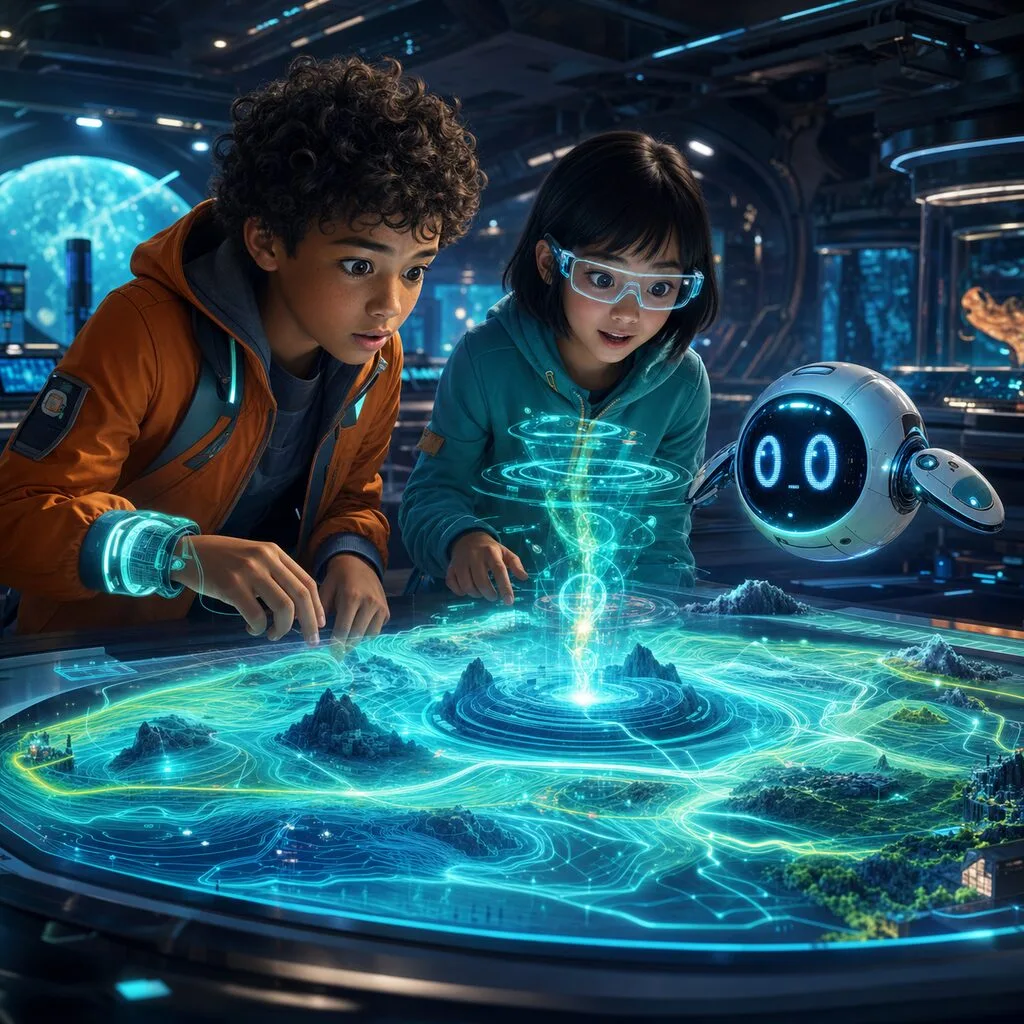
When the lab door closed behind the last member of the previous day's team, only the soft hum of screens and the bluish glow of holograms remained. Robo stood beside the table with his arms folded, staring impatiently at a strange map from a space game. Ami bent over it as carefully as if she were reading a secret code, while Pip floated above the projection panel like a small white sphere with shining eyes.
The map trembled again.
At first, only one dot moved. Then the green line, which had pointed right a moment before, shifted and angled slightly upward. At the edge, a tiny symbol lit up where none had been before.
“Did you see that?” Robo burst out. “That’s it! The map is leading us on.”
Ami adjusted her small augmented-reality glasses. “But not by chance,” she said calmly. “Watch the rhythm. It changes at the same interval every time.”
Robo leaned closer. His dark curls were a little untidy, and his brown eyes shone with excitement. The holographic wristband on his arm glinted; it could control several of the station’s systems.
“Even so, it’s something pulling us onward,” he said. “In a game, in the real world, anywhere. If there’s a new clue, we should investigate it.”
Pip gave a short beep. A row of tiny dots appeared in his LED eyes.
“Signal detected,” he announced. Then he paused, as if thinking, and added in his own way, “Not chaos. Pattern.”
Ami smiled. “Exactly. Something in the background is probably affecting the map. And it isn’t just a game.”
Robo folded his arms. “So what? Are we supposed to wait until the map explains where to go all by itself?”
“No,” Ami replied. “We need to find out what controls it.”
For a moment, the silence in the room was as thick as fog. Then the map trembled again, and a soft blue circle lit up in its centre. Robo held his breath. It looked almost like an invitation.
The station’s control room was colder. Screens covered the walls, displaying graphs, data, and faint signals from different parts of space. Captain Lyra was not there, so the children could focus on their own investigation. Robo would have happily taken apart half the panels and set off after the new clue at once. Ami, however, sat upright at the console, searching through archives the station had kept for years.
“We’re losing time,” Robo muttered. “Every minute matters.”
Ami looked up. “The right minute matters too. If we don’t know what the satellite is tracking, we could head in the wrong direction.”
“But the satellite is old,” Robo argued. “Maybe it doesn’t even work anymore. Maybe it’s just transmitting something out of habit.”
Pip flew between them and projected the same signal he had caught moments earlier onto a small screen. It did not look like a malfunction. It was precise, repeating, and strangely orderly.
“Automatic system,” Pip said in a low hum. Then he blinked briefly. “Without context.”
Robo rubbed his chin. “So you mean we first have to understand what the system is actually doing?”
“Yes,” Ami said. “And who knows? Maybe it isn’t a system that merely guarded the satellite. Maybe it’s tracking something much more important.”
Robo leaned back against his chair and sighed. It was clear that he wanted to race into space, into action, into adventure. But this time, he stopped himself.
“Fine,” he said at last. “First we check the data. But if we find a route, I’m going first.”
When Things Start to Change
Ami smiled. “That’s exactly what I expected you to say.”
Ami put on her augmented-reality glasses, and a transparent web of data lit up across the table before her. She examined the map, compared it with old station records, and checked archives with faint but still readable markings.
Robo watched her with interest. He had long known that Ami did not think the way he did. While he leapt from possibility to possibility and tried things out, she could stay calm and find patterns in chaos.
“Look,” she said after a while, pointing to a series of lines repeated at even intervals. “This isn’t random. The patterns return every few seconds. And here…”
An old satellite record appeared on the screen. Its name was damaged, but the numbers beneath it were still clear.
“That’s the satellite that should have gone inactive long ago,” Ami added.
Robo narrowed his eyes. “So it’s still alive?”
“Not in that sense,” she replied. “It’s more that it’s still transmitting something. As if it has an old program that hasn’t run its course yet.”
Pip moved closer to the records, and his LED eyes glowed blue. “Matching intervals,” he reported. “Mismatch only in position. Direction stable.”
Robo turned from her back to the map. The longer he watched it, the more he realised that Ami was not simply guessing. She was truly reading the image, the numbers, and the movement together. It was more than looking. It was like a game in which you could see several layers at once.
“So the map isn’t changing just to tease us,” he said more quietly. “It’s responding to data.”
Ami nodded. “To data from the satellite. And perhaps to something the satellite can see better than we can.”
Suddenly, Pip gave a brief warning tone. A new series of numbers began racing across a nearby screen.
“I detected a repeating signal,” he announced. “It isn’t just one packet of data. It’s a longer rhythm. It returns in exactly the same way.”
Robo quickly got to his feet. “And what does it show?”
Pip turned his projection. A location lit up on the wall, one that appeared in none of the station’s known archives. It was not a coordinate Robo or Ami remembered from the game. Nor was there any record of it in the regular mission files. It was only a clear trace in space, as if someone had pointed a finger at an empty place between the stars.
Ami blinked. “That place doesn’t belong to the game.”
“Nor to the station,” Pip added.
Robo leaned towards the projection. “Could it be Niva-7?”
Ami nodded slowly. “Maybe its surroundings. Or something connected to it.”
For a moment, silence settled over the room. Niva-7 was still the planet everyone was searching for, even though old records described it as lost. Everything connected with it mattered. And now it seemed that the game, the map, and the satellite were speaking with one voice.
Robo drew a breath. He no longer wanted to rush blindly ahead. He wanted to know why.
“So that old system isn’t just pointing to a random place,” he said. “It’s pointing to something that belongs to a bigger puzzle.”
“Yes,” Ami replied. “And that’s why we need to put the puzzle together properly.”
Pip blinked happily. “Together.”
Soon, they all moved to the main projection room. In its centre stood a large circular platform, with a holographic map floating above it. It was no longer chaotic. When Ami summarised what she had discovered and Pip added the precise signal, the map settled for a moment.
An Important Moment
The colours arranged themselves. The dots stopped trembling. The strange lines joined into one clearer point.
Robo smiled. “Look!”
A new coordinate node appeared on the map. It was bright and steady, as if it had finally decided to reveal the truth.
“That isn’t from the game,” Ami said softly. “And it isn’t in our archives either.”
“But it’s real,” Robo added.
Pip spun on his axis and projected a small message: “Unknown external source.”
“Do you think it’s near Niva-7?” Robo asked.
Ami thought for a moment. “Maybe. Or maybe it’s something that leads to it. Either way, it’s a new clue.”
Robo looked at her, then at Pip. At that moment, he understood that without Ami he would not have known how to read the map, and without Pip’s precision they would never have noticed the signal’s rhythm. He might have spotted the direction first, but the other two gave it meaning.
“Okay,” he said with a smile. “This time, I wanted to figure it out by myself. But you put it together more precisely.”
Ami gave him a gentle smile. “And you got us moving again.”
That was enough of an answer for Robo. It no longer mattered who had been right first. What mattered was that they had found it together.
Just when it seemed that the map had nothing more to reveal, a short pulse came from the star receiver. It was faint but clear. The hologram flickered for an instant, and another tiny light flashed at the very edge of the projection.
Pip immediately turned his sensors in that direction. “Another signal,” he announced. “Short. Precise.”
Robo laughed with excitement. “So it isn’t over! It keeps going!”
At that moment, Captain Lyra entered the room. Her short silver hair gleamed in the light of the panels, and her dark blue uniform with its green star emblem made her seem calm and steady. She looked at the children, the map, and the new point in the projection.
“I received your report,” she said. “And it looks as though you’ve discovered something important.”
Robo stood straighter. “The map reacts to an old satellite. And the satellite points to a new location outside the station archives.”
Captain Lyra considered this for only a second. “That was a good approach. You didn’t rush ahead without checking, did you?”
Robo looked at Ami. “I nearly did.”
Ami smiled. “But we stopped in time.”
The captain nodded. “That’s exactly how a good team works. You check the data, compare it, and only then take the next step.”
For a moment, they all looked at the small glowing point in space. It was not the end of the mystery. It was the beginning of another journey.
“Can we prepare for an expedition?” Robo asked.
Lyra smiled slightly. “Yes. But first I want to know more about that satellite. If it’s still sending data, we must understand why.”
Ami looked at the map. “And who programmed it to react to real data?”
The question hung in the air like luminous dust. Robo realised that this was the greatest mystery of all: not only where the clue led, but who had created it in the first place.
Pip blinked quietly, and the final words of the evening appeared on the screen: “To be continued.”
Robo smiled. He did not feel defeated. Quite the opposite. Everything was clearer than before. The map was changing, but it was no longer chaotic. There was something living, old, and important within it. And if they wanted to find the answer, they had to listen to one another.
What Comes Next
As they left the room, the small signal flashed softly once more somewhere in the distance. It was as if the universe were promising them that the next clue was already waiting.
And this time, they would find it together.