
Secrets of the Old School, Part 9: The Silent Map in the Floor

Ella and Thomas discover a silent map carved into the old school floor—and an owl-marked door hiding a forgotten room.
Secrets of the Old School, Part 9: The Silent Map in the Floor
The Story Begins
There was always something in the old school that did not reveal itself at first glance. Ella and Thomas already knew that. Under the stairs, they had found a brass key. Near the gym, they had opened old locker number 17. Each time, it felt as if the school were whispering another secret to them.
This time, a clue from the old Owls Club had led them to a hallway where children did not usually go. What was more, a small floor repair was due to begin there tomorrow. So if the boards held something important, they did not have much time.
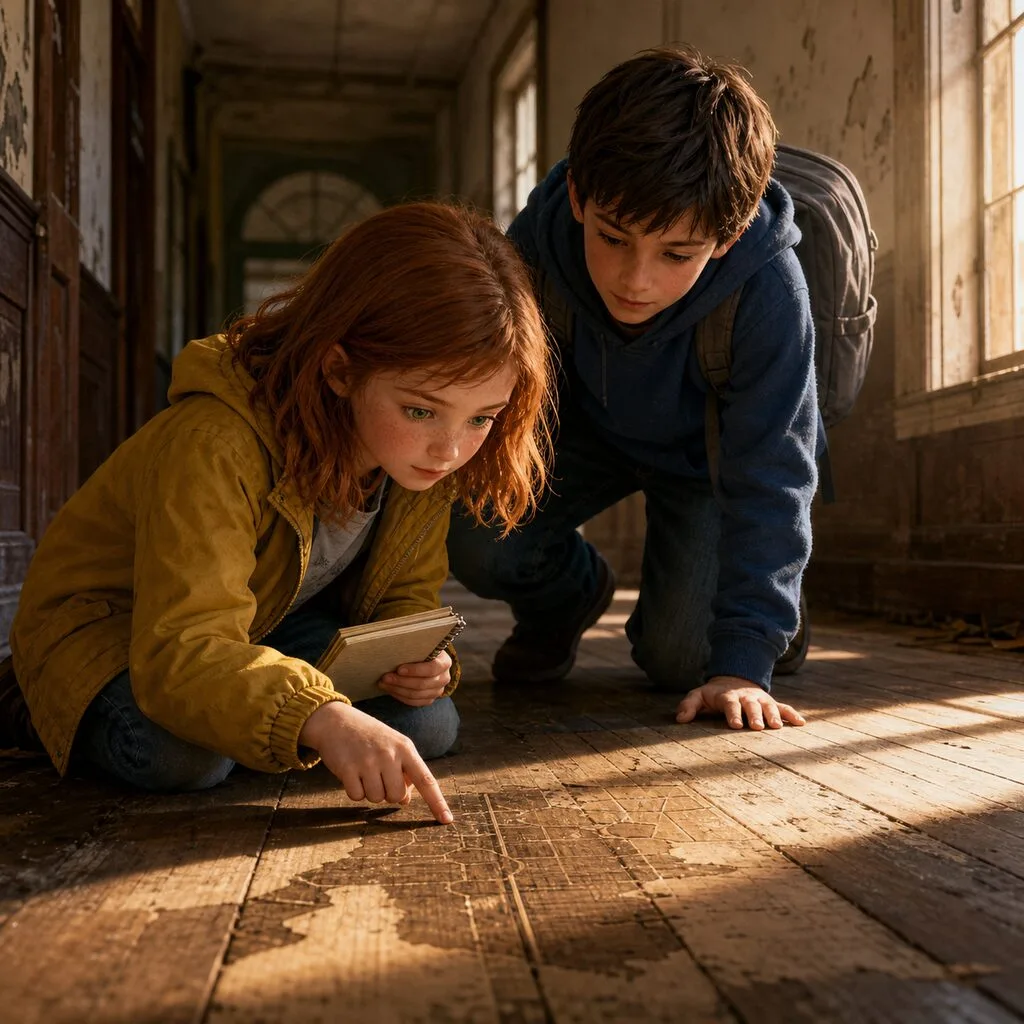
The hallway was narrow, quiet, and a little colder than the rest of the school. Soft afternoon light shone outside the window, but only thin stripes reached inside. The wooden floor was dark and polished by many years. Yet right in the middle of it, Ella noticed something strange.
“Thomas, look at this,” she whispered, bending down.
The boy stood beside her and studied the boards. At first, he saw nothing. Then he noticed that some boards were a little lighter and others darker. Tiny grooves ran between them, as if someone had once drawn them with a small tool.
Ella took out her little notebook and began to sketch what she saw. “The pattern starts here,” she said softly. “And it continues here.”
“It looks like a map,” Thomas said thoughtfully. “But not a paper one.”
The floor stayed silent, but that was the strangest thing about it. One groove pointed left, another right, and a third ended in a tiny arrow near the edge of a board. When the children looked more closely, they saw that the marks were not random. They had been placed to show something.
“Maybe it’s only decoration,” Ella said, but she immediately shook her head. “No, someone made this on purpose.”
Thomas knelt and measured the spaces between the marks with his fingers. “Look, they aren’t just beside one another. They’re in an order. As if they were leading someone.”
Just then, slow footsteps sounded behind them. The children turned, and when they saw Karl the caretaker, they felt better at once. He wore his green work jacket, and his eyes had that calm look, as if nothing in the old school could surprise him.
“So you’ve found the floor that wants to speak,” he said with a small smile.
Ella stood up. “Do you know what it is?”
Karl looked at the boards for a moment. Then he moved his hand just above one groove, as if he did not want to disturb a sleeping memory. “The school remembers more than people think,” he said quietly. “And sometimes it remembers what children wrote down long before you.”
Thomas frowned. “Was it some kind of game?”
“Maybe,” Karl replied. “Or maybe they were wayfinding marks. Long ago, people used marks like these when they needed to mark a path quietly. Not always on paper. Sometimes on wood.”
It was only a small answer, but it was enough to make the children even more curious. Ella wrote down the exact beginning of the pattern, and Thomas noticed that one board had a tiny notch on its edge.
“That’s strange,” he said. “It’s like a little sign.”
He carefully ran his finger along the edge, then smiled. “Wait… it’s an owl.”
Ella leaned closer. It was true. A tiny owl symbol had been carved into the edge of the board. It was neither large nor obvious. Anyone who did not kneel down could easily miss it.
When Things Start to Change
“Why an owl?” the girl asked.
Karl leaned against the wall and nodded. “For some pupils, owls were a sign of silence, watchfulness, and patient waiting. Long ago, small hideaways were created in the old school. Places where children read, wrote, whispered, and hid little things.”
“A secret club?” Thomas blurted out.
“Maybe a club,” Karl said. “Maybe just a quiet corner that helped someone. You’ll have to find that out for yourselves.”
The children exchanged a look. Excitement flashed in their eyes, but there was caution too. They did not need to run or make any sudden moves. It was enough to follow the clues.
At first, Ella thought the clearest arrow showed the right way. She wanted to head straight for the place where the boards met near the wall. But Thomas stopped her with a raised hand.
“Wait,” he said calmly. “Let’s take our time. If this is a map, we need to read all of it.”
The girl frowned for a moment, then nodded. Together, they counted boards, compared arrows, and wrote down the order of the marks. Meanwhile, Karl stood a little way off and let them think. He did not help them directly, but his quiet presence was like a light that did not dazzle.
After a while, Thomas pointed to one branch of the marks. “This would lead only to an empty wall.”
Ella nodded. “And here is the other path. This one goes farther.”
“Exactly,” Karl said. “Sometimes the most obvious direction is only a mistake. The right path is often quieter.”
The children moved a few steps farther. Another board with a faint groove lay on the floor, and just beyond it was an unremarkable old piece of wood that looked like an ordinary part of the wall. But when sunlight fell on it, they saw that it was the frame of a hidden door.
“Here!” Ella whispered.
Thomas placed his hand on the narrow edge. The door was not locked. It opened easily, as if it had been waiting for someone who noticed the right marks. Behind it was a small room that had seemed completely invisible from the hallway.
Inside, it was quiet. Truly, softly quiet—the kind of quiet found only in a room no one has entered for a long time. A few old slips of paper, a small box, and several little objects lay on the table. There was nothing shiny or large there. Even so, the room felt important.
Ella looked around slowly. “It looks like a hiding place,” she said softly.
“Or a place for thinking,” Thomas added.
A list of names lay on the table. Some were faded, while others could only be read halfway. Beside them were little notes, short sentences, and marks shaped like tiny arrows. Old buttons, a colourful ribbon, and one rolled-up slip of paper peeked out of the box.
Karl came in last. He did not speak at once. He only looked around with the expression of someone returning to a familiar place from long ago.
“So it’s true after all,” he said at last. “Former pupils hid notes and little objects here. They came quietly when they wanted to be alone or when they needed to keep something to themselves.”
Ella opened the slip of paper and carefully unrolled it. There was only one short sentence on it: “Don’t forget to follow the owl.”
“That owl is everywhere,” Thomas said with a smile.
“And maybe it’s more important than it seems,” Ella replied.
Then she noticed that part of one name on the list was missing. A piece of paper had been torn away, but something was written in tiny letters on the back of an old card lying beside it. Thomas turned it over and read aloud: “It belonged to those who liked to listen to silence.”
An Important Moment
The children looked at each other. It was not the whole answer. They still did not know exactly who the room had belonged to. But the new clue was clear and gentle. It pointed to a group of pupils who may once have liked to sit in silence, write notes, and hide small secrets from the noise of the school.
Karl clasped his hands behind his back. “You only need to listen slowly,” he said.
Thomas smiled. “So we found the right direction.”
“Yes,” Karl nodded. “And you found it together.”
Ella closed her notebook and put away her pencil. She felt that peace had settled over the room, as if something had finally moved into its proper place after a long wait. There was no need to prove anything more. They had discovered that the pattern in the floor was truly a map. They had also learned that a quiet hideaway full of old memories lay behind the hidden door. Best of all, they had uncovered it without arguing or rushing.
When they returned to the hallway, the warm light had grown softer. The little owl on the boards beneath their feet gleamed for just a moment, as if it wanted to tell them that their journey would continue. The children stopped once more by the door, but this time they felt no tension. Only curiosity.
“Do you think there’s more in there?” Ella asked.
Thomas adjusted the strap of his backpack. “Definitely. And now we know where to look next.”
Karl locked the door behind them, but only halfway. Then he gave the children a calm smile. “Sometimes it is enough to find the right question,” he said.
Ella laughed. “And we have quite a few questions.”
“Exactly,” Thomas added.
They left the hallway slowly. Not because they were afraid, but because they wanted to remember every detail. The quiet floor. The tiny grooves. The owl symbol. And the feeling that the school had once again allowed them to peek a little deeper into its memories.
Behind the hidden door, the room remained, waiting for another discovery. Somewhere inside it, perhaps on another card or in an old paper, there might be an answer to the question of who had owned this quiet place in the old part of the school.
Ella and Thomas did not know yet. But they did not mind at all. The mystery had opened only a little, and that was enough to make them want to continue. What was more, they now had a new clue: the little owl carved into the edge of the board.
And it would surely lead to the next story.