
The Big Mistake Club, Part 3: The Day of Swapped Name Tags

A gust swaps the children’s name tags, and Adam, Ela, and Samo must rescue a school event before the corridor turns into a maze.
The Big Mistake Club, Part 3: The Day of Swapped Name Tags
The Story Begins
That morning, paper, ribbons, and secret plans rustled in Mrs Benková’s classroom. On the teacher’s desk lay a big list of jobs, and beside it stood a box of colourful name tags on strings.
“Today we have a small school event for several classes,” said the teacher. “There will be displays of drawings, a short programme, and games in the corridor. Every helper will get one simple task.”
Adam reached for the list. “Simple? Great. I can handle three simple tasks at once. Or five. It depends on whether chairs count separately.”
Ela read her name tag and tilted her head. “One card says ‘prepare supplies’ and another says ‘supplies prepared’. Are those two different things?”
“Maybe one card works in the past tense,” Samo said seriously.
Mrs Benková smiled. “The name tags only help you know where to go. They are not magic commands.”
Samo touched the string around his neck. “So I can change places? Even if my name is on it?”
“Of course,” Mrs Benková nodded. “A name tag is not fate.”
Adam was already at the door. “Then let’s save the event before it needs saving!”
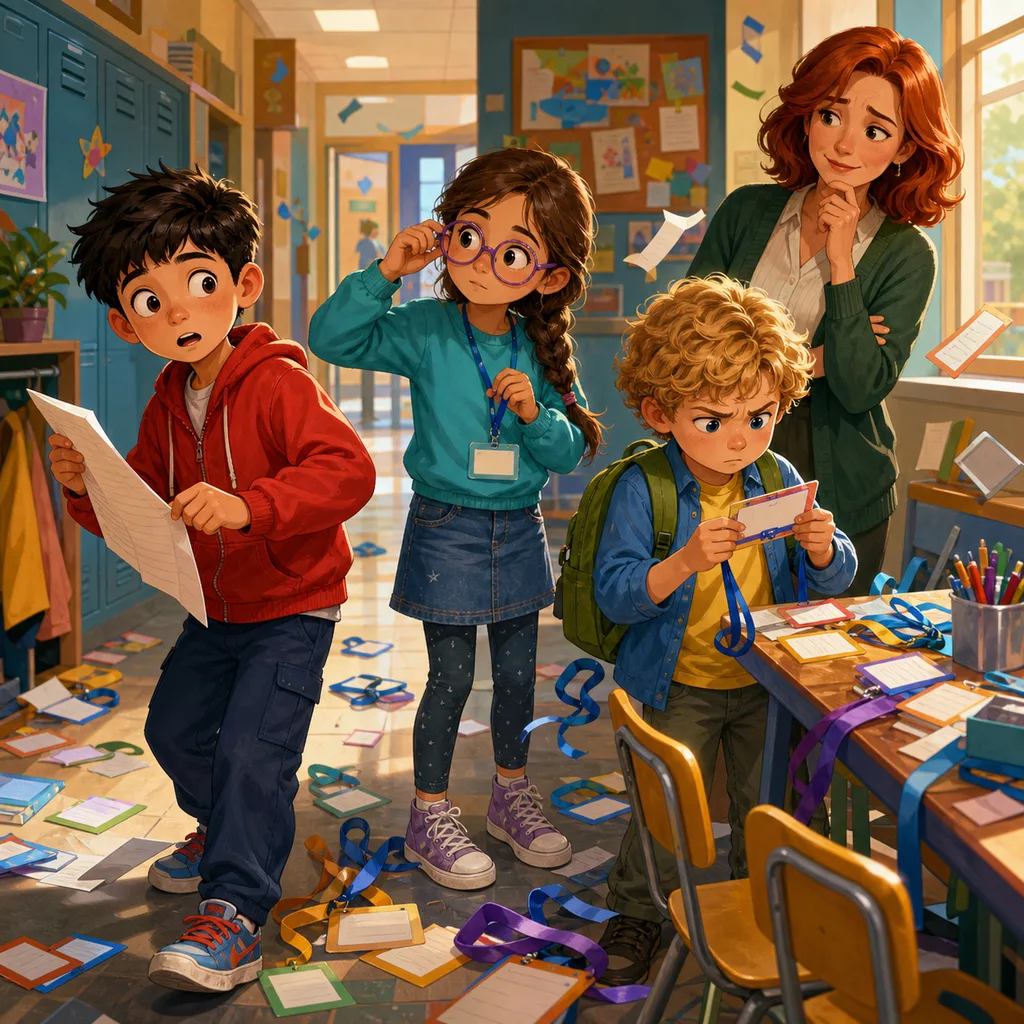
The corridor was busy. On a table stood boxes of pencils, paper arrows, ribbons, small cardboard numbers, and balloons. Someone opened the storeroom door, someone else brought another pile of name tags, and just then a draft swept across the table.
The cards lifted, spun around, and fell to the floor.
“Don’t run away!” Samo called after them. “You haven’t signed out yet!”
Adam bent down and grabbed the longest sheet of paper he could find. It was full of bullet points, arrows, and little notes. At the top it said: MAIN PREPARATION PLAN.
“Aha,” he said happily. “This is definitely for me.”
Ela picked up a card with a large microphone symbol. “And this is definitely for someone who likes speaking in front of a crowd.”
Samo pulled another slip from under a chair. He read slowly: “Put small things in the right place. Then come back with what belongs together.”
He thought for a moment. “That sounds like a job for a very careful person.”
“So, for you,” Ela said.
“Thank you. I will be careful until the very last staple.”
Meanwhile, Mrs Benková was helping the first graders with their coats. The three friends looked at one another, nodded, and each set off in a different direction along the corridor.
Adam’s plan began with the line: MOVE THE CHAIRS. Right below it was: CHECK THE BALLOONS. Then came: LAY OUT THE RIBBONS, PREPARE THE SIGN, ANNOUNCE THE ORDER, CHECK THE PROPS.
“Perfect,” he declared. “First I’ll do everything.”
He dragged two chairs towards the door, then noticed that the balloons by the window were a little crooked. He left the chairs in the middle of the corridor, straightened the balloons, and then spotted the ribbons. They seemed too short, so he carried them closer to the stage. After that, he found the sign and wrote WELCOME! on it in big letters.
A moment later he moved it again, because he thought more people would see it near the door. While he was moving it, he bumped into the arrows on the floor.
“These are pointing the wrong way,” he decided. “Or the right way. It depends on where we want to go.”
Ela came over with her microphone tag and watched him over her round purple glasses.
“Adam,” she said, “your plan has more points than our class has crayons.”
“Don’t worry. I have a system.”
When Things Start to Change
“Where is it?”
The boy looked around at the chairs, arrows, ribbons, and the sign, which was now pointing towards the storeroom. “It’s moving right now.”
Meanwhile, Ela arrived outside the hall. Children from the second grade stood by the microphone, waiting for someone to tell them where to stand. One boy held a paper clown, while a girl with two braids held a large box of props.
“Are you the announcer?” an older pupil asked her.
Ela looked at the card with the microphone. “Today, apparently, I am. The card chose an adventurous life.”
She switched on the microphone. It gave a short squeak. Ela did not move at all.
“First graders with paper animals, go to the blue wall,” she said calmly. “Put your bags under the coat hooks. Put the props on the table by the window. Not on the chairs, because the chairs will soon have a programme of their own.”
The children laughed and moved in the right direction.
“And who has a name tag with a star?” she continued. “You help with the games. If you do not have a star, you do not need to draw one. Stars are not tickets to Mars today.”
The line organised itself so quickly that Mrs Benková paused by the door. Ela did not speak loudly, but every word was as clear as an arrow on a clean floor.
Meanwhile, at the supply table, Samo arranged everything into little piles. Pencils by colour. Erasers by size. Ribbons by length. Cardboard numbers by whether they looked as if they belonged together.
“One is alone,” he muttered. “Two has two. That is easy. But seven and eight only pretend to be friends.”
He found a ruler and an eraser lying next to each other. He picked them up, one in each hand.
“Do you belong together?” he asked.
Of course, they did not answer.
“I’ll take silence as yes.”
So he put them into one box marked WRITING. Then he spotted three small bells. The card had said to put small things in the right place. Samo remembered hearing a sound near the microphone, so he carried the bells to the hall.
“These belong with the sound,” he explained to Ela.
“Samo, those are bells for the corridor game.”
“Oh. Then they belong in the corridor.”
He ran back. On the way, he saw the paper arrows that Adam had turned around. Since arrows belong with directions, he carefully placed them by the storeroom door.
Ten minutes later, the corridor had become a strange map. Chairs stood in a row in front of the storeroom. Balloons hung by the notice board. The props were by the window, apart from three bells that were travelling back and forth. And Adam had, besides his name tag, four cards, two ribbons, and the list around his neck, fluttering against his red hoodie like a little paper sail.
Then it was time for the programme to begin.
The first graders waited by the blue wall. The second graders stood by the door, though they were supposed to be at the games. Someone was looking for number three. Someone else held the WELCOME! sign and did not know where to put it. From the hall, a voice called, “Can we go now?”
Adam raised his hands. “All right! Everyone, take three steps to the right, then—”
“No,” Ela interrupted softly but quickly. “If they take three steps to the right, they’ll walk into the storeroom.”
Samo ran up with a box. “I found number three. It was with number six, but I think they only met by accident.”
Adam looked at his plan. Then at the children. And finally at the chair with a ribbon, an arrow, and one lonely name tag hanging from it.
An Important Moment
“I think we mixed things up a little,” he said.
“A little?” Ela raised an eyebrow. “The corridor thinks it’s a maze.”
Mrs Benková came closer. She did not look angry. She simply looked at the three of them and asked, “What do you need first?”
That was a better question than all of Adam’s quick ideas put together.
Samo pulled the club notebook from his green backpack. Its cover had an old ink stain and a large pencil drawn in one corner. Until now, they had mostly written funny rules in it after their mistakes. Now Ela opened it to a clean page.
“A quick rescue plan,” she said. “First, we work out what begins right away.”
“The welcome,” answered the older pupil by the microphone.
“Then the bell game,” Samo added.
“And after that, the drawings,” Adam said, more slowly now. “So we do not need to move the chairs at all right now.”
“Excellent discovery,” Ela remarked. “The chairs will be delighted.”
The boy did not frown. Instead, he rolled up the long plan. “I’ll put the arrows back and call the children into the right line. Just one group at a time.”
Ela took the microphone. “First graders, stay by the blue wall. Second graders, please go to the corridor games. If you are holding a prop, keep holding it. If you are only holding your nerves, you may let them go for a moment.”
Samo put the boxes on the table and pointed with his finger. “Bells here. Numbers here. Pencils there. The eraser and ruler can stay together, but only in the writing box.”
“Why?” Adam asked as he hurried past.
“Because I asked them.”
Soon the props were on the right table. The arrows pointed towards the hall again. The WELCOME! sign stood by the entrance, where everyone could really see it. Adam did not organise the whole school, only three important things. And that was exactly enough.
The programme began a little late, but nobody minded much. Ela welcomed the classes, Samo handed the bells to the right group, and Adam held the door so no one got tangled in the ribbons.
After the event, everyone returned to the classroom. Mrs Benková put the remaining name tags on a desk.
“It seems these belonged to someone else,” she said.
Adam found his own. “So the main preparation plan was not mine?”
“No,” said the teacher. “It was for three helpers.”
Ela unclipped the microphone name tag. “Too bad. I was getting used to the card doing whatever it wanted.”
“And I got sorting,” Samo said happily. “That fits. But next time, I’ll first ask whether things really have known each other since birth.”
At last, they wrote a new rule in big letters in the club notebook: A NAME TAG IS NOT FATE.
Adam laughed. “Today I almost ran half the school.”
“At least you noticed where everything belonged,” Ela said.
Samo looked at their proper name tags. “Can laughter be sorted by name tags too?”
Mrs Benková closed the box of cards. “I think that sorts itself.”
And when laughter filled the classroom, nobody needed to know exactly who it belonged to.
To be continued…