
The Unnumbered Corridor, part 12: When the Corridor Closed

Nora, Filip and Ben find Klara's instructions in the building records. After checking three old photographs with the families and returning the originals,
The Unnumbered Corridor, part 12: When the Corridor Closed
The morning sun lit the wall on the ground floor. There was no crack or hollow in it, although a corridor with faded green walls had led through that spot during the night.
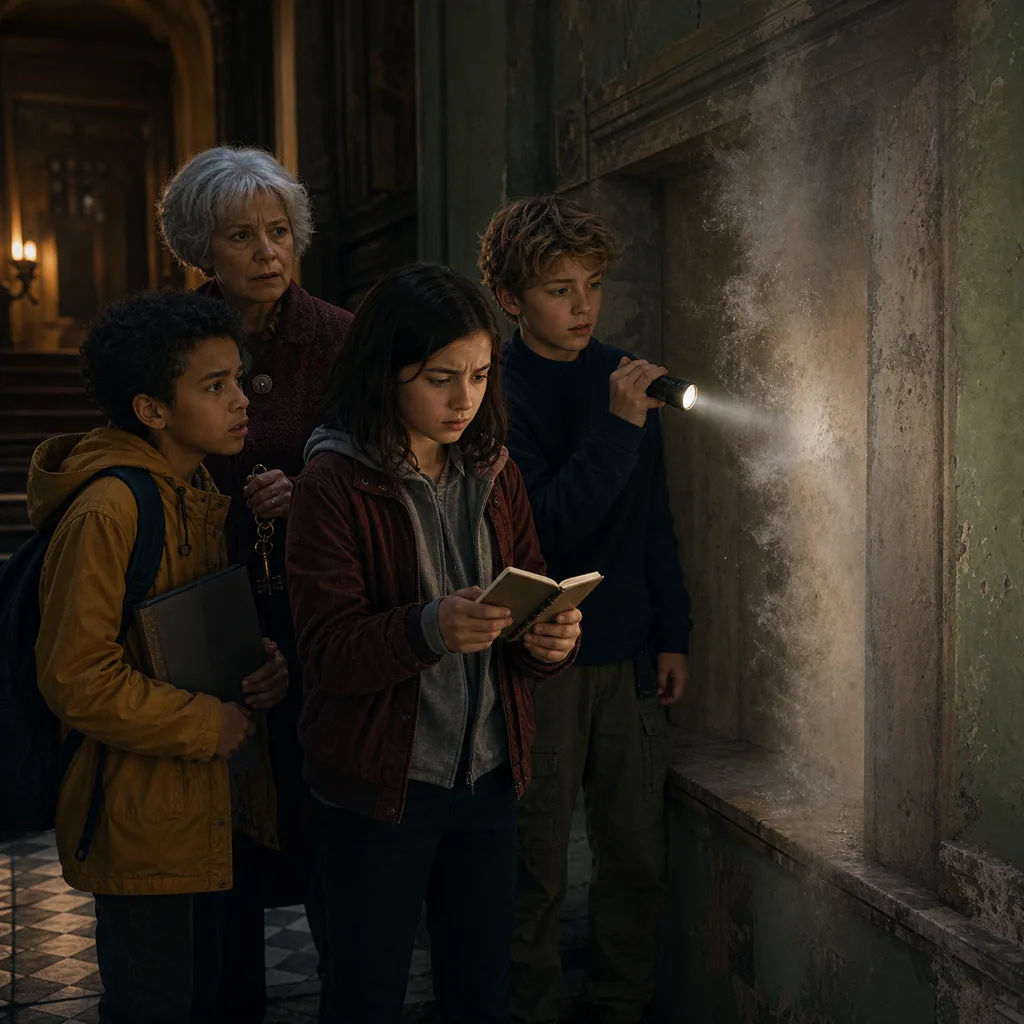
Nora stopped in front of the wall. She felt for her small paper notebook in the pocket of her rust-red jacket and opened it at her latest notes.
Anna Malíková. Peter Hruška. 14 June 1984.
“At least this hasn't disappeared,” she said.
Ben touched the wall with one finger, then quickly pulled his hand away.
“Please, let's not try to bring it back.”
“We won't,” Mrs Richterová promised. She chose a narrow key from her brass key ring. “We have names and a date. We can use those to search the records.”
Filip looked at the smooth wall. “I'd rather deal with paper than more doors.”
Nora nodded, although she missed the voice from Klara's unfinished recording. They had no player and no way to listen to it again. But the clue led to the records room, and now they finally knew what to look for.
Mrs Richterová took them there through an ordinary passage. She fixed the door open with a doorstop and switched on the light above the table. Inside, the room smelled of dust, paper and wooden shelves.
A copier stood by the window. Next to it lay a pack of clean paper.
Later, they found a heading in the register: Demolished Wing — 14 June 1984. Beneath it were both names from the notebook and an envelope number.
“They match,” Nora breathed.
Mrs Richterová took three photographs, an unfinished list, a receipt and a sheet called Copy of the Message from the envelope. The name Klara appeared below the message.
Nora compared the signature with the one on the receipt. The same long K. The same sharp ending on the letter a. The rest of the handwriting matched too.
Then she read aloud:
“Before the building work, I put the photographs away so that people's names and stories would not be lost. Return the originals to the families only after checking them. Make copies for the corridor. Place them on the shelf just inside the entrance, from left to right: 1 — Anna at the sewing table; 2 — Peter with a book by the window; 3 — a child with a cloth bird in the yard, owner still to be checked. Then go outside and finish reading the last sentence: The memories no longer have to wait here. They are home, among people. Signed: Klara.”
Below the message was a drawing of three holders. Nora copied the drawing and the whole message into her notebook, checking every line.
The first two photographs had names and the date they already knew. The third had no name. Beside it on the list was written: Yard — Anna/Peter? Check.
Meanwhile, Mrs Richterová made a test copy of a blank form. The paper came out clean and straight.
Suddenly, the door handle clicked behind Ben.
It slowly moved down, although the doorstop held the door open and nobody stood beside it.
The boy spun round and stepped back towards the others. Nora gripped her pencil so tightly that her fingers hurt.
Mrs Richterová checked the empty passage. “Stay by the table.”
Above the door, a metal air vent rattled.
“A draught,” Filip whispered. Then he frowned. “The vent, I mean. I can't explain the handle.”
They left the door open. Only when Ben nodded did they continue.
They spent longer looking at the third photograph. Both families knew the yard, and no flat number could be seen in the picture. The child held a bird whose left wing was lighter than its right.
“It could belong to Anna's family,” Filip suggested.
“It could,” said Nora. “But Klara wrote that we should check.”
Because of that, Mrs Richterová searched the old household records and connected them with people who lived in the building now. Then she invited Anna's granddaughter and Peter's son to bring their family albums. Both agreed.
When they arrived, the photographs were still lying face down.
“Do you remember a picture taken at a sewing table?” Nora asked Anna's granddaughter.
“With a striped curtain behind her?” The woman opened her album. “Grandma said she made it from leftover pieces of cloth. That's why the stripes were different widths.”
The curtain and the small box beside the sewing machine matched in both pictures.
Meanwhile, Peter's son described a book with a dark, repaired corner. His album held the same photograph as the second one from the envelope.
“Dad lent it to anyone who stopped by,” he explained. “He always said the book had to come back, even if the story stayed in your head.”
Ben smiled, but he grew serious again when they reached the third photograph.
“What about this bird?”
Anna's granddaughter turned a few pages. She stopped at exactly the same picture. Under it were the words: Mum Anna and my cloth bird.
“This child is my mother. My grandmother Anna is standing beside her. The bird's wing tore, and Anna repaired it with a different cloth.”
They placed the photographs side by side. The lighter left wing, the hanging beak and the shadows on the paving stones all matched.
“Mum told me about it,” the woman added, running a finger along the edge of the album. “The toy itself hasn't survived.”
Ben moved his water bottle away so that no water could drip onto the photographs. Suddenly, they seemed much too important to be treated as an ordinary pile of paper.
Finally, Mrs Richterová made three copies and wrote numbers on their backs. They compared each one with its original. She gave pictures one and three to Anna's granddaughter, and picture two to Peter's son. Both signed the correct lines on the list.
Ben received a paper folder containing the copies. The families took the originals home.
After putting the documents back into the envelope, they left the records room by the ordinary passage. That evening, they met again on the ground floor. It was already dark outside, but the ceiling lights shone on the same solid wall.
Filip unclipped his torch from his belt and tested it. The beam crossed the floor as far as Mrs Richterová's door.
“This works even without the building's electricity,” he said.
Nora opened her notebook at the drawing. Ben checked the back of each copy and arranged them in order: one, two, three.
“If the corridor appears, we'll only go to the shelf by the entrance,” Mrs Richterová said. “If the opening changes or the lights go out again, come straight back. Leave the photographs there if you have to.”
“Even if I say stop?” Ben asked.
“Then too.”
Nora nodded. “No more doors.”
They also agreed to leave if nothing happened. Nobody would touch the light switches or the wiring. They did not know how long the corridor might stay open, so they practised everything in front of the wall first.
For a while, the only sounds were the lift and the clink of a spoon from one of the flats.
Then the lights went out.
Nora held her breath. Filip's torch still shone on the floor, and nobody moved.
A few moments later, the electric lights came back on. But the wall was no longer whole.
A greenish entrance had opened in its place. Just inside stood a shallow shelf with three empty holders.
Filip raised the beam. Nora compared the holders with her drawing: one, two, three, from the left. It would take only one step to reach the shelf.
Ben was already passing over the folder when two footsteps sounded right behind him.
Tap. Tap.
He froze with his hand in the air. Everyone else was standing in front of him.
Together, they turned. The bright ground-floor passage was empty all the way to the stairs.
“Did you hear that?” he whispered.
“Yes,” Nora answered.
Filip pointed his torch behind Ben. “Sound can travel through the building. But I don't know why it sounded so close.”
Mrs Richterová put a hand on Ben's shoulder. “We can leave.”
The boy looked at the shelf, then at the clear path to her flat.
“Just those three. Like we agreed.”
Filip briefly checked his phone. It had no signal. He put it away. Their instructions were on paper, and Mrs Richterová was standing with them.
Nora stepped up to the shelf. Her knee was shaking, so she planted her foot firmly on a tile and took the first copy.
Anna at the sewing table fitted into the left-hand holder.
A slow footstep sounded deep inside the corridor.
The girl did not look round. Filip stayed at the entrance, lighting both the shelf and the way back. Ben passed the second picture from the ordinary passage.
Peter with his book went into the middle holder.
Another footstep sounded closer.
A tall shadow moved across the distant green wall. Filip moved his torch to the right, but the shadow moved the other way. Nora felt cold beneath the sleeves of her grey hoodie.
“I can see it,” her friend breathed. “I don't know where it's coming from.”
But the space beside the shelf was still clear, and Nora had an open way back behind her. She reached for the third copy, hesitated, then reached again, as if she had forgotten what she was doing.
Ben held the folder firmly with both hands.
“The one with the bird. It's number three.”
She looked at her notebook, then at the back of the photograph. The numbers matched. Carefully, she slipped the picture into the right-hand holder.
The footsteps continued. Now the pauses between them were shorter.
“Back to me,” Mrs Richterová called.
Nora and Filip stepped back into the ordinary passage. The older woman counted them by touching their shoulders: Nora, Filip, Ben. Everyone was outside. Nobody had followed the shadow.
The three photographs still stood on the shelf. The loudest footstep yet came from the green half-darkness. For a moment, Nora felt that something had stopped right beside the entrance.
Her mouth was dry. Her notebook shook so much that the letters seemed to jump.
Ben held the empty folder against his chest. Filip kept his torch beam on the entrance, while Mrs Richterová stood between the children and the opening.
Nora swallowed. Her first sound was almost too quiet to hear, but on her second try she said the whole sentence:
“The memories no longer have to wait here. They are home, among people.”
All four watched the shelf. For a moment, the photographs were still clearly visible. Then the green walls and the holders disappeared. A solid wall replaced the opening.
At that same moment, the footsteps stopped.
Nora stood with her mouth open. Only when the wall was whole did Mrs Richterová lead them a little farther away.
“That wasn't just electricity,” Filip said quietly.
Nobody argued. Ben slowly loosened his grip on the folder. Nora wrote down that they had all been outside when the corridor closed.
The next morning, they returned by the same ordinary passage. Sunlight fell on the unbroken wall. Neither the corridor nor the shelf was there.
Near the bottom left edge, Nora noticed a tiny white curved mark. She held the printed millimetre scale from her notebook beside it. It was about three millimetres wide.
“Was it here before?” Ben asked.
“I didn't notice it,” she answered. “That doesn't mean it wasn't here.”
Nobody scratched the wall. The girl only drew the mark.
Mrs Richterová confirmed that the originals were still with the families. Nora added today's date and wrote underneath:
“14 June 1984: Anna Malíková and Peter Hruška are confirmed in the register for the demolished wing. Anna's family received originals 1 and 3; Peter's family received original 2. The copies were placed from left to right, 1–2–3. We finished reading Klara's message, and the corridor closed when we were all outside. This morning, the wall is still whole. Near the bottom left corner is a white curved mark about three millimetres wide. We do not know where it came from.”
Then she closed her notebook. They were not planning another attempt.
As they walked away together along the sunny passage, Ben's empty paper folder rustled softly.