
kľúč z ozveny je nová časť seriálu Robo a stratená planéta, pripravená ako dvojjazyčný detský príbeh v slovenčine aj angličtine.
kľúč z ozveny: začína sa príbeh
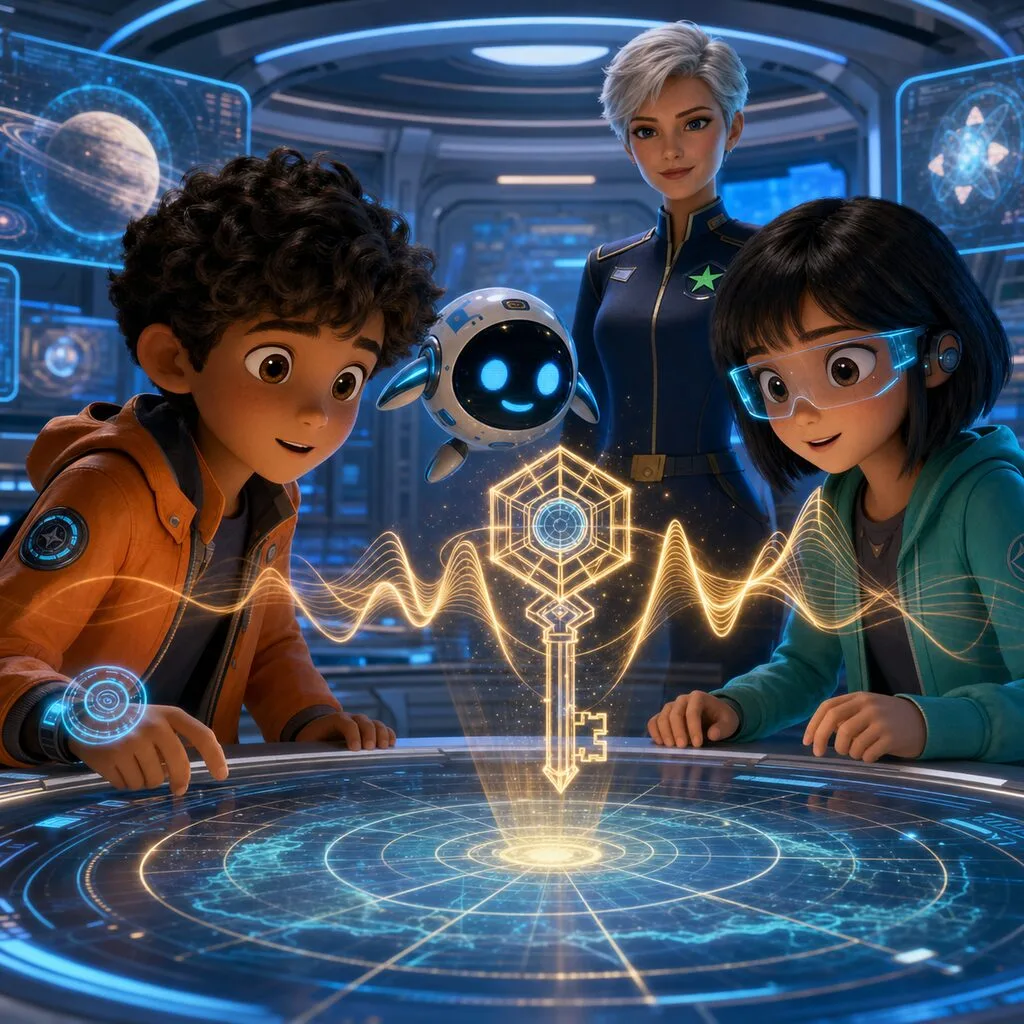
V spoločnej hernej miestnosti na výskumnej stanici bolo ticho len naoko. Hologram starej vzdelávacej hry sa jemne vlnil nad stolom a modré svetlá na stenách pulzovali ako pokojný dych stroja. Robo sa naklonil dopredu, jeho tmavé kučery sa takmer dotkli okraja projekcie. Na oranžovej veste sa mu zaleskli drobné odlesky. Ami stála vedľa neho, na nose mala malé rozšírené okuliare a v ruke držala poznámkový panel. Pip levitoval medzi nimi, biela a modrá guľa s malými bočnými plutvičkami a svietiacimi očami.
„Tak poďme zistiť, čo táto stará hra skrýva,“ povedal Robo nadšene. „Možno je tam ďalšia stopa k Nive-7.“
Ami sa usmiala, no už pritom prstom kreslila do vzduchu malé čiarky. „Najprv si všimnime, čo sa zmenilo. Hra je rovnaká ako predtým, ale pridala nový zvukový režim.“
Pip vydal krátke pípnutie. Z reproduktora sa ozval zvláštny tón. Potom prišla ozvena. Nebola to obyčajná ozvena. Vrátila sa až po chvíli, akoby hľadala správnu odpoveď.
Robo stisol pery. „To je zvláštne. Reaguje neskoro.“
„Nie neskoro,“ opravila ho Ami. „Čaká na niečo presné.“
Na obrazovke sa objavil signál v podobe troch farebných pruhov. Hra vyzvala tím, aby ho porovnal so skutočnými dátami stanice. Vedľa projekcie sa otvorila tabuľka so záznamami o tónoch, časoch a smeroch. Bolo to ako malá logická hra, len omnoho dôležitejšia.
Robo skúšal prvú kombináciu. „Toto bude ono.“
Ozvala sa len slabá chyba. Modrá ozvena sa nerozsvietila.
„Skúsime ďalšiu,“ navrhla Ami pokojne.
Chlapec sa pousmial. „Môžem aj rýchlejšie. Veď stačí hádať a skúšať.“
Ami si založila ruky. „Ale ak budeme hádať, strácame čas. A možno aj stopu.“
Pip preletel vyššie a premietol tri malé kruhy. Každý mal inú farbu. Zrazu vydal sériu tónov, ktoré sa podobali na prvý signál, ale nie celkom. Na paneli sa ukázalo: zhoda len na jednej vrstve z troch.
„Vidíte?“ ozval sa Pip svojím veselým syntetickým hlasom. „Jedna vrstva správna. Dve nesprávne. Úspešnosť nízka.“
Robo sa zasmial. „Tvoje čísla sú vždy také priamočiare.“
„To je užitočné,“ povedala Ami. „A Pip má pravdu. Musíme porovnávať dôkladne.“
Neskôr sa presunuli bližšie k veľkej projekčnej stene. Na nej sa rozsvietili záznamy zo stanice. Tón, čas, smer. Tón, čas, smer. Všetko bolo zapísané v dlhom rade a vyzeralo to jednoducho, no len dovtedy, kým sa človek nepokúsil nájsť správny vzor.
Robo stíchol. Hoci ho lákalo skočiť rovno k výsledku, pozorne sledoval, ako Ami triedi údaje. Nepohybovala sa rýchlo, ale presne. Každý záznam porovnala s tým predchádzajúcim, potom označila tie, ktoré sa opakovali príliš podobne, a nakoniec upozornila na malý rozdiel v jednom starom zázname.
„Tu,“ povedala ticho. „Tento signál bol neskôr opravený. Ak ho použijeme, ozvena sa nevráti správne.“
„Ale rozdiel je iba drobný,“ namietol Robo.
„Práve drobnosti rozhodujú,“ odvetila.
Pip sa priblížil k obrazovke a jeho LED oči na okamih zablikali. „Potvrdzujem. Rozdiel malý. Význam veľký.“
Chlapec prikývol. Tentoraz nepovedal nič. Len sa postavil vedľa Ami a nechal ju viesť porovnanie. Spolu vytvorili nový rad. Tón sa zhodoval. Čas sedel. Smer bol správny. A potom sa ozvala ozvena — tentoraz jasná, čistá, modrá.
Z hĺbky hry sa odrazil svetelný kruh. „Výborne,“ ozvalo sa zo systému. „Pokračujte k archívu.“
Deti na seba prekvapene pozreli.
„Archív?“ vyhŕkol Robo. „Takže to nebola len hra.“
Ami už mala pripravený ďalší panel. Na ňom sa rozsvietila mapa výskumnej stanice. Modrý bod pulzoval pri staršej sekcii budovy. Ozvena ich viedla presne tam.
Cestou chodbou bolo počuť len ich kroky a tiché bzučanie stanice. Pri archívnej sekcii sa pred nimi objavili veľké kruhové dvere so svetelným zámkom. Červené kontrolky svietili pokojne, ale neústupne. Na displeji sa ukázal krátky text: Prístup iba po bezpečnostnom teste.
Pred dverami stála kapitánka Lira. Mala krátke strieborné vlasy, tmavomodrú uniformu a na hrudi znak zelenej hviezdy. Jej hlas bol pokojný, no pevný.
Keď sa veci začnú meniť
„Vidím, že ste sem prišli po správnej stope,“ povedala. „Archív sa neotvára rýchlo. Len bezpečne.“
Robo si premeral dvere. „My to zvládneme.“
„Viem,“ odvetila kapitánka. „Ale len ak budete postupovať pokojne a bezpečne.“
Ami prikývla. „Budeme si dávať pozor.“
Pip sa zatočil vo vzduchu. „Pozorovanie potvrdené.“
Kapitánka Lira im podala prístupový panel, ktorý neotváral zámok priamo. Namiesto toho spustil tri logické úlohy na kontrolu dát. Na stene sa rozžiarili tri okná.
Prvá úloha znela: zoradiť signály podľa času.
Druhá: označiť, ktoré záznamy sú staršie a ktoré boli opravené.
Tretia: nájsť bezpečný vzor, ktorý sa opakuje vo všetkých správnych údajoch.
„To je ako malá skúška trpezlivosti,“ poznamenala Ami.
„A pozornosti,“ dodal Pip.
„A mojej neobľúbenej pomalosti,“ zamrmlal Robo, hoci sa už usmieval.
Prvý rad zvládli rýchlo. Druhý bol ťažší. Niektoré údaje mali rovnaký čas, ale odlišný smer. Iné vyzerali novšie, no v skutočnosti len prepisovali starší záznam. Ami si všimla nenápadný znak pri jednom z nich — malý trojuholník v rohu dátového poľa.
„Toto je opravená verzia,“ vysvetlila. „A tamto je pôvodný záznam.“
Robo sa naklonil bližšie. „Keby sme si to nevšimli, išli by sme zlým smerom.“
„Presne tak,“ odpovedala.
V tretej úlohe sa objavil bezpečnostný vzor. Opakoval sa vo všetkých správnych záznamoch, ale len vtedy, keď sa čítali vo vrstvách. Hore bol tón, uprostred čas a dole smer. Pip rýchlo porovnal všetky tri vrstvy a nadchol sa: „Zhodný vzor nájdený! Zhodný vzor nájdený!“
Dvere archívu sa otvorili s hlbokým, tichým hukotom.
Vo vnútri bola miestnosť plná holografických políc a starých záznamov. Svetlo bolo jemné, modro-biele, a všetko pôsobilo starostlivo uložené. Uprostred stál hlavný terminál, na ktorom sa po ich úspechu rozžiarila nová dátová vrstva. Bola staršia než zvyšok záznamov a čakala, až ju niekto prečíta správne.
Robo zadržal dych. Na obrazovke sa objavilo meno: Niva-7.
„Takže to predsa nie je len legenda,“ povedal potichu.
Ami sa naklonila bližšie. „Pozri na dátum. Toto je starý projekt. Vzdelávací projekt.“
Na monitore sa zobrazila poznámka: Niva-7 bola zaradená do programu skúmania a učenia. Nie ako mýtus. Ako cieľ.
„To znamená…“ začal Robo.
„Že o nej niekto vedel dávno pred nami,“ doplnila Ami.
Medzitým Pip premietol ďalší úsek záznamu. Niektoré riadky boli vyblednuté, iné novšie. Dáta sa skladali z viacerých vrstiev a ak ich človek čítal narýchlo, videl len chaos. Ak však postupoval pomaly, objavil poriadok. V jednej vrstve bola bezpečnostná stopa. V druhej poznámka o zvláštnom súradnicovom vzore. V tretej upozornenie, že treba byť opatrný, pretože signál využíva viac vrstiev dát a nedá sa pochopiť jedným pohľadom.
Kapitánka Lira prišla bližšie k terminálu. „Tento archív je citlivý. Preto reaguje len na správne poradie a overené údaje. Nie na rýchle skratky.“
Robo sa pozrel na Amu. „Mala si pravdu.“
Dievča sa usmialo. „A ty si mal nápad ísť ďalej. Bez toho by sme sa sem nedostali.“
Chlapec sa trochu začervenal. Bolo príjemné počuť, že aj jeho nápady sú dôležité. Lenže tentoraz pochopil, že dobrý nápad musí ešte prejsť kontrolou.
Pip sa zrazu rozžiaril. „Nová zhoda. Ozvena a bezpečnostný vzor sú identické.“
Na obrazovke sa objavil symbolický kľúč — nie kovový predmet, ale geometrická kombinácia svetla a tónov. Kľúč z ozveny. Keď sa uzavrel, v strede terminálu sa otvorila skrytá mapa. Na nej sa rozsvietili presné súradnice. Neboli to bežné body na známych mapách. Boli posunuté ďalej, do oblasti, ktorá v atlase stanice nemala názov.
„To je ono,“ zašepkala Ami.
„Presné súradnice mimo bežných máp,“ dodal Pip, akoby čítal z technickej príručky.
Robo si súradnice rýchlo zapamätal. Už nechcel nič preskakovať. Tentoraz sa pozorne pozeral, aby mu nič neušlo. Raz ich ešte skontrolovali, potom znova. Až keď sa na obrazovke objavil posledný riadok Súradnice uložené, uvoľnil sa.
Dôležitý okamih
Kapitánka Lira prikývla. „Dobre ste pracovali. Získali ste ďalšiu stopu. Ale toto je len začiatok.“
Deti vyšli na vyhliadku pri archíve. Za sklom žiarili hviezdy a stanica sa pomaly otáčala v tichom priestore. Na holograme pred nimi svietili nové súradnice. Vyzerali ako kľúč k niečomu skrytému a dôležitému.
Robo sa oprel o zábradlie a vydýchol si. „Vieš čo? Tentoraz som sa naozaj naučil spomaliť.“
Ami sa naňho pozrela s úsmevom. „A ja som sa naučila dôverovať tvojim nápadom skôr, než ich úplne premeriam.“
Pip sa zatočil vo vzduchu. „Tímová rovnováha zlepšená o dvadsaťšesť percent.“
„To je veľa,“ zasmial sa Robo.
„To je presné,“ odpovedal malý robot.
Ozvena sa ozvala ešte raz, ticho a čisto, akoby sa rozlúčila. No tentoraz už neznela ako náhoda. Znela ako pozvánka. Ako premyslený odkaz z vrstvy dát, ktorá niekde ďalej stále čakala.
Kapitánka Lira sa postavila vedľa nich. „Máte nové súradnice. Zajtra môžeme zistiť viac. Dnes už stačilo.“
A tak sa epizóda skončila pokojne, ale nie definitívne. Tím získal kľúč z ozveny a presné miesto, kam sa môžu vydať nabudúce. Zistili, že Niva-7 bola kedysi dôležitou súčasťou vzdelávacieho projektu. Stále však nevedeli, kto signál navrhol ani prečo sa vracia práve teraz. Jedno však bolo isté: keď sa Robo, Ami a Pip spoliehali jeden na druhého a overovali každý údaj, dokázali nájsť aj stopu, ktorá sa skrývala hlboko v tichej ozvene.
Robo and the Lost Planet, part 8: The Key from the Echo
The Story Begins
In the shared game room on the research station, the silence was only on the surface. A hologram of an old learning game gently rippled above the table, and the blue lights on the walls pulsed like the calm breathing of a machine. Robo leaned forward, his dark curls almost touching the edge of the projection. Tiny reflections shone on his orange smart jacket. Ami stood beside him, small augmented-reality glasses on her nose and a note panel in her hand. Pip floated between them, a white and blue sphere with tiny side fins and glowing LED eyes.
“Let’s find out what this old game is hiding,” Robo said with excitement. “Maybe there is another clue to Niva-7.”
Ami smiled, but she was already drawing small lines in the air with one finger. “First, let’s notice what changed. The game is the same as before, but it added a new sound mode.”
Pip gave a short beep. A strange tone came from the speaker. Then an echo followed. It was not an ordinary echo. It returned only after a moment, as if it were searching for the right answer.
Robo pressed his lips together. “That’s odd. It reacts late.”
“Not late,” Ami corrected him. “It is waiting for something exact.”
On the screen, a signal appeared as three colored bars. The game asked the team to compare it with the station’s real data. Next to the projection, a table opened with records of tones, times, and directions. It looked like a small logic game, only much more important.
The boy tried the first combination. “This must be it.”
Only a weak error sounded. The blue echo did not light up.
“Let’s try another one,” Ami suggested calmly.
He smiled. “I can go faster too. You just have to guess and try.”
Ami folded her arms. “But if we guess, we waste time. And maybe the clue too.”
Pip floated higher and projected three small circles. Each one had a different color. Suddenly, he made a series of tones that were similar to the first signal, but not quite. On the panel, the result appeared: only one layer out of three matched.
“See?” Pip said in his cheerful synthetic voice. “One layer correct. Two layers wrong. Success rate low.”
Robo laughed. “Your numbers are always so direct.”
“That is useful,” Ami said. “And Pip is right. We need to compare carefully.”
After a while, they moved closer to the large projection wall. Records from the station lit up on it. Tone, time, direction. Tone, time, direction. Everything was written in a long row and seemed simple, but only until someone tried to find the right pattern.
The young explorer fell quiet. Even though he wanted to jump straight to the answer, he watched carefully as Ami sorted the data. She did not move fast, but she was exact. She compared each record with the one before it, then marked the ones that repeated too closely, and in the end she pointed out a tiny difference in one old record.
“Here,” she said softly. “This signal was corrected later. If we use it, the echo will not return properly.”
“But the difference is only small,” Robo objected.
“Small details matter most,” she answered.
Pip moved closer to the screen and his LED eyes blinked for a moment. “Confirmed. Small difference. Big meaning.”
The boy nodded. This time he said nothing. He simply stood beside Ami and let her lead the comparison. Together, they made a new row. The tone matched. The time was right. The direction was correct. Then the echo came back — this time clear, clean, and blue.
When Things Start to Change
From deep inside the game, a glowing circle bounced back. “Excellent,” the system said. “Continue to the archive.”
The children looked at one another in surprise.
“Archive?” Robo blurted out. “So this was not just a game.”
Ami already had the next panel ready. A map of the research station lit up on it. A blue dot pulsed near an older section of the building. The echo was leading them there exactly.
On the way through the corridor, only their footsteps and the station’s soft hum could be heard. At the archive section, large round doors with a light lock appeared in front of them. Red control lights glowed calmly, but they did not give in. On the display, a short message appeared: Access only after a safety test.
Captain Lyra was standing in front of the doors. She had short silver hair, a dark navy uniform, and a green star emblem on her chest. Her voice was calm but firm.
“I see you followed the right clue,” she said. “The archive does not open quickly. Only safely.”
Robo looked at the doors. “We can handle it.”
“I know,” the captain replied. “But only if you move calmly and safely.”
Ami nodded. “We will be careful.”
Pip spun in the air. “Observation confirmed.”
Captain Lyra handed them an access panel, but it did not open the lock directly. Instead, it started three logic tasks to check the data. Three windows lit up on the wall.
The first task was to put signals in order by time.
The second was to mark which records were older and which had been corrected.
The third was to find the safe pattern that repeated in all the correct data.
“That’s like a small test of patience,” Ami said.
“And attention,” added Pip.
“And my least favorite thing: going slow,” muttered Robo, though he was already smiling.
They solved the first row quickly. The second was harder. Some data had the same time but a different direction. Others looked newer, but in fact they were only rewritten older records. Then Ami noticed a tiny sign on one of them — a small triangle in the corner of the data field.
“This is the corrected version,” she explained. “And that one is the original record.”
Robo leaned closer. “If we had missed that, we would have gone the wrong way.”
“Exactly,” she said.
In the third task, the safety pattern appeared. It repeated in all the correct records, but only when they were read in layers. At the top was the tone, in the middle the time, and at the bottom the direction. Pip quickly compared all three layers and became excited. “Matching pattern found! Matching pattern found!”
The archive doors opened with a deep, quiet hum.
Inside was a room full of holographic shelves and old records. The light was soft, blue-white, and everything looked carefully stored. In the center stood the main terminal, and after their success a new data layer lit up on it. It was older than the rest of the records and had been waiting for someone to read it correctly.
Robo held his breath. A name appeared on the screen: Niva-7.
“So it really is not just a legend,” he said quietly.
Ami leaned closer. “Look at the date. This is an old project. An educational project.”
A note appeared on the monitor: Niva-7 was included in a program of study and exploration. Not as a myth. As a goal.
“That means…” Robo began.
“That someone knew about it long before us,” Ami finished.
Meanwhile, Pip projected another part of the record. Some lines were faded, others were newer. The data was made of several layers, and if someone read it too quickly, it looked like chaos. But if they went slowly, they found order. In one layer there was a safety trace. In another, a note about a strange coordinate pattern. In the third, there was a warning to be careful, because the signal used several layers of data and could not be understood at first glance.
An Important Moment
Captain Lyra came closer to the terminal. “This archive is sensitive. That is why it only responds to the correct order and verified data. Not to quick shortcuts.”
Robo looked at Ami. “You were right.”
The girl smiled. “And you were right to want to keep going. Without that, we would never have reached here.”
The boy blushed a little. It felt good to hear that his ideas mattered too. Still, this time he understood that a good idea must also be checked.
Pip suddenly lit up. “New match. The echo and the safety pattern are identical.”
On the screen, a symbolic key appeared — not a metal object, but a geometric combination of light and sound. The echo key. When it closed, a hidden map opened in the center of the terminal. Exact coordinates lit up on it. They were not ordinary points on known maps. They were shifted farther out, into an area that had no name in the station atlas.
“That’s it,” Ami whispered.
“Exact coordinates outside the usual maps,” Pip added, as if reading from a technical manual.
Robo quickly memorized the coordinates. He did not want to skip anything anymore. This time he looked carefully so nothing would escape him. They checked them once more, and then again. Only when the last line appeared on the screen — Coordinates saved — did he relax.
Captain Lyra nodded. “You worked well. You found another clue. But this is only the beginning.”
The children stepped out to the viewing deck near the archive. Outside the glass, stars shone, and the station slowly turned in the silent space. On the hologram in front of them, the new coordinates glowed. They looked like a key to something hidden and important.
Robo leaned on the railing and let out a breath. “You know what? This time I really learned to slow down.”
Ami looked at him with a smile. “And I learned to trust your ideas before I measure them all the way through.”
Pip spun in the air. “Team balance improved by twenty-six percent.”
“That’s a lot,” Robo laughed.
“That is exact,” the little robot answered.
The echo sounded once more, softly and clearly, as if it were saying goodbye. But this time it did not sound like an accident. It sounded like an invitation. Like a planned message from a deeper layer of data that was still waiting somewhere farther away.
Captain Lyra stood beside them. “You have new coordinates. Tomorrow we can find out more. For today, that is enough.”
And so the episode ended in a calm way, but not in a final one. The team had gained the echo key and the exact place they could visit next. They had learned that Niva-7 had once been an important part of an educational project. But they still did not know who designed the signal or why it was returning now. One thing was clear, though: when Robo, Ami, and Pip trusted one another and checked every piece of data, they could find even a clue hidden deep inside a quiet echo.