
Vypočujte si slovenskú audio verziu príbehu
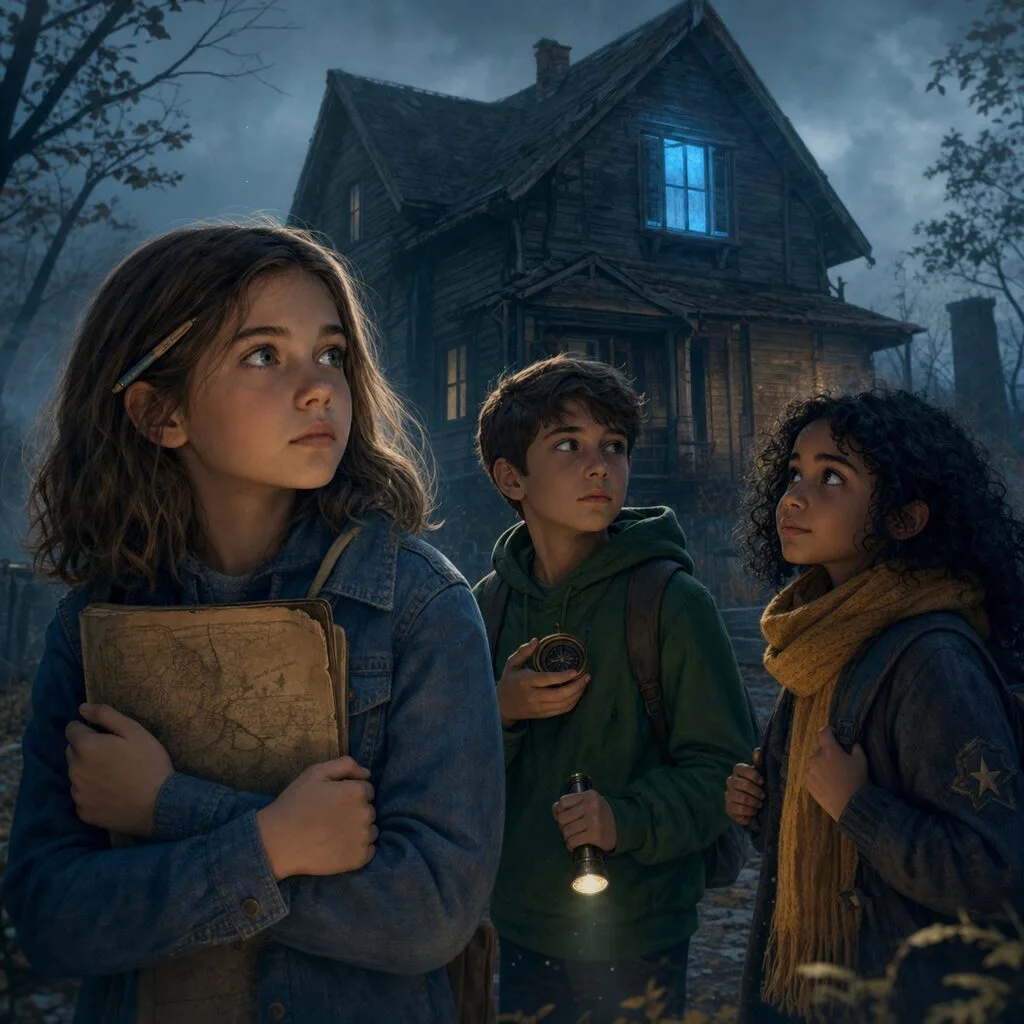
Okno, ktoré svietilo modro je nová časť seriálu Dom na konci mapy, pripravená ako dvojjazyčný detský príbeh v slovenčine aj angličtine.
Okno, ktoré svietilo modro: začína sa príbeh
Modrá bodka na starej mape sa objavila znova práve vo chvíli, keď sa na uliciach rozsvietili lampy.
Nina stála pri nízkom kamennom múriku a držala mapový zošit tak pevne, až jej ceruzka za uchom skĺzla do vlasov. Pred nimi sa z hmly dvíhal úzky starý dom. Mal tmavú strechu, zatvorené dvere a jedno jediné okno na poschodí svietilo modro.
„Je presne tam,“ povedala a prstom ukázala na bodku pri okraji mapy. „Minule bola pri dome. Teraz je pri tom okne. Ani o milimeter vedľa.“
Oliver zdvihol baterku, hoci ju ešte nezapol. Na šnúrke pri nej sa mu pohupoval starý mosadzný kompas po dedovi. „To znamená, že sa zmenilo pravidlo. Alebo nám dom ukazuje ďalší krok.“
„Nemusí to byť pravidlo,“ ozvala sa Mia. Žltú šatku mala vytiahnutú až po bradu a jej malý ruksak s nášivkou hviezdy sa jej opieral o chrbát. „Možno len nechce, aby sme niečo prehliadli.“
Okolo domu sa nehýbal ani jeden strom. Hmla nebola hustá, no pohlcovala konce cesty, akoby za nimi už nebola ulica, ale len bledé prázdne miesto.
Nina prehltla. Tma v nej vždy vyvolávala nepríjemné šteklenie pod rebrami, najmä keď mala pocit, že v nej niečo čaká. Tentoraz však nebola sama.
„Dobre,“ povedala. „Pôjdeme pomaly. Najprv sa pozeráme. Nič neberieme, nič neotvárame silou a nekričíme, ako keby sme boli v strašidelnom filme.“
Oliver sa usmial. „To je škoda. Mal som pripravený veľmi presvedčivý výkrik.“
Mia sa potichu zasmiala a napätie trochu povolilo.
Dvere domu sa otvorili s tichým zavŕzganím ešte skôr, než sa ich niekto dotkol. Za nimi bola úzka chodba, ktorú poznali z predošlého večera. Staré drevo pod nohami chladilo cez podrážky tenisiek. Modré svetlo sa však už neodrážalo zo schodiska. Tiahlo zhora, z izby na konci chodby.
„Tam,“ zašepkala Nina.
Vyšli po schodoch vedľa seba. Oliver šiel v strede a baterkou osvetľoval len podlahu pred nimi. Mia sa držala blízko Niny. Keď došli na poschodie, modré svetlo ich privítalo mäkko, skoro ako svetlo z akvária.
Izba pod oknom bola prázdna iba na prvý pohľad.
Pri stene stála stará drevená školská lavica. Nebola veľká ako stôl v triede, skôr nízka a úzka, s vyrezaným otvorom na atramentovú fľaštičku. Na jej doske ležala tenká vrstva prachu. Niekto do nej prstom nakreslil rovnú čiaru od jedného rohu po druhý.
„Lavica je otočená k oknu,“ všimla si Nina. „Nie k dverám. A stojí presne v modrom svetle.“
Oliver pristúpil bližšie. „Možno sem niekto doniesol starý nábytok. Dom môže byť bývalý sklad. Alebo—“
Jeho baterka jemne udrela o niečo pod lavicou.
Zvuk bol krátky, tlmený, ako keď ceruzka spadne na koberec.
Chlapec si kľakol a zapol baterku. Kužeľ žltého svetla prešiel po zaprášenej podlahe. Pod lavicou ležala školská taška z tmavohnedej kože. Jeden popruh mala pretrhnutý, kovové pracky boli zelenkasté od veku.
„Nie je to odložené,“ povedala Mia ticho. „Je to schované.“
Nina si všimla, že tieň lavice sa pri každom ich pohybe posúva zvláštne pomaly. Keď Oliver naklonil baterku, tieň sa natiahol k dverám. Keď sa Mia nadýchla a pohla šatkou, modrý odlesk na podlahe sa zavlnil ako voda.
„Taška je medzi nohami lavice presne uprostred,“ povedala Nina. „Akoby ju niekto vložil tam, aby ju našiel len človek, ktorý sa pozrie zblízka.“
Oliver natiahol ruku, ale zastal. Pozrel na kamarátky. „Môžem ju vytiahnuť?“
Mia prikývla. „Len opatrne.“
Kožená taška sa pohla bez odporu. Chlapec ju položil na lavicu a otvoril kovovú pracku. Vo vnútri nebolo nič okrem zošita so zažltnutými rohmi. Obal bol modrosivý, miestami ošúchaný, a cez jeho stred sa tiahla vyblednutá nálepka.
Na nálepke stálo: Samuel H.
„Poznáte niekoho takého?“ spýtal sa Oliver.
Nina pokrútila hlavou. „V našej škole nie.“
„Ani v susedstve,“ dodala Mia. „Možno žil dávno pred nami.“
Keď sa veci začnú meniť
Oliver skúmal zošit, ale nedvíhal ho z lavice. Naklonil sa tak blízko, že mu prameň krátkych hnedých vlasov padol do čela. „Papier je starší, ale nie až taký, aby patril do múzea. Pozrite, sú tu riadky na písanie a čísla strán. Je to školský zošit.“
Nina rozviazala šnúrku na svojom mapovom zošite. „Zapíšem si meno. Samuel H., školská taška, lavica pri modrom okne.“
Mia pozrela k oknu. „Prečo by niekto nechal zošit v dome, ktorý sa objavuje len po zotmení?“
Na tú otázku nik neodpovedal. V izbe sa ozvalo slabé klopnutie. Nie z chodby. Nie spoza steny. Priamo z lavice, akoby drevo pod zošitom potichu pripomenulo, že tam stále je.
Oliver otvoril obal.
Prvé strany boli plné úloh. Krivé násobenie, diktáty, nakreslené listy stromov a krátke poznámky červeným atramentom. Na jednej strane bolo napísané: Pekne opravené. Na ďalšej stálo: Pozor na mäkké i.
„To je naozaj školský zošit,“ povedala Nina.
Listy sa zastavili pri poslednej popísanej stránke. Nad spodným okrajom sa nachádzala jedna veta, napísaná tmavomodrým atramentom.
Oliver ju prečítal nahlas: „Keď sa vrátim, ukážem im, kde som sedel.“
Všetci traja sa na seba pozreli.
„Kto sa má vrátiť?“ opýtala sa Mia.
„Samuel,“ povedal Oliver. „Je to jeho zošit. To je najjednoduchšie vysvetlenie.“
„Možno,“ odpovedala Nina. „Ale prečo je veta napísaná až úplne na konci? A prečo nemá dátum?“
Oliver posunul zošit k nej. „Skús ho otvoriť ty. Na tej istej strane.“
Dievča položilo prsty na obal. Boli trochu chladné, no donútila sa ich nepohnúť. Opatrne zošit zavrela a znovu otvorila.
Posledná veta už nebola tá istá.
Tentoraz stálo na stránke: „Keď nájdeš lavicu pri okne, nepresúvaj ju.“
Nina sa prudko nadýchla. „Vidíte to?“
„Vidíme,“ povedal Oliver, hoci sa tváril, akoby sa mu práve pokazil obľúbený výpočet. „Možno je atrament citlivý na svetlo.“
„Tak prečo neukázal tú istú vetu aj mne?“ spýtala sa.
Mia natiahla ruku. „Môžem skúsiť?“
Zošit otvorila veľmi jemne, skoro s otázkou v pohybe prstov. Modré svetlo pri okne na okamih zosilnelo. Prach nad lavicou sa zdvihol do drobných trblietavých bodiek.
Mia sa dlho pozerala na posledný riadok.
„Čo tam je?“ spýtala sa Nina.
Dievča prehltlo. „Je tam: Nezabudnite, že som čakal.“
V miestnosti zavládlo ticho. Nebolo prázdne ani nepríjemné. Skôr sa podobalo chvíli, keď celá trieda čaká, kým učiteľ dočíta dôležitú správu.
Oliver si sadol na podlahu vedľa lavice. „Dobre. Máme tri vety. Jedna hovorí o návrate, druhá o lavici a tretia o čakaní. Musí v tom byť systém.“
„Možno si každý všimol niečo iné,“ povedala Nina. „Ty chceš vedieť, kto sa vracia. Ja som sa pozerala na lavicu. Mia sa pýtala, prečo tu ten zošit ostal.“
Mia si objala kolená. „Tá moja veta neznie ako hádanka. Znie smutne.“
Oliver sa zamračil, potom vytiahol kompas. „Ak sú slová nejaký kód, kompas by mohol—“
„Oliver,“ prerušila ho Nina, tentoraz mierne.
Chlapec sa zarazil. „Ja len skúmam možnosti.“
„Viem. Ale zatiaľ nemusíme všetko rozobrať na kúsky.“
Aby mohol zošit porovnať so svetlom baterky, zdvihol ho z lavice. V tej istej chvíli modré okno zhaslo.
Izbu pohltila tma.
Nina cúvla o krok a narazila chrbtom do steny. Srdce jej búšilo tak hlasno, až mala pocit, že ho počujú všetci. Oliverova baterka sa síce hneď rozsvietila, no jej žltý kruh bol malý a slabý. Chlad starého dreva sa zrazu dostal až pod rukávy bundy.
„Polož ho späť,“ zašepkala Mia.
Oliver sa ani nepohol. „Myslíš, že to spôsobilo toto?“
„Neviem,“ odpovedala pokojne. „Ale pred chvíľou sme sa pozerali. Teraz sme chceli dôkaz odniesť. Možno ten zošit nemá rád, keď sa s ním narába ako s vecou.“
Nina sa oprela dlaňou o stenu, aby sa jej netriasli prsty. „Mne sa to nepáči. A… áno, tma ma znervózňuje. Veľmi.“
Dôležitý okamih
Oliverov výraz sa zmenil. Už nevyzeral ako niekto, kto rieši hádanku. Pozrel na Ninu, potom na Miu a napokon na zošit vo svojej ruke.
„Prepáčte,“ povedal. „Chcel som len zistiť, čo to je.“
Opatrne položil zošit presne na miesto, kde ležal predtým. Urovnal ho podľa prachu okolo rohov, akoby vracal knihu na poličku v knižnici pani Urbanovej.
„Prepáč,“ dodal nahlas, tentoraz smerom k lavici a modrému oknu. „Nemali sme ho brať.“
O chvíľu sa pri skle objavil slabý modrý bod. Rozšíril sa do známeho svetla, jemnejšieho než predtým, ale pokojného. Nina vydýchla.
Práve vtedy sa v jej mapovom zošite pohla jedna tenká čiara.
Všetci sa naklonili nad mapu. Medzi ulicami, ktoré poznali z mesta, pribudol nový názov. Bol napísaný drobným rukopisom, aký nepatril ani Nine, ani Oliverovi, ani Mii.
Tichá lavica.
„Taká ulica neexistuje,“ povedal Oliver.
„Na normálnej mape nie,“ odvetila Nina.
Mia sa zadívala na lavicu. „Možno to nie je ulica. Možno je to miesto, ktoré si dom pamätá.“
Modré svetlo sa rozlialo po stene. Najprv sa zdalo, že ide len o tieň okenného rámu. Potom sa však na omietke ukázali jemné čiary. Jedna lavica. Druhá. Tretia. Rad malých školských lavíc, všetky otočené tým istým smerom.
Nebolo to úplne ako obraz. Skôr ako odraz niečoho, čo sa už dávno stalo a nechcelo zmiznúť.
Vzduchom preletel slabý zvuk. Nie slovo, nie veta. Len šuchot papiera a vzdialené zaškrípanie kriedy po tabuli.
Mia sklonila hlavu. „Táto izba nie je nahnevaná. Je smutná.“
Nik sa jej nevysmial. Dokonca ani Oliver nie.
„Myslíš, že tu bývala trieda?“ spýtal sa.
„Možno nie presne tu,“ odpovedala Nina a už kreslila do zošita. „Ale dom si ju pamätá. Pozrite, lavica pod oknom je väčšia než tie na stene. Akoby zostala jedna skutočná a ostatné boli iba spomienka.“
Oliver sa vrátil ku stránke so Samuelovým menom. Tentoraz zošit nechytil. Naklonil sa nadňou a čítal len očami.
„Samuel H. písal úlohy. Sedel niekde pri okne. A posledná veta hovorí o čakaní na návrat.“
„Možno sa nevrátil do školy,“ povedala Mia.
Slová nezazneli dramaticky. Boli vyslovené ticho, s opatrnosťou, akú si zaslúži cudzí smútok.
Nina doplnila na mapu malý obdĺžnik pri novom názve ulice. „Toto je lavica. A tu je modré okno. Keď sme vošli, svetlo dopadalo na jej ľavý roh. Teraz dopadá na pravý.“
„Prečo je to dôležité?“ spýtal sa Oliver.
Dievča pokrčilo ramenami. „Zatiaľ neviem. Ale zmenilo sa to. A mapa sa nemení bez dôvodu.“
Chlapec prikývol. Potom vytiahol z vrecka malý papierik a zapísal naň dve veci: Samuel H. a Tichá lavica. Viac už nehľadal. Kompas zostal ticho v jeho dlani.
Napokon Mia položila ruku na okraj lavice, ale nie na zošit. „Necháme ho tu?“
„Presne tam, kde bol,“ povedala Nina.
„Súhlasím,“ dodal Oliver. „Tentoraz bez experimentov.“
„To znie skoro ako dospelé rozhodnutie,“ usmiala sa Mia.
„Prosím, nehovor to nahlas. Mohol by som si na to zvyknúť.“
Keď vychádzali z izby, Nina sa ešte raz obzrela. Starý zošit ležal na lavici, školská taška bola zasunutá pod ňou a modré svetlo pokojne svietilo cez prach. Izba už nepôsobila tak stiesnene. Stále ukrývala tajomstvo, no akoby sa prestala báť, že jej ho niekto vytrhne z rúk.
Vonku bola hmla redšia. Traja kamaráti kráčali po ceste vedľa seba, Oliver držal baterku zhasnutú pri kolene a Mia išla medzi nimi. Nina niesla mapu otvorenú, hoci v šere sotva videla čiary.
Pri názve Tichá lavica sa modrá bodka pomaly usadila na mieste.
Za nimi zostalo jedno okno svietiť do noci. Nie ako výstraha, ale ako malá lampička pri ceste, ktorá vedela, že si ju niekto všimol.
Pokračovanie nabudúce…
The House at the Edge of the Map, part 2: The Window That Glowed Blue
The Story Begins
The blue dot on the old map appeared again just as the street lamps turned on.
Nina stood by a low stone wall and held her map notebook so tightly that the pencil behind her ear slipped into her hair. In front of the children, an old narrow house rose out of the mist. It had a dark roof, closed doors, and one single window upstairs glowing blue.
“It’s exactly there,” she said, pointing at the dot near the edge of the map. “Last time it was near the house. Now it’s by that window. Not even one millimeter away.”
Oliver lifted his flashlight, though he had not switched it on yet. On the string near it, his old brass compass from his grandfather swayed gently. “That means the rule changed. Or the house is showing us the next step.”
“It doesn’t have to be a rule,” Mia said. She had pulled her yellow scarf up to her chin, and her small backpack with the star patch leaned against her back. “Maybe it just doesn’t want us to miss something.”
Not one tree moved around the house. The mist was not very thick, but it swallowed the ends of the road, as if there was no street after that, only a pale empty place.
Nina swallowed. Darkness always made an unpleasant flutter under her ribs, especially when she felt that something was waiting inside it. This time, though, she was not alone.
“Okay,” she said. “We go slowly. First we look. We do not take anything, we do not open anything by force, and we do not scream like we are in a spooky movie.”
Oliver smiled. “That’s a shame. I had a very convincing scream ready.”
Mia laughed softly, and the tension loosened a little.
The house door opened with a quiet creak before anyone touched it. Behind it was the narrow hallway they knew from the previous evening. Old wood under their shoes felt cold through the soles of their trainers. But the blue light was no longer reflecting from the stairs. It was coming from above, from the room at the end of the hall.
“There,” Nina whispered.
They climbed the stairs side by side. Oliver walked in the middle and pointed his flashlight only at the floor in front of them. Mia stayed close to Nina. When they reached the upstairs landing, the blue light welcomed them softly, almost like light from an aquarium.
The room under the window looked empty only at first glance.
A very old wooden school desk stood by the wall. It was not as big as a classroom table, but low and narrow, with a carved hole for an ink bottle. A thin layer of dust covered its top. Someone had drawn a straight line across the desk from one corner to the other with a finger.
“The desk is turned toward the window,” Nina noticed. “Not toward the door. And it’s standing right in the blue light.”
Oliver stepped closer. “Maybe someone brought old furniture here. The house could be a former storage room. Or—”
His flashlight gently bumped something under the desk.
The sound was short and dull, like a pencil dropping onto a carpet.
The boy knelt down and switched on the flashlight. The yellow beam moved over the dusty floor. Under the desk lay a school bag made of dark brown leather. One strap was torn, and the metal buckles had turned green with age.
“It’s not just left here,” Mia said quietly. “It’s hidden.”
Nina noticed that the desk’s shadow moved strangely slowly whenever they moved. When Oliver tilted the flashlight, the shadow stretched toward the door. When Mia breathed in and her scarf shifted, the blue reflection on the floor rippled like water.
When Things Start to Change
“The bag is between the desk legs, right in the middle,” Nina said. “It’s as if someone put it there so only a person who looked closely would find it.”
Oliver reached out, then stopped. He looked at the girls. “Can I pull it out?”
Mia nodded. “Just carefully.”
The leather bag moved without any resistance. He placed it on the desk and opened the metal clasp. Inside was nothing except a notebook with yellowed corners. The cover was blue-gray, worn in places, and a faded label crossed the middle.
On the label, it said: Samuel H.
“Do you know anyone like that?” Oliver asked.
Nina shook her head. “Not at our school.”
“Not in the neighborhood either,” Mia added. “Maybe he lived long before us.”
Oliver studied the notebook, but he did not lift it from the desk. He leaned so close that a strand of his short brown hair fell into his forehead. “The paper is older, but not old enough for a museum. Look, there are writing lines and page numbers. It’s a school notebook.”
Nina untied the string on her map notebook. “I’ll write the name down. Samuel H. School bag. Desk by the blue window.”
Mia looked toward the window. “Why would someone leave a notebook in a house that appears only after dark?”
No one answered that question. Then a soft tap sounded in the room. Not from the hall. Not behind the wall. Right from the desk, as if the wood under the notebook quietly reminded them that it was still there.
Oliver opened the cover.
The first pages were full of schoolwork. Crooked multiplication, dictation, drawn leaves from trees, and short notes in red ink. On one page, someone had written: Well corrected. On the next one it said: Watch the soft i.
“It really is a school notebook,” Nina said.
The pages stopped at the last written page. Near the bottom edge there was one sentence, written in dark blue ink.
Oliver read it aloud: “When I come back, I will show them where I sat.”
All three looked at one another.
“Who is coming back?” Mia asked.
“Samuel,” Oliver said. “It’s his notebook. That’s the simplest explanation.”
“Maybe,” Nina answered. “But why is the sentence written at the very end? And why is there no date?”
Oliver pushed the notebook toward her. “Try opening it. On the same page.”
The girl put her fingers on the cover. They were a little cold, but she made herself keep them steady. Carefully, she closed the notebook and opened it again.
The last sentence was not the same anymore.
This time the page said: “When you find the desk by the window, do not move it.”
Nina drew in a sharp breath. “Do you see that?”
“We do,” Oliver said, though he looked as if his favorite calculation had just broken. “Maybe the ink is sensitive to light.”
“Then why didn’t it show the same sentence for me?” she asked.
Mia held out her hand. “Can I try?”
She opened the notebook very gently, almost asking with the movement of her fingers. The blue light by the window brightened for a moment. Dust above the desk rose into tiny shining specks.
Mia stared at the last line for a long time.
“What does it say?” Nina asked.
The girl swallowed. “It says: Don’t forget that I waited.”
Silence filled the room. It was not empty or unpleasant. It was more like the moment when a whole class waits for the teacher to finish reading an important message.
An Important Moment
Oliver sat down on the floor beside the desk. “Okay. We have three sentences. One talks about coming back, one about the desk, and one about waiting. There must be a system.”
“Maybe each of us noticed something different,” Nina said. “You wanted to know who is coming back. I was looking at the desk. Mia wondered why the notebook was left here.”
Mia hugged her knees. “My sentence does not sound like a puzzle. It sounds sad.”
Oliver frowned, then took out the compass. “If the words are some kind of code, the compass could—”
“Oliver,” Nina interrupted, this time gently.
The boy stopped. “I’m just checking the possibilities.”
“I know. But we do not have to take everything apart yet.”
So that he could compare the notebook with the flashlight beam, he lifted it from the desk. In the very same moment, the blue window went dark.
The room was swallowed by darkness.
Nina stepped back and bumped her back against the wall. Her heart was beating so loudly that she felt sure everyone could hear it. Oliver’s flashlight turned on at once, but its yellow circle was small and weak. The cold of the old wood suddenly reached under the sleeves of her jacket.
“Put it back,” Mia whispered.
Oliver did not move. “Do you think that caused this?”
“I don’t know,” Mia answered calmly. “But a moment ago we were looking. Now we wanted to carry the proof away. Maybe the notebook does not like being handled like a thing.”
Nina pressed her palm against the wall so her fingers would stop shaking. “I don’t like this. And… yes, darkness makes me nervous. A lot.”
Oliver’s expression changed. He no longer looked like someone solving a puzzle. He looked at Nina, then at Mia, and finally at the notebook in his hand.
“Sorry,” he said. “I only wanted to find out what it was.”
Carefully, he placed the notebook exactly where it had been before. He lined it up with the dust around the corners, as if he were putting a book back on a shelf in Mrs Urbanová’s library.
“Sorry,” he added aloud, this time toward the desk and the blue window. “We should not have taken it.”
After a while, a faint blue dot appeared by the glass. It spread into the familiar light, softer than before, but peaceful. Nina let out a breath.
Right then, one thin line moved in her map notebook.
All three leaned over the map. Between the streets they knew from town, a new name had appeared. It was written in a small handwriting that belonged to none of them.
Silent Bench.
“That street does not exist,” Oliver said.
“Not on a normal map,” Nina replied.
Mia stared at the desk. “Maybe it isn’t a street. Maybe it’s a place the house remembers.”
The blue light spread along the wall. At first it seemed to be only the shadow of the window frame. Then fine lines appeared on the plaster. One desk. Another. A third. A row of small school desks, all turned in the same direction.
It was not quite like a picture. It was more like the reflection of something that had happened long ago and did not want to disappear.
A faint sound moved through the air. Not a word, not a sentence. Just the rustle of paper and the distant squeak of chalk on a blackboard.
Mia lowered her head. “This room is not angry. It is sad.”
No one laughed at her. Not even Oliver.
“Do you think there used to be a class here?” he asked.
What Comes Next
“Maybe not exactly here,” Nina answered, and she was already drawing in her notebook. “But the house remembers it. Look, the desk under the window is bigger than the ones on the wall. It’s as if one real desk stayed behind and the others were only a memory.”
Oliver went back to the page with Samuel’s name. This time he did not touch the notebook. He leaned over it and read with his eyes only.
“Samuel H. did his schoolwork. He sat somewhere by the window. And the last sentence talks about waiting for someone to come back.”
“Maybe he did not come back to school,” Mia said.
The words did not sound dramatic. They were spoken softly, with the care that another person’s sadness deserves.
Nina added a small rectangle to the map beside the new street name. “This is the desk. And here is the blue window. When we came in, the light fell on its left corner. Now it falls on the right one.”
“Why is that important?” Oliver asked.
The girl shrugged. “I don’t know yet. But it changed. And the map does not change without a reason.”
The boy nodded. Then he took a small slip of paper from his pocket and wrote down two things: Samuel H. and Silent Bench. He did not search for more now. The compass stayed quiet in his hand.
Finally, Mia put her hand on the edge of the desk, but not on the notebook. “Should we leave it here?”
“Right where it was,” Nina said.
“I agree,” Oliver added. “This time, no experiments.”
“That almost sounds like an adult decision,” Mia said with a smile.
“Please don’t say that out loud. I might get used to it.”
When they walked out of the room, Nina looked back once more. The old notebook lay on the desk, the school bag was tucked under it, and the blue light shone calmly through the dust. The room no longer felt so tight. It still held its secret, but it seemed to have stopped being afraid that someone would pull it from its hands.
Outside, the mist was thinner. The three friends walked along the road side by side, Oliver holding his flashlight turned off near his knee, and Mia walking between them. Nina carried the map open, even though she could barely see the lines in the dim light.
At the name Silent Bench, the blue dot settled slowly into place.
Behind them, one window stayed lit in the night. Not like a warning, but like a small lamp by the road that knew someone had noticed it.
To be continued…
