
Vypočujte si slovenskú audio verziu príbehu
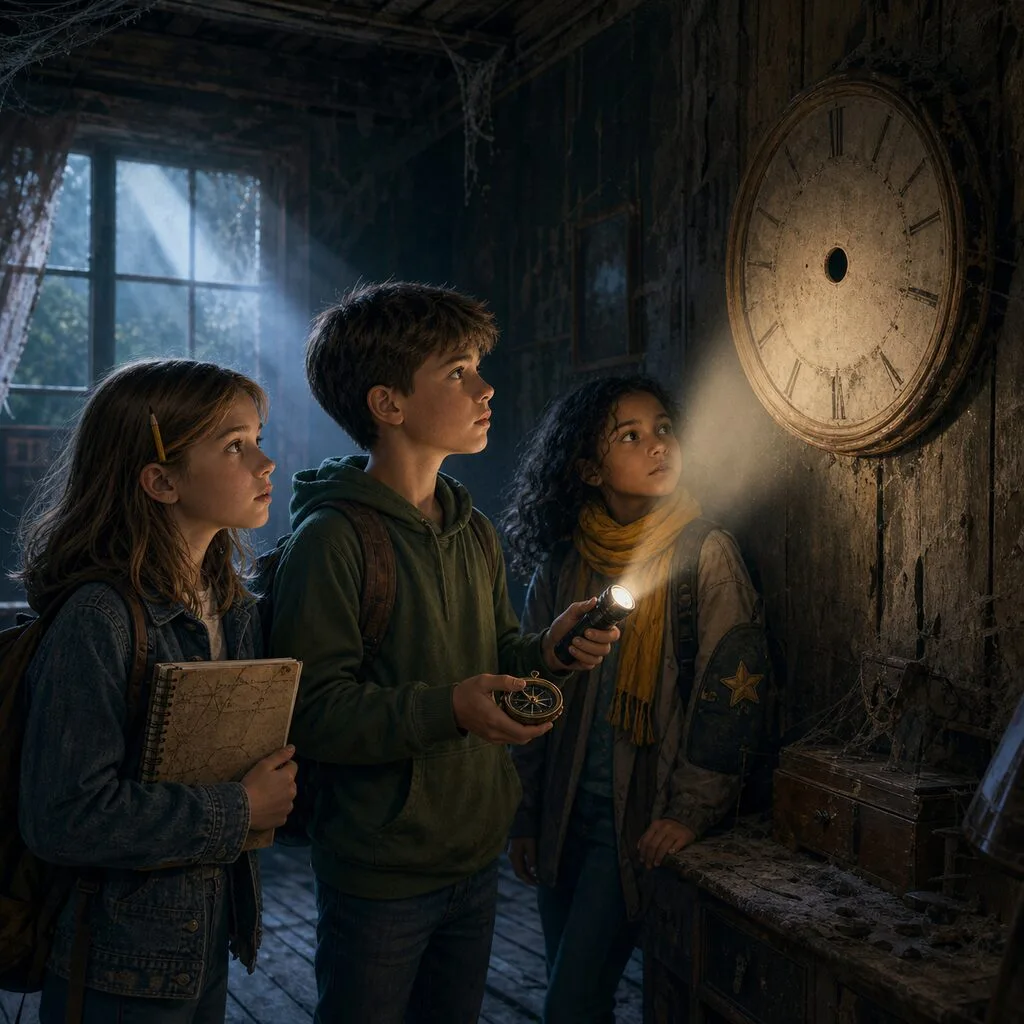
Traja kamaráti stoja v starej izbe pri hodinách bez ručičiek, v prachu a modrom svetle, s pocitom tichého napätia.

Hodiny bez ručičiek je nová časť seriálu Dom na konci mapy, pripravená ako dvojjazyčný detský príbeh v slovenčine aj angličtine.

Hodiny bez ručičiek: začína sa príbeh

Nina pritisla dlaň na studenú kľučku a pozrela na kamarátov.

„Ak sa tentoraz dvere samy otvoria, ja ich rozhodne nebudem chváliť,“ zašepkal Oliver. V zelenej mikine vyzeral trochu bledšie než zvyčajne, ale baterku s kompasom po dedovi držal pevne.

Mia si upravila žltý šál. „Dvere nemusia byť zlé len preto, že vedia, kedy prídeme.“

„To je presne veta, po ktorej sa dvere v strašidelnom príbehu otvoria,“ poznamenal Oliver.

Nina sa napriek neistote usmiala. Potom stlačila kľučku.

Dvere domu na konci mapy sa otvorili potichu, akoby ich niekto zvnútra práve odistil. Za nimi čakala vstupná izba s úzkym stolom, starou lavicou pri stene a oknom, z ktorého padalo namodralé svetlo. Vonku už bola tma, no vnútri nevládla úplná čierňava. Modrý odlesk kreslil na podlahu tenké obdĺžniky.

Vzduch voňal starým drevom, prachom a niečím, čo Nine pripomínalo školskú knižnicu po daždi.

„Minule bolo modré svetlo pri schodoch,“ všimla si. Z malého zápisníka vytiahla mapu, ktorú našli v knižnici pani Urbanovej. „Dnes je pri okne. Dom reaguje na konkrétne veci, pamätáte?“

„Alebo má iba zvláštny vkus v osvetlení,“ povedal Oliver.

Mapa zašuchotala, keď ju Nina rozložila na stole. Roh pri nakreslenej škole bol pokrčený. Práve tam sa včera objavila nejasná čiara, ktorá predtým na papieri nebola.

Mia sa naklonila bližšie. „Ten roh vyzerá, akoby ho niekto dlho zvieral v ruke.“

Oliver odvrátil oči. „Ja som si ju doma len na chvíľu pozrel. Vieš, aby som si overil, či tá čiara nemohla byť škvrna od atramentu.“

Nina zdvihla pohľad. „Doma? Veď sme sa dohodli, že mapa zostane v obale.“

„Aj zostala. Väčšinu času.“ Chlapec rýchlo namieril baterku na roh stola. „Nechcel som ju poškodiť.“

Skôr než sa Nina stihla spýtať viac, cez dom prešiel slabý závan. Plameň baterky sa nepohol, no prach nad stolom sa zatočil do drobného kruhu. Niekde v ďalšej miestnosti jemne cinkol kov.

Mia sa zadívala do tmavej chodby. „To neznelo ako okno.“

„Nie,“ odpovedala Nina. „Znelo to ako hodiny.“

Zobrali mapu, baterku aj Oliverov kompas a prešli cez úzke dvere. V susednej izbe nebol takmer žiadny nábytok. Iba vysoká skriňa bez dvierok, na zemi zvinutý koberec a na stene staré nástenné hodiny.

Viseli trochu nakrivo. Ich drevený rám bol tmavý a lesklý od veku, ciferník zažltnutý. Najpodivnejšie však bolo, že uprostred nebola ani hodinová, ani minútová ručička.

„Možno ich niekto rozobral,“ povedal Oliver, hoci sa k hodinám nepriblížil.

Nina sledovala prázdny stred ciferníka. „Nie. Pozri na sklo. Nie je prasknuté. A tam, kde bývajú ručičky, nie je ani otvor.“

Mia položila prsty na okraj mapy. „Vyzerajú, akoby ručičky nikdy nepotrebovali.“

Oliver sa nervózne usmial. „Takže čas tu ukazuje… čo? Náladu domu?“

Odpoveď prišla hneď.

Hodiny odbili raz.

Zvuk bol hlboký, ale nie príliš hlasný. Nebol to hrom ani výkrik. Skôr pevný tón, ktorý sa rozliezol po stenách a zanechal po sebe chladné ticho. Baterka na okamih zablikala.

Oliverovi spadol kompas z dlane na koberec.

„Prečo odbili?“ spýtal sa.

Mia pozrela naňho. „Čo si povedal naposledy?“

„Že som mapu pozeral doma.“

Nina prekrížila ruky. „A to je celé?“

Chlapec si olízol pery. „No… urobil som si fotku. Len pre istotu, keby sa na nej niečo zmenilo aj mimo domu.“

Hodiny odbili druhý raz.

Po stene vedľa nich prebehla tenká modrá čiara. Začala pri podlahe, vystúpila k ciferníku a zhasla pri strope.

Oliver prudko zdvihol hlavu. „Dobre, dobre. Nevedel som, že to zoberú tak doslova.“

„Kto to?“ spýtala sa Nina.

„No… hodiny. Dom. Neviem.“

Mia hovorila potichu, no jej hlas znel jasne. „Neodbili, keď si povedal o fotke. Odbili, keď si povedal len časť.“

V miestnosti zavládlo napätie. Nina cítila, ako jej po chrbte prebehlo nepríjemné mravčenie, hoci sa snažila nedávať to najavo. Nemala rada tmavé izby, najmä také, v ktorých sa ozývali veci bez ručičiek.

Keď sa veci začnú meniť

„Fotku si urobil bez opýtania?“ spýtala sa.

Oliver prikývol. „Ale nič som s ňou neurobil.“

Hodiny zostali ticho.

„To neznamená, že je to v poriadku,“ povedala Nina. Jej slová boli presné a ostré ako čiary ceruzkou na mape. „Tá mapa patrí nám všetkým. A pani Urbanová nám ju zverila.“

„Viem.“ Oliver sa zohol po kompas. „Len som chcel zistiť, či sa ten nový znak neobjavil aj na fotke. Keby áno, mali by sme dôkaz. Keby nie, vedeli by sme, že sa mení iba tu.“

„A zistil si niečo?“

„Nie úplne.“ Zaváhal. „Na fotke bol roh mapy prázdny. Ale možno som ju odfotil skôr, než sa čiara ukázala.“

„Možno,“ zopakovala Nina. V tom jedinom slove bolo počuť, že jej to nestačí.

Oliver sa narovnal. „Nechcel som vás obísť. Chcel som nám pomôcť.“

Hodiny odbili tretí raz.

Tentoraz sa modrá čiara na stene rozdelila na dve tenké vetvy. Jedna ukázala k mape, druhá k Oliverovi. Potom obe zmizli.

Chlapec sklopil zrak. „Dobre. To nebola celá pravda.“

Nina mlčala. Mia sa medzi nich postavila tak, aby nikto nemusel stáť sám pod hodinami.

„Čoho si sa bál?“ spýtala sa jemne.

Oliver pokrčil ramenami, no potom ich pomaly spustil. „Že niečo prehliadneme. Že na mape bude stopa a ja ju nepochopím včas. A… že ak budem mať fotku, budem mať aspoň niečo, čo viem preskúmať normálne. Bez modrého svetla a bez hodín, ktoré ma opravujú.“

Nina sa nadýchla, aby mu odpovedala, ale Mia zdvihla dlaň.

„Nemusíš sa tváriť, že si to spravil pre nás všetkých, keď si to spravil aj pre seba,“ povedala. „To nie je hanba. Len to treba povedať správne.“

Oliver sa zamračil. „Takže mám povedať, že som chcel mať výhodu?“

„Ak je to pravda, tak áno. Ale nemusíš sa za to ponižovať.“

Chvíľu bolo počuť iba tiché bzučanie baterky. Potom Oliver položil kompas na stôl vedľa mapy.

„Odfotil som ju tajne,“ povedal pomaly. „Chcel som si ju doma skúmať sám, lebo som si myslel, že možno prídem na niečo skôr než vy. Zároveň som sa bál, že bez fotky niečo pokazíme alebo prehliadneme. Mal som sa opýtať. Neopýtal som sa.“

Hodiny neodbili.

Namiesto toho sa prázdny stred ciferníka na okamih rozsvietil jemnou modrou bodkou. Svetlo sa pohlo po stene, skĺzlo na stôl a dotklo sa pokrčeného rohu mapy.

Papier ticho zašuchotal.

Nina sa naklonila tak blízko, až jej ceruzka za uchom skoro spadla. Pokrčený roh sa pomaly narovnával. Starý papier sa vyhladil, akoby ho niekto z druhej strany opatrne vyrovnával dlaňou.

Na mieste, ktoré bolo pred chvíľou prázdne, sa objavil maličký symbol. Vyzeral ako kruh s dvanástimi krátkymi čiarami po obvode. V strede nemal ručičky.

„Hodiny,“ zašepkala Mia.

Nina vytiahla zápisník a porovnávala polohu znaku s plánom mesta. „Sú pri škole. Presne pri starej časti, za telocvičňou.“

Oliver posvietil baterkou zboku. V modrom lesku sa vedľa symbolu ukázali tenučké písmená, sotva viditeľné medzi linkami ulíc.

Skryté veci treba vysloviť nahlas.

Prečítali si vetu dvakrát. Potom sa Nina pozrela na hodiny.

„Takže dom nereaguje na strach,“ povedala. „Ani na každý hluk. Reaguje, keď niekto schová dôležitú časť pravdy.“

„To je dosť nepraktické pravidlo,“ zamrmlal Oliver. „Predstavte si, že by ho mali učitelia. Každý pondelok by na chodbe odbíjali hodiny.“

Mia sa zachichotala. Aj Nina sa krátko usmiala, hoci v očiach jej ešte zostala opatrnosť.

„Zajtra pôjdeme za pani Urbanovou,“ rozhodla. „Ak tie hodiny sú pri starej časti školy, možno o nich bude vedieť.“

Na druhý deň po vyučovaní našli knihovníčku pri stole medzi dvoma vysokými policami. Mala strieborné okuliare na nose, sivý sveter a zväzok kľúčov na modrej stužke. Keď jej ukázali symbol na mape, prsty sa jej na okamih zastavili nad stránkou knihy.

Dôležitý okamih

„Kde ste to videli?“ spýtala sa.

Nina sa s Miou a Oliverom vymenila pohľad. Nechceli klamať, ale ani nemohli vysvetliť celý dom na konci mapy.

„Na starej mape,“ odpovedala Nina opatrne. „Objavil sa tam nový detail.“

Pani Urbanová ich chvíľu skúmala, potom prikývla. „V starej časti školy naozaj viseli veľké nástenné hodiny. Boli tam dávno pred prestavbou. Keď opravovali chodbu za telocvičňou, veci odtiaľ presunuli do skladu. Aspoň myslím.“

„Aspoň myslíte?“ spýtal sa Oliver.

Knihovníčka si zložila okuliare. „Nie všetko, čo sa v škole kedysi stalo, zostalo pekne zapísané v zošitoch. Niektoré predmety zmizli pri sťahovaní. Niektoré spomienky tiež.“

Mia si všimla, že pani Urbanová sa pri poslednej vete zadívala k zatvoreným dverám skladu.

O chvíľu už pred nimi ležal starý plán školy. Papier bol hrubý, žltkastý a voňal po kartóne. Nina našla zadnú chodbu, potom schody a nakoniec malú miestnosť označenú iba písmenom S.

„Tu bývali hodiny,“ ukázala pani Urbanová. „Nad dverami. Ďalej za tou chodbou bola kedysi trieda, ktorú dnes už nepoužívame.“

„Prečo?“ vyhŕkol Oliver.

Knihovníčka sa jemne usmiala, ale neodpovedala hneď. „To je dlhší príbeh. Najprv si však zistite, čo presne hľadáte.“

Večer sa traja kamaráti znova stretli v dome na konci mapy. Tentoraz otvorili dvere bez vtipov, no aj bez takého strachu ako predtým. Na stole ležala mapa vedľa Nininho zápisníka a Oliverovej malej baterky.

„Veríš mi aspoň trochu viac?“ spýtal sa Oliver, keď sa nad papierom objavila slabá modrá žiara.

Nina si prešla prstom po linke vedúcej k škole. „Som stále nahnevaná. Ale páči sa mi, že si sa priznal sám, nie až keď ťa hodiny prinútili povedať každé slovo.“

„Technicky ma prinútili až tri odbitia,“ povedal.

„Technicky,“ dodala Mia, „si to potom povedal ty.“

Chlapec prikývol. „Nabudúce sa spýtam.“

„Nabudúce sa skúsime viac pýtať aj my,“ povedala Nina. „Aby nikto nemal pocit, že musí pátrať sám.“

Mia položila ruku na okraj mapy. Z druhej strany ju pritisla Nina a Oliver priložil dlaň vedľa ich rúk, trochu rozpačito, akoby to bol experiment, ktorý nechce pokaziť.

Na mape sa pri symbole hodín objavila ešte jedna slabá čiara. Viedla popri starej škole, za telocvičňu, až k zadnej chodbe. Tam sa končila pri malom prázdnom štvorci.

Hodiny bez ručičiek zostali ticho. Modré svetlo pri okne zmäklo a na podlahe sa už netriasli tiene.

Traja kamaráti stáli nad novou stopou spolu. Za stenami domu šumel večerný vietor a kdesi v starej škole na druhom konci mesta možno čakala miestnosť, na ktorú si nikto poriadne nespomenul.

Pokračovanie nabudúce…

Nabudúce: Zo schodiska sa ozýva veta: Nezabudnite na posledný deň

The House at the Edge of the Map, part 3: The Clock Without Hands

The Story Begins

Nina pressed her palm against the cold handle and looked at her friends.

"If the door opens by itself this time, I will definitely not praise it," Oliver whispered. In his green hoodie, he looked a little paler than usual, but he held his small flashlight with the old brass compass very tightly.

Mia adjusted her yellow scarf. "Doors do not have to be bad just because they know when we are coming."

"That is exactly the kind of sentence that makes a door open in a ghost story," Oliver said.

Even with her nerves, Nina smiled. Then she pressed the handle.

The door of the house at the edge of the map opened quietly, as if someone inside had just unlocked it. Behind it waited an entrance room with a narrow table, an old bench by the wall, and a window that dropped blue light into the room. It was already dark outside, but inside there was no deep blackness. The blue glow drew thin rectangles on the floor.

The air smelled of old wood, dust, and something that reminded Nina of the school library after rain.

"Last time the blue light was by the stairs," she noticed. She took the map from her small notebook and spread it out. It was the map they had found in Mrs Urbanová’s library. "Today it is by the window. The house reacts to specific things, remember?"

"Or it just has strange taste in lighting," said Oliver.

The map rustled when Nina laid it on the table. The corner near the drawn school was wrinkled. Yesterday, a blurry line had appeared there, and it had not been on the paper before.

Mia leaned closer. "That corner looks like someone held it in their hand for a long time."

Oliver looked away. "I only looked at it at home for a little while. You know, just to check whether that line could have been an ink stain."

Nina lifted her eyes. "At home? We agreed that the map would stay in its cover."

"It did stay there. Most of the time." The boy quickly pointed his flashlight at the edge of the table. "I did not want to damage it."

Before Nina could ask more, a soft draft moved through the house. The flashlight beam did not move, but dust above the table turned into a small circle. Somewhere in another room, metal gave a gentle chime.

Mia stared into the dark hallway. "That did not sound like a window."

"No," Nina said. "It sounded like a clock."

They took the map, the flashlight, and Oliver’s compass, then walked through the narrow doorway. The next room had almost no furniture. There was only a tall cupboard without doors, a rolled-up carpet on the floor, and old wall clocks on the wall.

They hung a little crooked. Their wooden frame was dark and shiny with age, and the clock face had turned yellow. The strangest thing was that there was no hour hand or minute hand in the middle.

"Maybe someone took them apart," Oliver said, although he did not move closer.

Nina studied the empty center of the clock face. "No. Look at the glass. It is not cracked. And where the hands should be, there is not even a hole."

Mia placed her fingers on the edge of the map. "They look like they never needed hands."

Oliver gave a nervous smile. "So what does time show here? The mood of the house?"

The answer came at once.

The clock struck once.

The sound was deep, but not too loud. It was not thunder or a scream. It was more like a strong tone that spread across the walls and left a cold silence behind. The flashlight blinked for a moment.

When Things Start to Change

Oliver’s compass slipped from his hand and fell onto the carpet.

"Why did it strike?" he asked.

Mia looked at him. "What did you say last?"

"That I looked at the map at home."

Nina folded her arms. "And that is all?"

The boy licked his lips. "Well… I took a photo. Just in case, if something changed on it even outside the house."

The clock struck a second time.

A thin blue line ran along the wall beside them. It started near the floor, went up to the clock face, and faded near the ceiling.

Oliver jerked his head up. "Okay, okay. I did not know they would take it so literally."

"Who?" Nina asked.

"Well… the clock. The house. I do not know."

Mia spoke softly, but her voice was clear. "They did not strike when you said the photo. They struck when you said only part of it."

The room grew tense. Nina felt an uncomfortable tingle run down her back, though she tried not to show it. She did not like dark rooms, especially ones where things with no hands made sounds.

"Did you take the photo without asking?" she asked.

Oliver nodded. "But I did not do anything with it."

The clock stayed silent.

"That does not mean it was right," Nina said. Her words were sharp and exact, like pencil lines on a map. "This map belongs to all of us. And Mrs Urbanová trusted us with it."

"I know." Oliver bent down to pick up the compass. "I just wanted to see whether the new mark would also appear on the photo. If it did, we would have proof. If it did not, we would know the change only happened here."

"And did you find anything?"

"Not exactly." He hesitated. "On the photo, the corner of the map was empty. But maybe I took it before the line appeared."

"Maybe," Nina repeated. In that one word, it was clear she did not think that was enough.

Oliver stood up straighter. "I did not want to leave you out. I wanted to help us."

The clock struck a third time.

This time, the blue line on the wall split into two thin branches. One pointed toward the map, and the other pointed toward Oliver. Then both disappeared.

The boy lowered his eyes. "All right. That was not the whole truth."

Nina stayed quiet. Mia stepped between them so that no one had to stand alone under the clock.

"What were you afraid of?" she asked gently.

Oliver shrugged, then slowly let his shoulders drop. "That we would miss something. That there would be a clue on the map, and I would not understand it in time. And… if I had a photo, I would at least have something I could study in a normal way. Without blue light and without clocks correcting me."

Nina took a breath to answer, but Mia raised her hand.

"You do not have to pretend you did it for all of us when you did it for yourself too," she said. "That is not shameful. You just have to say it properly."

Oliver frowned. "So I should say I wanted an advantage?"

"If that is true, then yes. But you do not have to humiliate yourself over it."

For a moment, only the soft buzz of the flashlight could be heard. Then Oliver set the compass on the table next to the map.

"I took the photo in secret," he said slowly. "I wanted to study it alone at home, because I thought I might figure something out before you did. At the same time, I was scared that without a photo, we might mess up or miss something. I should have asked. I did not ask."

An Important Moment

The clock did not strike.

Instead, the empty center of the clock face lit up for a moment with a tiny blue dot. The light moved across the wall, slid onto the table, and touched the wrinkled corner of the map.

The paper rustled softly.

Nina leaned so close that the pencil behind her ear nearly fell out. The wrinkled corner slowly straightened. The old paper smoothed out as if someone on the other side were gently pressing it flat with a hand.

On the spot that had been empty a moment ago, a tiny symbol appeared. It looked like a circle with twelve short lines around the edge. In the middle, there were no hands.

"A clock," Mia whispered.

Nina took out her notebook and compared the symbol with the town plan. "It is near the school. Right by the old part, behind the gym."

Oliver shone his flashlight from the side. In the blue light, very thin letters appeared beside the symbol, barely visible between the street lines.

Hidden things must be spoken aloud.

They read the sentence twice. Then Nina looked at the clock.

"So the house does not react to fear," she said. "And not to every sound. It reacts when someone hides an important part of the truth."

"That is a very inconvenient rule," Oliver muttered. "Imagine if teachers had it. Every Monday, the clocks would strike in the hallway."

Mia giggled. Nina also smiled briefly, though she still felt careful.

"Tomorrow we will go to Mrs Urbanová," Nina decided. "If those clocks are near the old part of the school, maybe she knows something about them."

The next day after classes, they found the librarian at her table between two tall shelves. She wore silver glasses on her nose, a gray cardigan, and a bunch of keys on a blue ribbon. When they showed her the symbol on the map, her fingers paused above the page in her book.

"Where did you see this?" she asked.

Nina exchanged a look with Mia and Oliver. They did not want to lie, but they also could not explain the whole house at the edge of the map.

"On the old map," Nina answered carefully. "A new detail appeared there."

Mrs Urbanová studied them for a moment, then nodded. "In the old part of the school, there really were large wall clocks. They were there long before the building was changed. When they repaired the hallway behind the gym, things from there were moved into storage. At least I think so."

"At least you think so?" Oliver asked.

The librarian took off her glasses. "Not everything that happened in the school was written down neatly in notebooks. Some objects were lost during the move. Some memories too."

Mia noticed that Mrs Urbanová looked toward the closed storage room door when she said the last words.

Soon an old school plan was spread out before them. The paper was thick, yellowish, and smelled like cardboard. Nina found the back hallway, then the stairs, and finally a small room marked only with the letter S.

"The clocks used to be here," Mrs Urbanová said, pointing. "Above the door. Farther along that hallway there used to be a classroom that we do not use anymore today."

"Why?" Oliver blurted out.

The librarian smiled gently, but she did not answer right away. "That is a longer story. First, find out exactly what you are looking for."

That evening, the three friends met again in the house at the edge of the map. This time they opened the door without jokes, but also without as much fear as before. The map lay on the table beside Nina’s notebook and Oliver’s small flashlight.

What Comes Next

"Do you trust me a little more now?" Oliver asked when a faint blue glow appeared over the paper.

Nina ran her finger along the line leading to the school. "I am still angry. But I like that you told the truth yourself, not only after the clocks made you say every word."

"Technically, they only made me say it after three strikes," he said.

"Technically," Mia added, "you said it yourself after that."

The boy nodded. "Next time I will ask."

"Next time, we will try to ask more too," Nina said. "So no one feels they have to search alone."

Mia put her hand on the edge of the map. Nina pressed her hand from the other side, and Oliver placed his palm beside theirs, a little awkwardly, as if this was an experiment he did not want to ruin.

On the map, beside the clock symbol, one more faint line appeared. It led past the old school, behind the gym, and to the back hallway. There it ended at a small empty square.

The clock without hands stayed silent. The blue light by the window softened, and the shadows on the floor no longer shook.

The three friends stood over the new clue together. Outside the walls of the house, the evening wind whispered, and somewhere in the old school on the other side of town, a room that almost nobody remembered might still be waiting.

To be continued…

Next time: A sentence whispers from the staircase: Do not forget the last day