
Vypočujte si slovenskú audio verziu príbehu
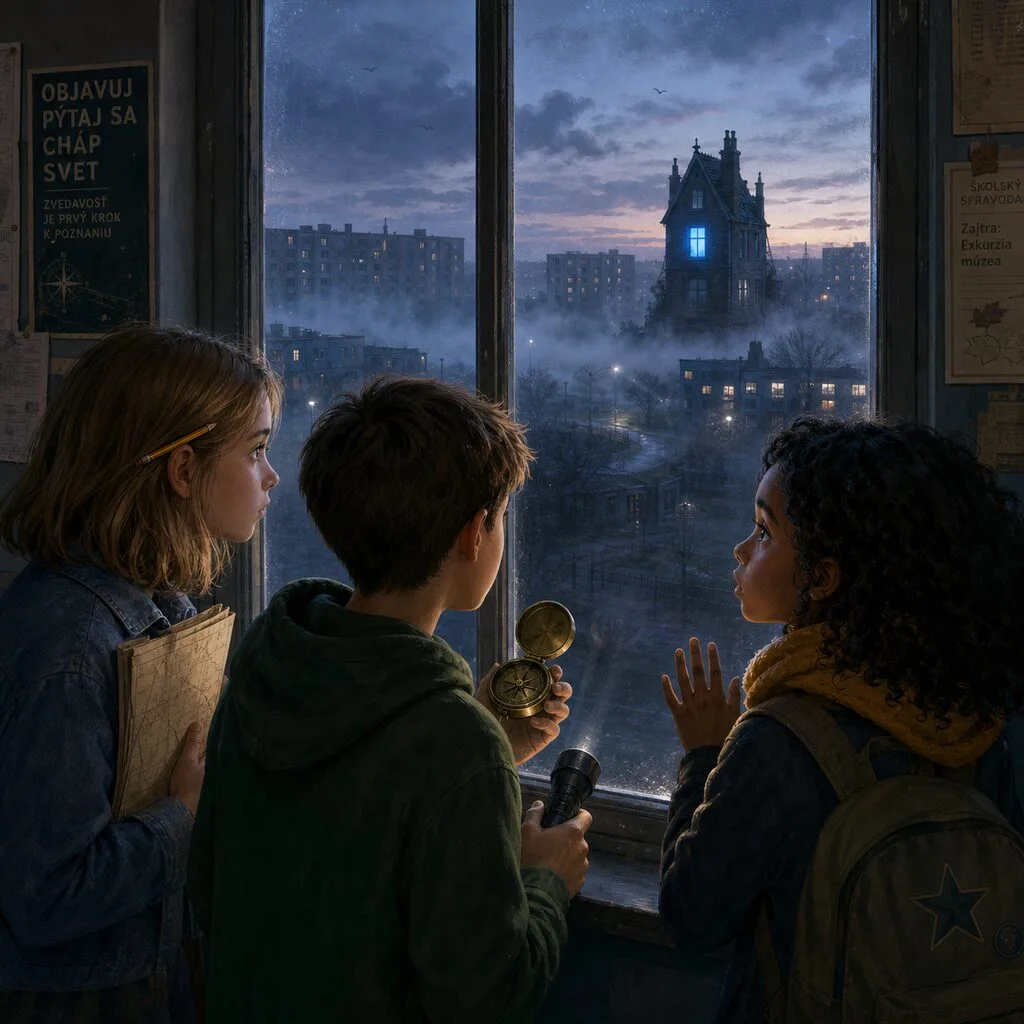
Mapa bez ulice je nová časť seriálu Dom na konci mapy, pripravená ako dvojjazyčný detský príbeh v slovenčine aj angličtine.
Mapa bez ulice: začína sa príbeh
Posledné slnečné pásy sa pomaly posúvali po podlahe školskej knižnice, keď pani Urbanová zazvonila malým mosadzným zvončekom.
„O desať minút zatvárame,“ oznámila spoza svojich strieborných okuliarov. „Knihy sa samy neuložia. Aspoň nie tie slušné.“
Nina sa naklonila nad stôl pri okne a zatvorila atlas. Hľadali niečo o starom meste, presnejšie o tom, ako kedysi vyzeralo okolie školy. Oliver tvrdil, že staré ulice museli byť zakreslené v mestských plánoch. Mia chcela nájsť fotografie, lebo podľa nej sa z nich dalo vyčítať viac než z čiar.
„V každej mape je poriadok,“ povedal Oliver a prstom ťukol na atlas. „Ulica, číslo, smer. Ľudia majú radi, keď veci niekam patria.“
„To hovoríš ty,“ odvetila Nina. Zastrčila si ceruzku pevnejšie za ucho. „Niekedy sa cesta skončí len preto, že ju ešte nikto nedokreslil.“
Medzitým Mia obišla stôl a zastala pri najnižšej polici. Medzi veľkými školskými zväzkami, ktoré mali na chrbtoch vyblednuté roky, si všimla tenký tmavý roh.
„Toto sem asi nepatrí,“ zašepkala.
Vytiahla knihu opatrne, akoby sa bála, že sa rozsype. Nemala názov ani obrázok. Jej obal bol sivohnedý, ošúchaný a na chrbte zostal iba svetlejší obdĺžnik po dávno odlepenej nálepke.
Nina si ju vzala do rúk. Papier voňal prachom, drevom a niečím suchým, čo pripomínalo povalu u starej mamy.
„Možno je to denník,“ nadhodil Oliver. „Alebo nudná účtovná kniha. Také bývajú najhrubšie.“
Kniha však nebola ani hrubá, ani zvlášť ťažká. Keď ju Nina otvorila približne v strede, spod strán sa vysunul preložený papier a ticho dopadol na stôl.
Všetci traja sa nad ním sklonili.
Bola to mapa ich mesta.
Najprv na nej nevideli nič nezvyčajné. Námestie, rieka, škola, zastávka autobusu, park pri nemocnici. Čiary ulíc boli nakreslené tenkým čiernym atramentom a niektoré názvy sa už takmer nedali prečítať.
Potom Nina ukázala na pravý dolný roh.
Za poslednou zakreslenou ulicou, tam, kde sa papier menil na prázdnu plochu, stál malý dom. Mal úzku strechu, dve okná a dvere bez chodníka. Nevedla k nemu cesta. Neobklopovali ho stromy ani plot. Len prázdne miesto.
„To je chyba,“ vyhlásil Oliver okamžite.
Mia sa zamračila. „Aká chyba nakreslí celý dom?“
„Možno niekto skúšal pero.“
„Dom sa neskúša perom,“ povedala Nina. Už si otvárala svoj malý zápisník s mapami. „A pozrite. Je presne pri sídlisku. Ale o kus ďalej, než siaha ktorákoľvek cesta.“
Pani Urbanová sa objavila na konci regála s kľúčmi na stužke. Nevyzerala prekvapene. Skôr tak, ako keby našla žiakov pri čítaní knihy, ktorú nemali odložiť na nesprávne miesto.
„Našli ste niečo zaujímavé?“ spýtala sa.
Oliver rýchlo prehodil rukou cez mapu. „Len starý plán mesta.“
Knihovníčka sa naň pozrela ponad okuliare. Jej pohľad sa na okamih zastavil pri malom dome. Potom prikývla.
„Staré veci bývajú zaujímavé, keď sa na ne človek pozerá dosť pozorne,“ povedala.
Nina si všimla, že pani Urbanová nepovedala, že mapa je obyčajná.
Mapu rozložili na väčšom stole medzi atlasy. Za oknami už tmavli koruny stromov a školská chodba za dverami bola prázdna. Z vedľajšej triedy zaznel kovový zvuk, možno niekto položil stoličku na lavicu. Oliver sa aj tak otočil.
„Prievan,“ zamrmlal, hoci okná boli zatvorené.
Nina porovnávala tenké čiary na papieri s novou mapou mesta v atlase. Každú križovatku si zapisovala do zošita. Pri sídlisku nakreslila tri paneláky, chodník, lavičku a prázdny pás trávy za nimi.
„Tu by to malo byť,“ povedala po chvíli. „Lenže tam nič nie je. Iba nízka tráva a stará lavička pri chodníku.“
„Niekedy tam býva hmla,“ doplnila Mia. „Keď ideme ráno do školy.“
Oliver vytiahol z vrecka malú baterku po dedovi. Pri nej mal pripevnený starý mosadzný kompas. Zapol svetlo a presunul ho nad mapu.
„Ak je atrament citlivý na teplo alebo svetlo, môže sa ukázať druhá vrstva,“ vysvetľoval. „To by bolo logické.“
Keď sa veci začnú meniť
Kužeľ svetla prešiel cez námestie, cez rieku a napokon zastal pri dome na kraji mapy.
Práve vtedy Mia zalapala po dychu.
„Pri okne!“
Všetci sa naklonili bližšie.
Vedľa horného okna domu sa objavila drobná modrastá bodka. Nebola väčšia než špendlíková hlavička. Napriek tomu ju bolo jasne vidieť. Pred chvíľou tam určite nebola.
Oliver baterku zhasol. Bodka nezmizla.
Zapol ju znova. Modrá farba zostala, len akoby v svetle jemne žiarila.
„To nie je možné,“ povedal chlapec tichšie, než zamýšľal.
Mia nepustila okraj stola. „Ten dom nevyzerá strašidelne.“
„Nie?“ Oliver sa pozrel na kresbu.
Dievča pokrútilo hlavou. „Vyzerá, akoby bol sám.“
Pani Urbanová prišla bližšie. Jej prsty, trochu pokrivené od veku, sa zastavili tesne nad papierom, ale mapy sa nedotkli.
„Kniha bez názvu bola ukrytá medzi školskými zväzkami veľmi dlho,“ povedala. „Možno čakala, kým ju niekto otvorí správnym spôsobom.“
„Čo to znamená?“ opýtala sa Nina.
Knihovníčka sa pousmiala, no neodpovedala priamo. „Že niektoré veci sa neukážu tomu, kto sa ponáhľa. A teraz sa už, prosím, ponáhľať musíme. Knižnica zatvára.“
Oliver ukázal na modrú bodku. „Je to trik? Starý papier, chemikália, svetlo?“
„Možno,“ povedala pani Urbanová. „A možno sa najprv pozrite poriadne, až potom vymýšľajte vysvetlenia.“
Mapu zložila späť do knihy, ale potom ju ešte raz vytiahla a podala Nine.
„Do rána ju majte pri sebe. Kniha zostane tu.“
Nina vzala papier tak opatrne, ako keby držala tenký ľad.
Vonku už bola noc, keď sa traja kamaráti stretli pri sídlisku. Oliver prišiel v zelenej mikine, s baterkou a kompasom. Mia mala okolo krku žltý šál a na chrbte malý ruksak s nášivkou hviezdy. Nina si priniesla zápisník, ceruzku a mapu vloženú medzi dve tvrdé dosky.
„Nemusíme ísť až tam,“ povedal Oliver hneď na úvod. „Môžeme sa najprv pozrieť z chodníka. Je to rozumný postup.“
„To znamená, že sa bojíš?“ spýtala sa Mia bez posmechu.
„To znamená, že nechcem zakopnúť o lavičku v tme.“
Nina sa usmiala, ale žalúdok mala stiahnutý. Cez deň jej prázdny pás trávy nikdy neprekážal. Teraz sa za panelákmi rozlievala hmla a každý tmavší ker vyzeral ako niečo, čo sa rozhodlo nehybne čakať.
Z jedného otvoreného okna sa ozývalo tikotanie starých hodín. Pravidelné tik, tik, tik sa miešalo so vzdialeným šumom áut.
Nina rozložila mapu pod pouličnou lampou. „Ak sedí mierka, máme ísť popri treťom paneláku. Potom doprava cez chodník a ešte asi dvadsať krokov.“
Oliver nasmeroval kompas. „Sever máme tamto. Aspoň niečo funguje normálne.“
Mia sa zahľadela do hmly. „Tu je vzduch chladnejší.“
„Vzduch nemá adresu,“ povedal Oliver.
„Nie, ale miesto môže mať náladu.“
Chlapec chcel niečo namietnuť, lenže v tej chvíli mu baterka na okamih zablikala. Svetlo zoslablo, potom sa vrátilo. Pred nimi ležala lavička, presne ako na Nininej kresbe.
Za ňou už nebola iba tráva.
V mäkkej hmle sa črtal úzky dom.
Mal dve poschodia a strechu, ktorá sa mierne nakláňala k jednému boku. Jeho steny neboli úplne jasné, akoby ich niekto nakreslil ceruzkou a potom ich trocha zotrel dlaňou. V hornom okne žiarilo tlmené modré svetlo.
Nina prestala dýchať.
Oliverova baterka mierila priamo na stavbu, no svetelný kužeľ sa jej nedotýkal. Končil tesne pred domom, ako keby sa svetlo rozhodlo ďalej neísť.
„Odraz,“ povedal Oliver. „Možno… odraz z okna.“
Pred nimi však nebolo žiadne okno, ktoré by mohlo odrážať dom, čo tam cez deň nestál.
Mia urobila malý krok dopredu. „Nezerá sa na nás nahnevane.“
„Dom sa nemôže pozerať,“ odsekol Oliver, ale jeho hlas sa zachvel.
O chvíľu modré svetlo v okne zosilnelo. Neoslepovalo. Pripomínalo lampu zakrytú modrým sklom. Za ním sa mihol iba slabý tieň, náznak niekoho pri ráme okna.
Nina cúvla až k lavičke.
Dom sa nerozbehol, neotvoril dvere ani nevydal žiadny hrozný zvuk. Len tam stál sám, tichý a krehký. Potom hmla prešla ponad trávu a stavba sa pomaly rozplynula.
Dôležitý okamih
Ostala lavička, vlhká tráva a prázdno.
„Videli ste to tiež?“ spýtal sa Oliver.
„Áno,“ odpovedala Mia.
Nina neprehovorila. Kľakla si pri lavičke, roztvorila mapu a pritisla ju k drevenej doske sedadla. Modrá bodka už nebola vedľa okna. Presunula sa priamo naň.
Na papieri sa jej farba jemne triasla, akoby v nej dýchalo malé svetielko.
„Označuje okno,“ povedala Nina. „Nie miesto pri dome. Presne okno.“
Mia sa posadila vedľa nej. „Možno tam niekto na niečo čaká.“
„Alebo je to miesto, kam sa máme pozrieť nabudúce,“ dodal Oliver. Tentoraz neznel, že našiel odpoveď. Skôr ako keby si ju opatrne skúšal vysloviť.
Hmla sa pohla bližšie k lavičke. Nina si uvedomila, že pevne drží ceruzku, až ju bolia prsty.
„Nechcem ísť bližšie,“ priznala sa.
Oliver sa na ňu otočil. „Nemusíme.“
„Nie preto, že by som nechcela zistiť, čo to je.“ Nina sa zahľadela na prázdne miesto, kde stál dom. „Chcem. Veľmi. Len… tma ma znervózňuje. A keď sa ten dom ukázal, mala som pocit, že mi nohy prestali patriť.“
Mia sa k nej naklonila. „To je v poriadku. Aj ja sa bojím. Len nemám pocit, že by nám chcel ublížiť.“
Oliver podal Nine baterku. „Drž ju ty. Budeme svietiť spolu.“
Chvíľu sa pozerala na malú kovovú rukoväť. Potom ju prijala. Jej prsty sa dotkli Oliverových a svetlo ostalo stabilné.
„Zajtra sa vrátime,“ rozhodla Nina. „Ale pripravenejší. Zoberiem si presnejší nákres. Ty možno nájdeš, či tu kedysi stála nejaká budova. A Mia…“
„Ja budem počúvať, či je tu zase tak ticho,“ doplnila Mia.
„To je plán,“ uznal Oliver. „Nie úplne normálny plán, ale plán.“
Spoločne sa vrátili k jasnejšiemu chodníku pri škole. Pri vchode svietila pouličná lampa a pod jej svetlom stála pani Urbanová. Zamykala bočné dvere knižnice, akoby tam na nich čakala, hoci sa na nič nepýtala.
Nina rozprestrela mapu naposledy. Pri okne malého domu sa modrá bodka usadila celkom zreteľne. Okraj papiera na okamih slabo zablikal.
Pani Urbanová sa naň pozrela a ticho povedala: „Zajtra budete potrebovať odvahu aj trpezlivosť.“
Oliver prehltol. „Aspoň ten dom nevyžaduje domáce úlohy.“
Mia sa zasmiala prvá. Nina potom tiež, hoci stále cítila v hrudi jemné chvenie.
Mapu zložila, vložila medzi dosky zápisníka a vykročila domov medzi kamarátmi. Za nimi ostala škola, hmla a prázdne miesto pri sídlisku. Na papieri však pri malom okne svietila bodka, ktorá tam čakala na ďalšiu noc.
Pokračovanie nabudúce…
The House at the Edge of the Map, part 1: The Map Without a Street
The Story Begins
The last полос of sunlight moved slowly across the school library floor when Mrs Urbanová rang a small brass bell.
"We close in ten minutes," she said from behind her silver glasses. "Books do not put themselves away. At least, not the well-behaved ones."
Nina leaned over the table by the window and closed the atlas. They were looking for something about the old town, more exactly about what the area around the school used to look like. Oliver said old streets must have been marked in city plans. Mia wanted to find photos, because, in her opinion, photos could tell you more than lines.
"Every map has order," Oliver said, tapping the atlas with one finger. "Street, number, direction. People like it when things belong somewhere."
"That sounds like you," Nina answered. She pushed her pencil more firmly behind her ear. "Sometimes a road ends only because no one has drawn the rest yet."
Meanwhile, Mia walked around the table and stopped by the lowest shelf. Between the big school volumes with faded years on their spines, she noticed a thin dark corner.
"This probably does not belong here," she whispered.
She pulled the book out carefully, as if she was afraid it might fall apart. It had no title and no picture. Its cover was grey-brown and worn, and on the spine there was only a lighter rectangle where a label had been long ago.
Nina took it in her hands. The paper smelled of dust, wood, and something dry, like the attic at her grandmother’s house.
"Maybe it is a diary," Oliver guessed. "Or a boring account book. Those are usually the thickest."
But the book was neither thick nor especially heavy. When Nina opened it near the middle, a folded sheet slid out from between the pages and landed quietly on the table.
All three of them bent over it.
It was a map of their town.
At first, they saw nothing strange. There was the square, the river, the school, the bus stop, and the park by the hospital. The streets were drawn in thin black ink, and some names were already hard to read.
Then Nina pointed to the lower right corner.
Beyond the last street on the map, where the paper became empty space, stood a small house. It had a narrow roof, two windows, and a door with no path leading to it. No road went there. No trees or fences stood around it. Only blank space.
"That is a mistake," Oliver said at once.
Mia frowned. "What kind of mistake draws a whole house?"
"Maybe someone was testing the pen."
"You do not test a house with a pen," Nina said. She was already opening her small notebook of maps. "And look. It is exactly by the housing estate. But a little farther than any road reaches."
Mrs Urbanová appeared at the end of the shelf with her keys on a ribbon. She did not look surprised. She looked more like someone who had found students reading a book they should not have left in the wrong place.
"Did you find something interesting?" she asked.
Oliver quickly laid a hand over the map. "Just an old town plan."
The librarian looked at him over her glasses. Her eyes stopped for a moment on the small house. Then she nodded.
"Old things become interesting when you look at them closely enough," she said.
Nina noticed that Mrs Urbanová did not say the map was ordinary.
They spread the map out again on a larger table between the atlases. Outside the windows, the treetops were already darkening, and the school corridor behind the door was empty. From a nearby classroom came a metal sound, maybe someone putting a chair on a desk. Oliver still turned around.
When Things Start to Change
"A draft," he muttered, although the windows were closed.
Nina compared the thin lines on the paper with the new town map in the atlas. She wrote every crossing in her notebook. Near the housing estate, she drew three apartment blocks, a path, a bench, and the empty strip of grass behind them.
"It should be here," she said after a while. "But there is nothing there. Only short grass and an old bench by the path."
"Sometimes there is fog there," Mia added. "In the morning, when we walk to school."
Oliver took a small flashlight from his pocket. It was his grandfather’s, and an old brass compass was attached to it. He switched on the light and moved it over the map.
"If the ink reacts to heat or light, another layer may show up," he explained. "That would make sense."
The beam crossed the square, crossed the river, and finally stopped at the house at the edge of the map.
At that exact moment, Mia gasped.
"By the window!"
All three leaned closer.
Next to the upper window of the house, a tiny blue dot had appeared. It was no bigger than a pinhead. Even so, it was easy to see. It definitely had not been there a moment ago.
Oliver switched off the flashlight. The dot did not disappear.
He turned it on again. The blue color stayed, only now it seemed to glow softly in the light.
"That is not possible," the boy said more quietly than he meant to.
Mia kept her hands on the edge of the table. "That house does not look scary."
"It does not?" Oliver looked at the drawing.
The girl shook her head. "It looks like it is alone."
Mrs Urbanová came closer. Her fingers, a little bent with age, stopped just above the paper, but she did not touch the map.
"The book without a title was hidden among the school volumes for a very long time," she said. "Maybe it was waiting for someone to open it the right way."
"What does that mean?" Nina asked.
The librarian smiled a little, but she did not answer directly. "It means some things do not show themselves to the person who is in a hurry. And now we really must hurry. The library is closing."
Oliver pointed at the blue dot. "Is it a trick? Old paper, chemical, light?"
"Maybe," Mrs Urbanová said. "And maybe you should look carefully first, and only then try to explain it."
She put the map back into the book, but then she took it out again and handed it to Nina.
"Keep it with you until morning. The book stays here."
Nina took the paper as carefully as if she were holding thin ice.
Outside, night had already fallen when the three friends met by the housing estate. Oliver came in a green hoodie, with the flashlight and compass. Mia had a yellow scarf around her neck and a small backpack with a star patch on her back. Nina brought her notebook, a pencil, and the map between two hard covers.
"We do not have to go all the way there," Oliver said at once. "We can look from the path first. That is the sensible way."
"Does that mean you are scared?" Mia asked without teasing him.
"It means I do not want to trip over a bench in the dark."
Nina smiled, but her stomach felt tight. During the day, the empty strip of grass had never bothered her. Now fog spread behind the apartment blocks, and every darker bush looked like something waiting very still.
An Important Moment
From one open window came the ticking of old clocks. The regular tick, tick, tick mixed with the distant hum of cars.
Nina spread the map under a streetlamp. "If the scale is right, we should go past the third apartment block. Then right across the path and about twenty more steps."
Oliver pointed the compass. "North is that way. At least one thing works normally."
Mia looked into the fog. "The air is colder here."
"Air does not have an address," Oliver said.
"No, but a place can have a mood."
The boy was about to argue, but just then his flashlight flickered for a moment. The light dimmed, then came back. Ahead of them, there was a bench, exactly like the one on Nina’s drawing.
Behind it, there was no longer only grass.
In the soft fog, a narrow house took shape.
It had two floors and a roof that leaned a little to one side. Its walls were not completely clear, as if someone had drawn them with a pencil and then rubbed them a little with a hand. A soft blue light glowed in the upper window.
Nina stopped breathing.
Oliver’s flashlight pointed straight at the building, but the beam did not touch it. It ended just before the house, as if the light had decided not to go any farther.
"Reflection," Oliver said. "Maybe… a reflection from a window."
But there was no window in front of them that could reflect a house that had not stood there during the day.
Mia took a small step forward. "It does not look angry."
"A house cannot look," Oliver said sharply, but his voice shook.
A moment later, the blue light in the window grew stronger. It did not blind them. It reminded Nina of a lamp covered with blue glass. Behind it, only a faint shadow moved, the hint of someone near the window frame.
Nina stepped back until she reached the bench.
The house did not run, did not open a door, and did not make any terrible sound. It only stood there, alone, quiet, and fragile. Then the fog passed over the grass, and the building slowly faded away.
Only the bench, the wet grass, and emptiness remained.
"Did you see that too?" Oliver asked.
"Yes," Mia answered.
Nina did not speak. She knelt by the bench, opened the map, and pressed it against the wooden seat board. The blue dot was no longer beside the window. It had moved right onto it.
On the paper, its color trembled softly, as if a little light was breathing inside it.
"It marks the window," Nina said. "Not the place beside the house. Exactly the window."
Mia sat down next to her. "Maybe someone there is waiting for something."
"Or maybe it is the place we should look at next," Oliver added. This time he did not sound as if he had found an answer. He sounded as if he was carefully trying it out.
The fog moved closer to the bench. Nina realized she was gripping her pencil so hard that her fingers hurt.
"I do not want to go closer," she admitted.
Oliver turned to her. "We do not have to."
"Not because I do not want to find out what it is." Nina looked at the empty place where the house had stood. "I do. Very much. Only… the dark makes me nervous. And when that house appeared, I felt like my legs did not belong to me anymore."
Mia leaned toward her. "That is all right. I am scared too. I just do not feel that it wants to hurt us."
What Comes Next
Oliver handed Nina the flashlight. "You hold it. We will shine together."
For a moment, she looked at the small metal handle. Then she took it. Her fingers touched Oliver’s, and the light stayed steady.
"We will come back tomorrow," Nina decided. "But better prepared. I will make a more exact drawing. You can maybe find out whether a building ever stood here. And Mia…"
"I will listen to whether it is that quiet again," Mia finished.
"That is a plan," Oliver said. "Not a normal plan, but a plan."
Together, they walked back to the brighter path by the school. By the entrance, a streetlamp was shining, and Mrs Urbanová stood under its light, locking the side door of the library as if she had been waiting for them, although she did not ask anything.
Nina spread the map out one last time. At the window of the small house, the blue dot settled clearly in place. The edge of the paper flickered faintly for a moment.
Mrs Urbanová looked at it and said quietly, "Tomorrow you will need courage and patience."
Oliver swallowed. "At least the house does not give homework."
Mia laughed first. Then Nina laughed too, even though she still felt a soft tremble in her chest.
She folded the map, slipped it between the covers of her notebook, and walked home between her friends. Behind them stayed the school, the fog, and the empty place by the housing estate. But on the paper, by the small window, a dot was shining, waiting for the next night.
To be continued…