
Vypočujte si slovenskú audio verziu príbehu
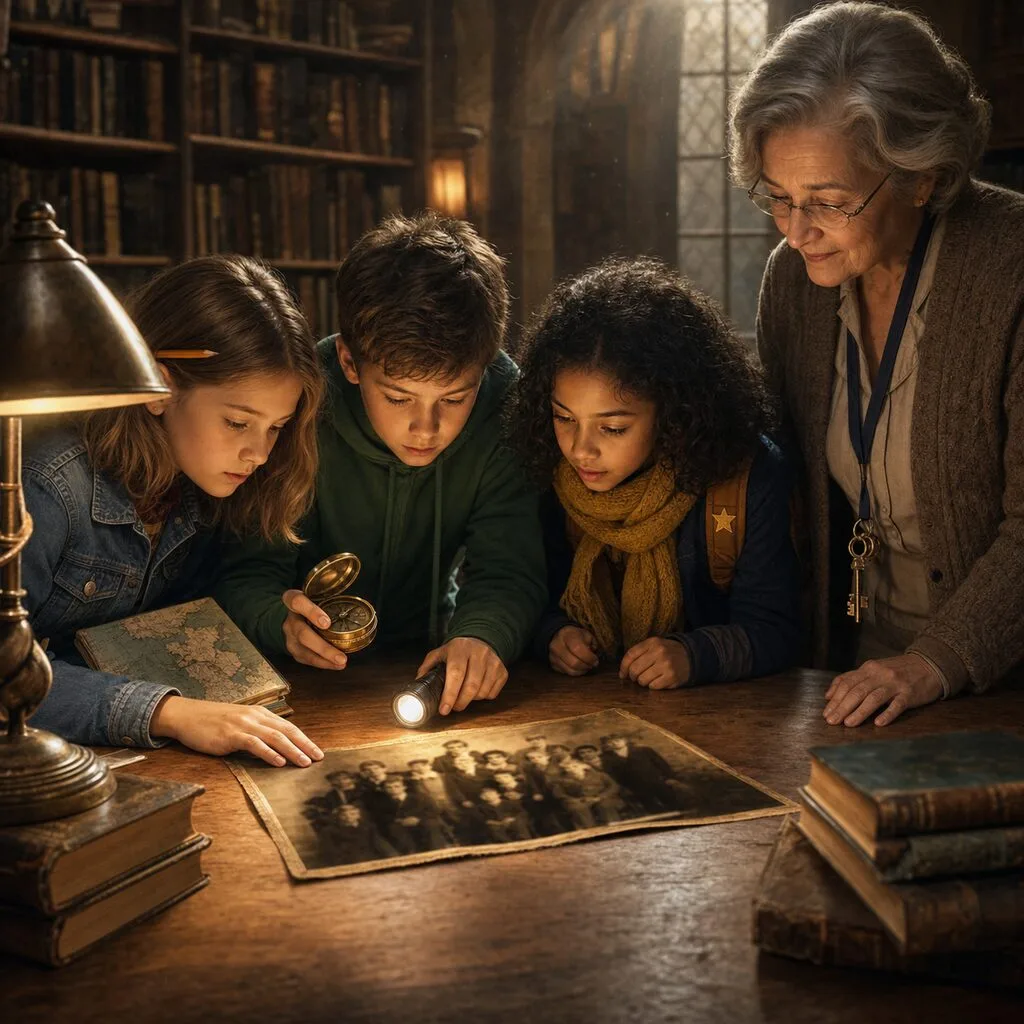
Chlapec na fotografii je nová časť seriálu Dom na konci mapy, pripravená ako dvojjazyčný detský príbeh v slovenčine aj angličtine.
Chlapec na fotografii: začína sa príbeh
Starú fotografiu položila Nina presne do kruhu svetla pod lampou. Lampa stála na najnižšom stole v školskej knižnici a jej žlté sklo bolo poškrabané drobnými čiarami. Vonku za vysokými oknami stekal po tabuliach dážď. Vnútri voňalo drevo, prach a stránky kníh, ktoré celé roky nik neotvoril.
„Toto je lepšie než na chodbe,“ povedal Oliver a vytiahol malú baterku. „Tu aspoň vieme, odkiaľ ide svetlo.“
„A vieme, kam sa schovať, keď fotka začne spievať?“ spýtala sa Mia.
Oliver sa na ňu pozrel. „Fotografie nespievajú.“
„To bol vtip,“ povedala Mia pokojne. „Ale trochu slabý, uznávam.“
Nina sa usmiala, hoci sa jej prsty pri okraji zošita s mapami pevnejšie stisli. Fotografia, ktorú našli po daždi pri dome na konci mapy, ležala medzi nimi. Bola malá, pokrčená a na rohoch zmäknutá vlhkosťou. Zachytávala triedu detí pri laviciach. Väčšina tvárí bola sivá, no stále rozoznateľná. Len chlapec v zadnom rade zostával rozmazaný, akoby sa niekto pokúsil jeho podobu zotrieť gumou.
Pod lampou sa na papieri zablysol tenký prúžok svetla.
„Pozrite,“ zašepkala Nina.
Pri ľavom okraji fotografie sa ukázal roh miestnosti. Predtým tam bola iba sivá škvrna. Teraz bolo vidieť kúsok okna, pás tmavšej steny a dve lavice postavené šikmo za sebou.
Nina vytiahla ceruzku spoza ucha a začala kresliť.
„To nie je obyčajný roh,“ povedala. „Lavice nestoja v radoch. Aspoň nie úplne. Tá zadná je otočená k oknu.“
Oliver naklonil hlavu takmer k stolu. „Možno je fotka poškodená. Keď je papier zvlnený, veci vyzerajú krivo.“
„Nie,“ ozvala sa Mia. Jej teplé hnedé oči sa upierali na rozmazaného chlapca. „On stojí pri tej otočenej lavici. Ale nepozerá sa na fotoaparát.“
V knižnici sa na chvíľu zdalo chladnejšie. Nie nepríjemne, skôr ako keď niekto otvorí dvere do prázdnej chodby. Mia si pritiahla žltý šál bližšie ku krku.
„Kam sa pozerá?“ spýtal sa Oliver.
Dievča chvíľu mlčalo. „Akoby čakal, že ho niekto zavolá.“
Oliver prešiel baterkou cez fotografiu. Kužeľ bieleho svetla sa na papieri pohol, no chlapcova tvár sa v ňom nezmenila na nič jasnejšie. Keď však baterku vypol a zostalo iba mäkké svetlo lampy, rozmazané črty sa jemne posunuli.
Nina videla tenký obrys ucha a líniu líca.
Oliver videl niečo celkom iné.
„V pozadí je chyba,“ povedal náhle. „Za nimi. Na nástenke.“
„Aká chyba?“
Chlapec ukázal nechtom na miesto nad hlavičkami detí. „Tá nástenka má zelený rám. Lenže na fotke je všetko staré. Lavice, okná, skrinka. Zelené plastové rámy sa v škole používali až oveľa neskôr. Aspoň podľa fotiek v chodbe.“
Mia sa naklonila. „Ja tam nevidím nástenku. Vidím dvere.“
„Dvere tam nemôžu byť,“ namietol Oliver. „Pozri, tie dve svetlé čiary sú pripináčiky.“
„Alebo kľučka a okraj skla,“ povedala Mia.
Nina si fotografiu opatrne vzala. V jej rukách sa obraz znovu zmenil. Pri stene sa objavil sotva viditeľný náčrt štyroch lavíc a medzi nimi úzka cesta. Žiadne dvere, žiadna nástenka. Len priestor, ktorý jej pripomínal plánek.
„Každý vidíme niečo iné,“ povedala.
Oliver si založil ruky. „To nie je možné. Papier predsa nemôže ukazovať tri rôzne veci naraz.“
„Možno neukazuje tri veci,“ navrhla Mia. „Možno ukazuje tú, ktorú práve potrebujeme nájsť.“
„Alebo tú, ktorú si vymýšľame,“ odvetil Oliver ostrejšie, než chcel.
Ticho po jeho slovách nebolo hrozivé. Skôr ťažké. Mia sklopila zrak a Nina prestala kresliť. Vtedy sa fotografia v svetle lampy nepatrne zachvela. Papier sa ani nepohol. Len žltý odlesk na jeho povrchu na okamih zavlnil, podobne ako hladina vody.
Oliver zbledol.
„Dobre,“ povedal po chvíli. „To som si nevymyslel.“
„Ani my nie,“ odpovedala Nina.
Práve vtedy sa medzi policami ozvali kroky. Pani Urbanová sa objavila s vozíkom plným kníh. Na nose mala strieborné okuliare a na stužke pri svetri sa jej ticho pohupovali kľúče.
„Dúfam, že ste sa nerozhodli čítať zakázané knihy po tme,“ povedala prísne milým hlasom.
Keď sa veci začnú meniť
Oliver rýchlo prikryl fotografiu dlaňou. Potom si uvedomil, že to vyzerá ešte podozrivejšie, a ruku stiahol.
Pani Urbanová sa zastavila.
Úsmev jej zmizol z tváre, ale nevyzerala nahnevane. Skôr prekvapene, akoby na stole zazrela predmet, ktorý mala zostať len v spomienke.
„Odkiaľ to máte?“ opýtala sa potichu.
Nina povedala pravdu. Vysvetlila jej, že fotografiu našli pri dome na konci mapy, v mokrej tráve pri starom múre. Nespomenula všetko: svetlo v prázdnom okne, tiché kroky v chodbe ani to, ako sa dom objavil tam, kde podľa mapy nemala byť žiadna ulica. Pani Urbanová už aj tak počúvala veľmi pozorne.
Keď Nina skončila, knihovníčka si prisunula stoličku. Nechytila fotografiu hneď. Najprv si upravila okuliare a zahľadela sa na rohy lavíc.
„Túto triedu poznám,“ povedala.
Mia zdvihla hlavu. „Boli ste tam?“
„Nie ako žiačka. Bola som vtedy mladá pomocníčka v knižnici. A občas som nosila učiteľom knihy do tried.“ Prstom sa zastavila tesne nad fotografiou. „Tieto lavice stáli v starej učebni na konci západnej chodby. Dnes je tam sklad výtvarných potrieb.“
Oliver ukázal na zelený detail. „A toto?“
Pani Urbanová sa zamračila. „To nebola nástenka. Bola to sklenená výplň dverí. Mala zelený rám, ale nie plastový. Kovový. Neskôr ju vymenili.“
Oliver otvoril ústa, no nič nepovedal. Mia naňho len krátko pozrela, bez víťazného úsmevu.
„Mala by som vám niečo ukázať,“ pokračovala knihovníčka. „Ak s tým budete zaobchádzať opatrne.“
Kľúče na jej stužke zazvonili, keď prešla k úzkej skrini na konci knižnice. Dolná časť bola zamknutá. Za matným sklom ležali veľké albumy, niektoré zabalené v sivom papieri. Pani Urbanová vytiahla jeden, ktorý bol potiahnutý tmavomodrým plátnom. Na chrbte sa sotva dalo prečítať: Škola – roky 19…
Položila ho na stôl s oboma rukami.
„Papier je starší než vy všetci dohromady,“ povedala. „Takže žiadne mastné prsty, žiadne ohýbanie strán a Oliver nebude na nič svietiť baterkou, ak to nie je naozaj potrebné.“
„To bolo namierené na mňa?“ spýtal sa Oliver.
„Veľmi presne,“ odvetila pani Urbanová.
Listovali pomaly. Na stránkach boli zábery zo školských výletov, športových dní aj zo slávností, pri ktorých deti držali papierové kvety. Neskôr sa objavili triedne fotografie. Pod každou bol dátum a trieda napísaná atramentom, ktorý už bledol do hneda.
Nina si všimla číslo skôr než ostatní.
„5.B,“ prečítala.
Na stránke boli dve fotografie. Na prvej stáli deti pred školou, pod vysokou lipou. Na druhej sedeli v triede pri laviciach. Tá druhá sa podobala ich rozmazanej snímke tak veľmi, až Oliverovi vypadol kompas z ruky a ticho cinkol o drevený stôl.
„To je tá miestnosť,“ vydýchla Nina. „Okno je na rovnakom mieste. A tá otočená lavica… tu je tiež.“
Na fotografii v albume sedel pri otočenej lavici chlapec v košeli s malým tmavým odznakom pri golieri. Jeho tvár bola nejasná, nie však rozmazaná. Hlava bola odvrátená bokom, akoby sa práve vtedy obrátil za niečím pri dverách.
Oliver priblížil okuliare pani Urbanovej k stránke, ale nedotkol sa jej. „Ten odznak. Je rovnaký ako na našej fotke. Taký malý štvorec s čiarou cez stred.“
Mia prikývla. „Preto ho Nina videla pri lavici. A ty si videl dvere.“
Pri dolnom okraji stránky boli mená. Väčšina sa dala prečítať: Zuzana, Erik, Hana, Roman. Jedno meno však bolo poškodené. Roh papiera bol odretý, akoby ho celé roky šúchali prsty. Zostalo len niekoľko písmen.
Samue…
Pani Urbanová si zložila okuliare. Držala ich v ruke a dlho hľadela na útržok mena.
„Samuel,“ povedala napokon. Jej hlas bol tichý, ale istý.
Všetci traja sa pozreli na chlapca pri otočenej lavici.
„Pamätáte si ho?“ opýtala sa Mia opatrne.
Knihovníčka sa nadýchla. „Pamätám si, že som to meno videla v zozname. A pamätám si, že raz nechal vrátenú knihu na pulte bez lístka. Mala v sebe záložku s nakreslenou hviezdou.“ Na chvíľu sa usmiala, potom však pokrútila hlavou. „Je zvláštne, ako málo toho človeku zostane. Neviem, aké mal oči. Neviem, či býval blízko školy. Neviem ani, prečo pri jeho mene nie je priezvisko.“
Dôležitý okamih
„Možno sa stránka poškodila náhodou,“ povedal Oliver, no už bez svojej obvyklej istoty.
„Možno,“ súhlasila pani Urbanová. „Staré záznamy sa sťahovali z jednej kancelárie do druhej. Niektoré sa stratili, iné boli prepísané nepresne. A niektoré triedy si pamätáme iba podľa toho, čo nám o nich povedal niekto iný.“
Nina položila vedľa albumu vlastný nákres. Čiary lavíc sa zhodovali. Pri zadnej stene však nakreslila malý prázdny priestor, ktorý na albumovej fotografii nebol celkom vidieť.
„Tu niečo chýba,“ povedala. „Ale neviem čo.“
Oliver sa zadíval na rozmazanú fotografiu pod lampou. „Ja som chcel, aby sa ukázal jeden jasný dôkaz. Meno, dátum, presná odpoveď. Lenže namiesto toho každý dostal inú časť.“
„To nemusí byť chyba,“ povedala Mia. „Niekedy si ľudia pamätajú izbu, niekedy odznak. A niekedy len to, že niekto čakal sám.“
Chlapec si prstami pootočil starý mosadzný kompas. Ihla sa na okamih zachvela, potom sa upokojila. „Ak ho každý videl trochu inak, možno preto jeho tvár na fotke nevie zostať rovnaká.“
Pani Urbanová zavrela album len napoly, aby nezakryla útržok mena. „Samuel bol v tej triede. To vieme. Vieme aj to, že sa naňho postupne zabudlo viac, než by sa malo. Zvyšok zatiaľ nevieme.“
Mia sa pozrela na rozmazaného chlapca. Chlad v knižnici už necítila. Z fotografie sa nevracal strach. Bol to smútok, ktorý konečne niekto prestal prehliadať.
Nina vytiahla starú mapu mesta. Nosila ju zloženú v obale na dne zošita a jej okraje boli jemné ako suché lístie. Keď ju rozprestrela vedľa albumu, fotografia sa zľahka posunula po stole. Zastala na samom kraji mapy, pri mieste, kde sa papier kedysi natrhol.
Pod jej rohom sa objavila tmavá čiarka.
Nina sa sklonila tak blízko, až sa jej vlasy dotkli stola.
„Nie je to čiarka,“ povedala.
Žlté svetlo lampy sa rozochvelo. Na okraji mapy, vedľa miesta bez názvu, sa na pár sekúnd ukázalo malé písmeno S. Nebolo napísané atramentom. Vyzeralo, akoby ho papier vytlačil zo svojej druhej strany.
Oliver už nepovedal, že to musí mať jednoduché vysvetlenie. Namiesto toho si ticho vložil kompas do vrecka.
„To miesto sme ešte nehľadali,“ všimla si Nina.
Mia prešla prstom tesne nad písmenom, no nedotkla sa ho. „Možno tam nie je odpoveď. Možno ďalšia spomienka.“
Pani Urbanová nechala album otvorený pri mene Samue… a usmiala sa na deti ponad strieborné okuliare.
„Tak potom budete potrebovať mapu, odvahu a niekoho, kto si všíma aj veci, ktoré sa nedajú hneď dokázať.“
Za oknom dážď pomaly ustával. Na stole ležala fotografia, otvorený album a mapa s písmenom S. Chlapec v zadnom rade už nevyzeral ako tieň bez mena. Stále bol rozmazaný, stále vzdialený, ale po prvý raz v ich príbehu mal smer.
Pokračovanie nabudúce…
The House at the Edge of the Map, part 6: The Boy in the Photograph
The Story Begins
Nina placed the old photograph exactly in the circle of light under the lamp. The lamp stood on the lowest table in the school library, and its yellow glass was scratched with tiny lines. Outside the tall windows, rain ran down the panes. Inside, the room smelled of wood, dust, and pages from books that no one had opened for years.
“This is better than the hallway,” Oliver said, pulling out his small flashlight. “At least here we know where the light comes from.”
“And do we also know where to hide if the photo starts singing?” Mia asked.
Oliver looked at her. “Photographs do not sing.”
“That was a joke,” Mia said calmly. “A weak one, I admit.”
Nina smiled, even though her fingers tightened around the edge of her map notebook. The photograph they had found after the rain near the house at the edge of the map lay between them. It was small, creased, and soft at the corners from the wet grass. It showed a classroom of children at their desks. Most of the faces were gray, but still clear enough to see. Only the boy in the back row stayed blurry, as if someone had tried to rub his image away with an eraser.
Under the lamp, a thin strip of light shone across the paper.
“Look,” Nina whispered.
At the left edge of the photograph, a corner of the room appeared. Before, there had only been a gray patch. Now they could see a bit of a window, a strip of darker wall, and two desks placed at an angle behind each other.
Nina pulled the pencil from behind her ear and began to draw.
“That is not a normal corner,” she said. “The desks are not in straight rows. At least not completely. The back one is turned toward the window.”
Oliver bent so close to the table that his head was almost over the picture. “Maybe the photo is damaged. When paper bends, things look crooked.”
“No,” Mia said. Her warm brown eyes stayed fixed on the blurry boy. “He is standing by that turned desk. But he is not looking at the camera.”
For a moment, the library felt colder. Not in a bad way, more like when someone opens a door to an empty hallway. Mia pulled her yellow scarf closer to her neck.
“Where is he looking?” Oliver asked.
The girl was quiet for a moment. “As if he is waiting for someone to call him.”
Oliver moved the flashlight over the photograph. The white beam slid across the paper, but the boy’s face did not become any clearer. Then he switched the flashlight off, and only the soft light of the lamp remained. In that light, the blurred features shifted a little.
Nina could make out the thin shape of an ear and the line of a cheek.
Oliver saw something else completely.
“There is a mistake in the background,” he said suddenly. “Behind them. On the wall board.”
“What mistake?”
He pointed with a fingernail to the space above the children’s heads. “That board has a green frame. But in the photo, everything is old. The desks, the windows, the cabinet. Green plastic frames were used at school much later. At least, that is what the photos in the hallway show.”
Mia leaned closer. “I do not see a board. I see a door.”
“That cannot be a door,” Oliver argued. “Look, those two light lines are pushpins.”
“Or a handle and the edge of glass,” Mia said.
Carefully, Nina took the photograph into her hands. In her fingers, the image changed again. Near the wall, she saw the faint outline of four desks and a narrow path between them. No door, no board. Just a space that reminded her of a floor plan.
When Things Start to Change
“We all see something different,” she said.
Oliver crossed his arms. “That is impossible. A piece of paper cannot show three different things at the same time.”
“Maybe it does not show three things,” Mia suggested. “Maybe it shows the one we need to find right now.”
“Or the one we are making up,” he answered more sharply than he meant to.
The silence after his words was not frightening. It was simply heavy. Mia looked down, and Nina stopped drawing. Then the photograph gave a tiny shake in the lamp light. The paper itself did not move. Only the yellow reflection on its surface rippled for a moment, like water.
Oliver went pale.
“All right,” he said after a while. “I did not make that up.”
“Neither did we,” Nina answered.
Just then, footsteps sounded between the shelves. Mrs Urbanová appeared, pushing a cart full of books. Silver glasses sat on her nose, and keys hung quietly from the ribbon on her sweater.
“I hope you have not decided to read forbidden books in the dark,” she said in a strict but kind voice.
Oliver quickly covered the photograph with his hand. Then he realized that made him look even more suspicious, so he pulled his hand back.
Mrs Urbanová stopped.
The smile left her face, but she did not look angry. She looked surprised, as if she had just seen an object on the table that was meant to stay only in memory.
“Where did you get that?” she asked softly.
Nina told the truth. She explained that they had found the photograph near the house at the edge of the map, in wet grass by an old wall. She did not say everything: the light in the empty window, the quiet steps in the hallway, or how the house had appeared where the map showed no street at all. Even so, Mrs Urbanová listened very carefully.
When Nina finished, the librarian pulled up a chair. She did not take the photograph right away. First she adjusted her glasses and studied the corners of the desks.
“I know this classroom,” she said.
Mia lifted her head. “Did you go there?”
“Not as a student. I was a young helper in the library then. And sometimes I carried books to teachers in their classrooms.” Her finger stopped just above the photo. “These desks stood in the old classroom at the end of the west corridor. Today it is a storage room for art supplies.”
Oliver pointed at the green detail. “And this?”
Mrs Urbanová frowned. “That was not a board. It was a glass panel in the door. It had a green frame, but not a plastic one. It was metal. Later they replaced it.”
Oliver opened his mouth, but nothing came out. Mia only gave him a short look, without any smile of victory.
“I should show you something,” the librarian continued. “If you handle it carefully.”
The keys on her ribbon clinked softly as she walked to the narrow cabinet at the end of the library. The lower part was locked. Behind the cloudy glass lay large albums, some wrapped in gray paper. Mrs Urbanová pulled out one covered in dark blue cloth. On the spine, the words could hardly be read: School – years 19…
She placed it on the table with both hands.
“The paper is older than all of you put together,” she said. “So no greasy fingers, no bending the pages, and Oliver does not shine his flashlight on anything unless it is really necessary.”
“Was that meant for me?” Oliver asked.
“Very exactly,” Mrs Urbanová replied.
An Important Moment
They turned the pages slowly. There were pictures from school trips, sports days, and celebrations where children held paper flowers. Later came class photos. Under each one was a date and a class written in ink that had faded to brown.
Nina noticed the number before the others did.
“5.B,” she read.
On the page, there were two photographs. In the first, the children stood in front of the school under a tall lime tree. In the second, they sat in the classroom at their desks. That second picture looked so much like their blurry photo that Oliver’s compass slipped from his hand and gave a quiet clink against the wooden table.
“That is the room,” Nina breathed. “The window is in the same place. And that turned desk… it is here too.”
In the album photo, a boy in a shirt sat at the turned desk. A small dark badge was pinned near his collar. His face was unclear, but not blurred. His head was turned away, as if he had just looked toward something by the door.
Oliver brought Mrs Urbanová’s glasses closer to the page, but he did not touch it. “That badge. It is the same as on our photo. A little square with a line across the middle.”
Mia nodded. “That is why Nina saw him by the desk. And you saw the door.”
At the bottom of the page were names. Most of them could be read: Zuzana, Erik, Hana, Roman. One name, however, was damaged. The corner of the paper was worn away, as if fingers had brushed over it for years. Only a few letters remained.
Samue…
Mrs Urbanová took off her glasses. She held them in one hand and looked at the torn name for a long time.
“Samuel,” she said at last. Her voice was quiet, but sure.
All three children looked at the boy by the turned desk.
“Do you remember him?” Mia asked carefully.
The librarian drew in a breath. “I remember seeing that name in a list. And I remember that once he left a returned book on the counter without a slip. It had a bookmark inside with a star drawn on it.” For a moment she smiled, then shook her head. “It is strange how little remains with a person. I do not know what his eyes looked like. I do not know whether he lived near the school. I do not even know why there is no family name beside his.”
“Maybe the page was damaged by chance,” Oliver said, but now he sounded less sure than usual.
“Maybe,” Mrs Urbanová agreed. “Old records were moved from one office to another. Some were lost, others were copied badly. And some classes are remembered only because someone else once told us about them.”
Nina placed her own drawing beside the album. The lines of the desks matched. Near the back wall, however, she drew a small empty space that the album photo did not show clearly.
“Something is missing here,” she said. “But I do not know what.”
Oliver stared at the blurry photograph under the lamp. “I wanted one clear clue. A name, a date, one exact answer. Instead, each of us got a different piece.”
“That may not be a mistake,” Mia said. “Sometimes people remember the room, sometimes the badge. And sometimes only that someone was waiting alone.”
The boy slowly turned the old brass compass in his fingers. The needle shook for a moment, then grew still. “If everyone saw him a little differently, maybe that is why his face cannot stay the same in the photo.”
What Comes Next
Mrs Urbanová closed the album only halfway so the torn name would not disappear. “Samuel was in that class. We know that. We also know that people forgot him more and more, more than they should have. The rest we do not know yet.”
Mia looked at the blurry boy. The cold feeling in the library had gone now. The photograph was not giving back fear. It was giving back sadness, which someone had finally stopped ignoring.
Nina took out the old town map. She kept it folded in a cover at the bottom of her notebook, and its edges felt as soft as dry leaves. When she spread it beside the album, the photograph slid a little across the table. It stopped at the very edge of the map, where the paper had torn long ago.
Under its corner, a dark line appeared.
Nina bent so close that her hair touched the table.
“That is not a line,” she said.
The yellow lamp light trembled. On the edge of the map, beside the place with no name, a small letter S appeared for a few seconds. It was not written in ink. It looked as if the paper had pressed it up from the other side.
Oliver did not say that it had to have a simple explanation. Instead, he quietly put his compass into his pocket.
“We have not looked for that place yet,” Nina noticed.
Mia traced a finger just above the letter, without touching it. “Maybe there is no answer there. Maybe there is another memory.”
Mrs Urbanová left the album open at Samue… and smiled at the children over her silver glasses.
“Then you will need a map, courage, and someone who notices even things that cannot be proved right away.”
Outside, the rain was slowly stopping. On the table lay the photograph, the open album, and the map with the letter S. The boy in the back row no longer looked like a shadow without a name. He was still blurry, still far away, but for the first time in their story, he had a direction.
To be continued…
