
Vypočujte si slovenskú audio verziu príbehu
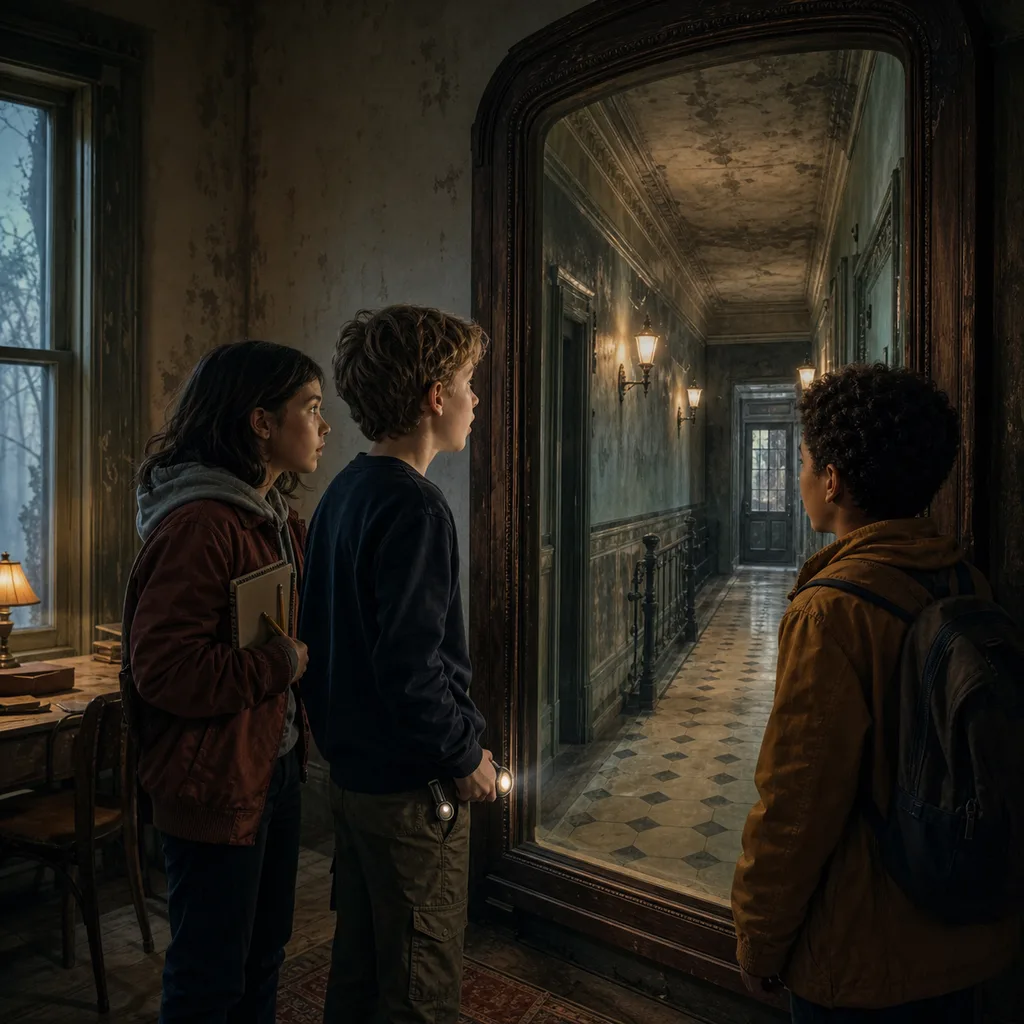
zakryté zrkadlo je nová časť seriálu Chodba bez čísla, pripravená ako dvojjazyčný detský príbeh v slovenčine aj angličtine.
zakryté zrkadlo: začína sa príbeh
Na chodbe pred bytom pani Richterovej zhasli svetlá presne vtedy, keď Filip dohovoril vetu o pokazenom časovači.
„Vidíte?“ ozval sa v tme. „Normálny dom. Normálna porucha. Nič nadprirodzené.“
Potom sa svetlá vrátili.
Lenže namiesto známej chodby s poštovými schránkami stáli Nora, Filip a Ben v úzkom priestore, ktorý už poznali až príliš dobre. Steny mali vyblednutú zelenú farbu, pri strope viedli staré kovové rúry a vzduch voňal po prachu, vlhkom dreve a niečom kovovom.
Chodba bez čísla sa znova ukázala.
Nora okamžite vytiahla z vrecka svoj malý papierový zápisník. Na obale mala nalepenú nálepku kométy, už trochu odretú od častého používania. Pozrela na hodinky.
„Sedemnásť hodín dvanásť minút,“ zašepkala a zapísala si čas. „Výpadok trval možno tri sekundy.“
„Štyri,“ opravil ju Filip. Baterku si ešte nezapol, no ruku už mal pri nej. „Počítal som. V hlave.“
Ben sa obzrel za seba. Za nimi neboli dvere, ktorými sem prišli. Bola tam iba dlhá stena a na nej tmavší obdĺžnik, akoby tam kedysi niečo viselo.
„Je tu tichšie než minule,“ povedal.
Filip sa usmial, ale iba jedným kútikom úst. „To je preto, že v tichu lepšie počuť, ako sa bojíme.“
„Ja nepočujem strach,“ povedal Ben. „Skôr to vyzerá, akoby celý dom čakal.“
Nora chcela povedať, že domy predsa nečakajú. V tej chvíli si však všimla niečo nové.
O pár krokov ďalej boli dvere.
Predtým tam určite neboli. V pamäti mala chodbu nakreslenú takmer presne, od prvej výpravy si zapisovala každú škvrnu na stene aj každú prasklinu v podlahe. Tieto dvere boli úzke, tmavohnedé a nemali číslo ani menovku. Na mosadznej kľučke ležala tenká sivá vrstva prachu.
„Nová miestnosť?“ spýtal sa Ben.
„Alebo starý servisný vstup,“ povedal Filip. Pristúpil bližšie, no nedotkol sa kľučky. „V domoch bývali technické šachty, sklady, miestnosti na káble. Keď niečo prerábali, mohli to zazd…“
Zastavil sa.
Na dverách bol malý vyrezaný znak. Vyzeral ako štvorček rozdelený šikmou čiarou na dve polovice.
Nora si ho rýchlo prekreslila.
„Tento znak tu bol aj minule?“ spýtala sa.
„Nie,“ odpovedal Ben hneď.
Filip sa nadýchol. „Dobre. Takže máme dvere, ktoré sa objavili v chodbe, ktorá sa objavuje iba počas výpadku. To stále nevylučuje technické vysvetlenie.“
„Nevylučuje,“ súhlasila Nora. „Ale najprv potrebujeme zistiť, kam vedú. Máme cestu späť?“
Všetci traja sa obrátili smerom, odkiaľ prišli. Za nimi bola chodba, zahnutá pri starej lampičke. Nebola dlhá, možno dvadsať krokov. Stačilo sa otočiť a bežať.
„Máme,“ povedal Ben. „Ak sa nič nezmení.“
„Tak sa nerozdeľujeme,“ rozhodla Nora. „A dvere otvoríme iba, ak ich otvoríme všetci spolu.“
Filip prikývol. Potom chytil kľučku cez rukáv mikiny, akoby bol technik v detektívke. Prach pod látkou slabo zaškrípal.
Dvere neboli zamknuté.
Otvorili sa tak pomaly, že ich najprv nepustili dnu, iba do tmavého pásu za nimi. Z miestnosti vyšiel chladný, zatuchnutý vzduch. Nebol nepríjemný, len starý. Vonia tak skriňa, ktorú nikto neotvoril celé roky.
Filip zapol baterku.
Svetelný kužeľ prešiel po úzkej podlahe, po holých stenách a napokon sa zastavil na veľkom sivom tvare pri zadnej stene.
Cez niečo vysoké tam visela plachta.
Siahala skoro až na zem. Bola hrubá, poprášená a na krajoch mala tmavé fľaky od veku. Pod ňou sa črtal rovný obdĺžnik, vyšší než Filip.
„Nábytok,“ povedal Filip príliš rýchlo. „Pravdepodobne skriňa.“
„Skriňa by mala boky,“ namietla Nora.
„Alebo staré okno,“ doplnil Ben. „Také, čo sa vytiahne zo steny a potom… neviem. Prečo by tu bolo staré okno?“
Všetci sa na okamih odmlčali.
Priestor nebol veľký. Naľavo stála úzka stolička bez sedadla, iba s dreveným rámom. Pod oknom, ktoré bolo zamurované tehlami, ležal zhrdzavený háčik. Na pravej stene sa nachádzal úzky výklenok zakrytý kovovým panelom. Panel bol natretý rovnakou farbou ako stena, ale náter sa okolo skrutiek odlupoval.
Keď sa veci začnú meniť
„Najprv obídeme izbu,“ povedala Nora. „Bez dotýkania sa vecí.“
Prešli pomaly popri stenách. Podlaha zavŕzgala len pod Benovou topánkou a chlapec okamžite stuhol.
„Prepáčte,“ šepol.
„Podlaha sa neurazila,“ povedal Filip. „Aspoň dúfam.“
Nervózne sa zasmiali. Aj Nora. Smiech netrval dlho, ale pomohol im dýchať o trochu pokojnejšie.
Keď sa vrátili pred plachtu, Ben natiahol ruku a zastavil sa pár centimetrov od látky.
„Všimli ste si?“ spýtal sa.
„Čo?“
„V chodbe je prievan. Cítil som ho pri dverách. Ale plachta sa ani nepohne.“
Nora pozrela na spodný okraj. Malé chumáče prachu ležali pokojne pri látke. Ani jeden sa nezachvel.
Filip prehltol. „Možno je tu vzduch príliš ťažký na pohyb. To znie hlúpo, ale…“
„Znie,“ povedal Ben. „No aj tak ju chceme odhrnúť.“
Nora prikývla. „Spolu. Pomalšie, než by si chcel ty.“
„To je urážka mojej vedeckej opatrnosti,“ zamrmlal Filip.
Každý chytil jeden okraj plachty. Na tri ju potiahli dole.
Látka sa zosunula bez šuchotu, akoby ju niekto celé roky držal napätú. Dopadla na podlahu.
Za ňou stálo zrkadlo.
Malo vysoký tmavý rám z dreva, vyrezávaný do jednoduchých vĺn. V rohoch boli drobné mosadzné kvety. Sklo nebolo rozbité ani špinavé. Bolo čisté tak dokonale, až to pôsobilo zvláštnejšie než prach na všetkom ostatnom.
Nora čakala, že uvidí ich troch, baterku a malú izbu.
Neuvidela.
V zrkadle sa tiahla chodba.
Nebola to presne tá, v ktorej stáli. Bola širšia a jasnejšia. Steny mali krémovú farbu so zeleným pásom pri podlahe. Zo stropu viseli lampy s jantárovými sklenenými tienidlami a ich svetlo sa lesklo na tmavom zábradlí. Pri dverách boli malé porcelánové tabuľky s čiernymi číslami.
„To je… odraz chodby,“ povedal Filip.
„Ale nie tejto,“ opravila ho Nora.
Prišla bližšie, len na vzdialenosť jedného kroku. Zrkadlo neukazovalo ani jej tvár, ani sivú mikinu, ani zápisník v ruke. Ukazovalo iba prázdnu starú chodbu.
Rýchlo si začala kresliť. Najprv lampy. Potom zábradlie. Tabuľky na dverách. Na jednej stene bola séria bledších obdĺžnikov, miest, kde kedysi zrejme viseli obrazy alebo fotografie.
Ben sa naklonil nabok. „Tie stopy po obrazoch sú aj za nami na chodbe.“
„Lenže tu sú na inom mieste,“ povedala Nora. „A je ich päť. V našej chodbe som videla tri.“
Filip prešiel baterkou popri ráme zrkadla. Svetlo sa v skle neukázalo. Skúsil sa pozrieť spozaň. Potom pokľakal a prehmatával spodný okraj rámu.
„Mohla by tam byť obrazovka,“ uvažoval. „Ale nevidím káble. Alebo projekcia cez skryté sklo. Ale kde je projektor? A prečo sa obraz nemení podľa uhla?“
„A prečo v ňom nie sme my?“ spýtal sa Ben ticho.
Filip sa narovnal. „To je… dobrá otázka.“
Zrkadlová chodba zostávala prázdna. Potom sa na jej konci mihol pohyb.
Všetci traja odskočili.
Nebola to postava. Iba tieň, ktorý prešiel od jednej steny k druhej, ako keď niekto v inej miestnosti zavrie dvere. Staré lampy v odraze na okamih zablikali.
Nora držala ceruzku tak silno, až ju zaboleli prsty.
„Nič sa nás nedotklo,“ povedal Ben. Hovoril viac sebe než ostatným. „Stojíme spolu. Dvere sú otvorené.“
„Presne,“ povedala Nora a pozrela smerom k východu. Dvere do chodby bez čísla zostali pootvorené. Za nimi svietilo mdlé svetlo. „Ak sa niečo zmení, odídeme.“
Filip sa znovu obrátil k zrkadlu. „Jeden pohyb ešte neznamená duchov. Staré mechanizmy môžu mať…“
Prerušil sa.
Na jednej porcelánovej tabuľke pri dverách sa objavili písmená.
Neboli tam dlho. Najprv iba K. Potom L. A potom celé meno.
KLÁRA.
Nora zalapala po dychu a zapísala ho tak rýchlo, že jej ceruzka preskočila cez okraj stránky.
„Videli ste to?“
„Áno,“ povedal Ben.
Filip mlčal.
Nápis zmizol. Na tabuľke bolo znova iba vyblednuté číslo, ktoré nedokázali prečítať.
„Mozog dopĺňa slová,“ povedal Filip, no hlas sa mu zlomil uprostred vety. „Keď niečo čakáme, môže nám…“
Dôležitý okamih
Meno sa vrátilo.
Tentoraz jasnejšie. KLÁRA, čiernymi písmenami na bielom porceláne.
Nora podčiarkla zápis. Raz. Potom ešte raz.
„Bolo tam dvakrát,“ povedala. „Na tom istom mieste. To nie je sen.“
Ben ustúpil o krok. Tvár mu zbledla, no neodbehol. „Klára musela žiť v tej starej časti domu. Ale prečo je jej meno na dverách?“
„Možno to nie je meno človeka,“ navrhol Filip. „Možno názov izby. Alebo… nie, to by bolo ešte divnejšie.“
Nora sa zahľadela na chodbu v skle. Strach jej sedel v hrudi ako studený kamienok. Zároveň však cítila niečo iné. Zrkadlo im neukazovalo náhodné obrazy. Ukazovalo detaily. Presné veci, ktoré si mohli zapísať a neskôr overiť.
„Pozrite sa na pravú stenu,“ povedala.
V odraze sa pri dverách s menom Klára končil zelený pás. Vedľa neho mala byť úzka tmavšia zvislá čiara, podobná škáre panelu v ich miestnosti.
Lenže nebola.
Stena v zrkadle bola úplne hladká.
Nora sa otočila k skutočnej pravej stene. Kovový panel tam stále bol. Prešla prstom tesne vedľa jeho okraja, bez toho, aby sa dotkla skrutiek.
„Toto by malo byť v odraze,“ povedala. „Ak zrkadlo ukazuje tú istú časť domu z minulosti, panel alebo výklenok by tam mal byť tiež.“
Filip pristúpil bližšie. Teraz už nevyzeral, že hľadá vtip. Skúmal stenu, potom zrkadlo, potom znovu stenu.
„Panel je pridaný neskôr,“ povedal po chvíli. „Pozrite. Farba je mladšia než ostatné vrstvy. A skrutky sú nové, nie také ako na dverách.“
„Takže tu kedysi nebol?“ spýtal sa Ben.
„Možno nie. Alebo zakrýva niečo, čo v tej starej chodbe nechceli ukázať.“
Chlapec sa otočil k odrazu. „Niečo nechceli ukázať… alebo niečo zrkadlo nechce ukázať.“
Na chvíľu nikto neodpovedal.
Nora si do zápisníka nakreslila jednoduchý pôdorys. Dvere. Zrkadlo. Panel. A do rohu dopísala: Hladká stena v obraze. Chýba detail.
„Nebudeme ho otvárať,“ povedala rozhodne.
Filip prekvapene zdvihol obočie.
„Prečo nie?“
„Lebo nevieme, čo je za ním. A nevieme, koľko času nám zostáva. Máme polohu a máme znak na dverách. Najprv to porovnáme s normálnou chodbou.“
Ben súhlasne prikývol. „To je plán. Plán je lepší než panika.“
Práve vtedy lampy v zrkadle pohasli.
Jantárové svetlo sa zmenilo na sivé. Obraz starej chodby sa jemne rozvlnil, akoby niekto prešiel prstom po hladine vody. Z miestnosti zmizol zatuchnutý pach a nahradil ho ostrý zápach ozónu, podobný vzduchu po búrke.
„Chodba sa mení,“ povedal Filip.
Nebolo treba nič vysvetľovať. Nora zavrela zápisník a strčila ho do vrecka bundy. Filip pevne schmatol baterku. Ben sa rozbehol ku dverám a otvoril ich dokorán.
„Cesta je voľná!“ zvolal.
Za nimi chodba bez čísla tmavla. Zelené steny strácali farbu, rúry pri strope sa rozmazávali. Zrkadlo ešte raz zablikalo.
Nora sa otočila.
Pri hladkom mieste na stene v odraze, presne tam, kde v skutočnej izbe bol kovový panel, zazrela maličkú značku. Štvorček rozdelený šikmou čiarou.
Rovnaký znak, aký mali dvere.
„Znak!“ vykríkla. „Pri chýbajúcej stene! Nakreslila som ho už predtým!“
Filip ju chytil za rukáv. „Nora, teraz!“
Vybehli z izby. Ben ich pustil pred seba a dvere za nimi zavrel len napoly, aby nestratili smer. Pod nohami sa podlaha zavlnila zvláštnym svetlom, nie ako zemetrasenie, skôr ako obraz v starom televízore.
O pár krokov ďalej zhaslo všetko.
Tma trvala krátko.
Potom sa nad nimi rozsvietila obyčajná chodba domu. Poštové schránky stáli na svojom mieste. Niekde za stenou hučala práčka. Z prízemia bolo počuť, ako niekto zatvára vchodové dvere.
Traja kamaráti stáli pri stene, zadýchaní a tichí.
Tam, kde pred chvíľou boli dvere bez mena, nebolo nič. Len vyblednutá maľba a malá prasklina pri lište.
Filip si oprel ruky o kolená. „Dobre,“ povedal po chvíli. „Mám novú vedeckú teóriu.“
Ben sa naňho pozrel. „Ak povieš, že to bola obrazovka, hodím ti zápisník do schránky pani Richterovej.“
Čo sa ukáže neskôr
„Nie. Teória je, že neviem.“
Nora vytiahla zápisník. Na stránke sa črtalo meno Klára, plán izby, hladká stena a dvakrát nakreslený znak.
„To je lepší začiatok než vymyslená odpoveď,“ povedala.
Na konci chodby sa ozvalo slabé cvaknutie, akoby niekde hlboko v starom dome zapadol malý kovový zámok.
Všetci traja sa pozreli tým smerom.
Potom Nora potichu zaklapla zápisník.
„Zajtra nájdeme, kam patrí tento znak,“ povedala. „A zistíme, kto bola Klára.“
Pokračovanie nabudúce…
The Unnumbered Corridor, part 4: The Room with the Covered Mirror
The Story Begins
The lights in the hallway outside Mrs. Richterová’s apartment went out at the exact moment Filip finished his sentence about a broken timer.
“See?” he said in the dark. “A normal building. A normal fault. Nothing supernatural.”
Then the lights came back.
But instead of the familiar hallway with the mailboxes, Nora, Filip and Ben were standing in a narrow space they knew only too well. The walls were faded green, old metal pipes ran near the ceiling, and the air smelled of dust, damp wood and something metallic.
The unnumbered corridor had appeared again.
Nora pulled her small paper notebook out of her pocket at once. A comet sticker was on the cover, a little worn from use. She looked at her watch.
“Five seventeen,” she whispered and wrote down the time. “The blackout lasted maybe three seconds.”
“Four,” Filip corrected her. He had not switched on his flashlight yet, but his hand was already near it. “I counted. In my head.”
Ben looked back over his shoulder. There were no doors behind them, no way they had entered. Only a long wall and, on it, a darker rectangle, as if something had once hung there.
“It’s quieter than last time,” he said.
Filip smiled, but only with one corner of his mouth. “That’s because in silence you can hear your fear better.”
“I don’t hear fear,” Ben said. “It feels more like the whole house is waiting.”
Nora wanted to say that houses do not wait. But then she noticed something new.
A few steps ahead, there were doors.
They had not been there before. She remembered the corridor almost exactly, because since the first visit she had written down every stain on the wall and every crack in the floor. These doors were narrow, dark brown, and had no number or nameplate. A thin grey layer of dust lay on the brass handle.
“A new room?” Ben asked.
“Or an old service entrance,” Filip said. He stepped closer, but did not touch the handle. “Buildings used to have technical shafts, storage rooms, cable rooms. When they rebuilt something, they might have walled it…”
He stopped.
On the door was a small carved sign. It looked like a square split by a diagonal line into two halves.
Nora quickly copied it into her notebook.
“Was that sign here last time?” she asked.
“No,” Ben said at once.
Filip took a breath. “Right. So we have doors that appeared in a corridor that only appears during a blackout. That still does not rule out a technical explanation.”
“It does not,” Nora agreed. “But first we need to find out where they lead. Do we have a way back?”
All three of them turned toward where they had come from. Behind them was the corridor, curving by an old lamp. It was not long, maybe twenty steps. They only had to turn and run.
“We do,” Ben said. “If nothing changes.”
“Then we do not split up,” Nora decided. “And we only open the door if we open it together.”
Filip nodded. Then he took the handle through the sleeve of his sweatshirt, like a detective in a TV show. Dust under the fabric made a soft scratching sound.
The door was not locked.
It opened so slowly that at first it did not let them into the room, only into a dark strip behind it. Cold, stale air came out. It was not unpleasant, only old. It smelled like a wardrobe that had not been opened for years.
Filip switched on his flashlight.
The beam crossed a narrow floor, bare walls, and finally stopped on a large grey shape by the back wall.
When Things Start to Change
A sheet hung over something tall.
It reached almost to the floor. It was thick, dusty, and had dark marks along the edges from age. Under it, a straight rectangle could be seen, taller than Filip.
“Furniture,” Filip said too quickly. “Probably a cupboard.”
“A cupboard would have sides,” Nora said.
“Or an old window,” Ben added. “One that gets pulled out of a wall and then… I don’t know. Why would there be an old window here?”
For a moment, they all went quiet.
The room was not large. On the left stood a narrow chair without a seat, just its wooden frame. Under the window, which had been bricked up, lay a rusty hook. On the right wall there was a narrow recess covered by a metal panel. The panel was painted the same colour as the wall, but the paint was peeling near the screws.
“First we walk around the room,” Nora said. “Without touching anything.”
They moved slowly along the walls. The floor creaked only under Ben’s shoe, and the boy froze at once.
“Sorry,” he whispered.
“The floor is not offended,” Filip said. “At least I hope not.”
They gave a nervous laugh. Nora did too. The laugh did not last long, but it helped them breathe a little easier.
When they came back to the sheet, Ben stretched out his hand and stopped a few centimetres from the fabric.
“Did you notice?” he asked.
“What?”
“There’s a draught in the corridor. I felt it near the door. But the sheet does not move at all.”
Nora looked at the lower edge. Small clumps of dust lay still by the cloth. Not one of them stirred.
Filip swallowed. “Maybe the air here is too heavy to move. That sounds silly, but…”
“It does,” Ben said. “Still, we want to pull it away.”
Nora nodded. “Together. Slower than you would like.”
“That is an insult to my scientific carefulness,” Filip muttered.
Each of them took one edge of the sheet. On three, they pulled it down.
The cloth slid without a sound, as if someone had kept it stretched tight for years. It fell to the floor.
Behind it stood a mirror.
It had a tall dark wooden frame carved with simple waves. Tiny brass flowers sat in the corners. The glass was not broken or dirty. It was so perfectly clean that it felt stranger than the dust on everything else.
Nora expected to see the three of them, the flashlight and the small room.
She did not.
In the mirror, there was a corridor.
It was not exactly the one they were standing in. This one was wider and brighter. The walls were cream-coloured with a green strip near the floor. Amber glass shades hung from the ceiling, and their light shone on a dark railing. By the doors were small porcelain nameplates with black numbers.
“That’s… a reflection of a corridor,” Filip said.
“But not this one,” Nora corrected him.
She stepped closer, only one pace. The mirror showed neither her face, nor her grey hoodie, nor the notebook in her hand. It showed only an empty old corridor.
She quickly began to draw. First the lamps. Then the railing. The door plates. On one wall there was a line of paler rectangles, places where pictures or photos had probably once hung.
Ben leaned to the side. “Those marks from pictures are there behind us in the corridor too.”
“But here they are in a different place,” Nora said. “And there are five. In our corridor, I saw three.”
An Important Moment
Filip moved his flashlight along the mirror frame. The light did not appear in the glass. He tried to look behind it. Then he knelt down and felt along the bottom edge of the frame.
“There could be a screen there,” he thought out loud. “But I don’t see any cables. Or a projection through hidden glass. But where is the projector? And why does the image not change with the angle?”
“And why are we not in it?” Ben asked quietly.
Filip stood up straight. “That is… a good question.”
The mirrored corridor stayed empty. Then movement flashed at the far end.
All three jumped back.
It was not a person. Only a shadow moving from one wall to the other, like someone closing a door in another room. The old lamps in the reflection flickered once.
Nora held her pencil so tightly her fingers hurt.
“Nothing touched us,” Ben said. He was speaking more to himself than to the others. “We are standing together. The door is open.”
“Exactly,” Nora said, looking toward the exit. The door to the unnumbered corridor was still partly open. A weak light shone through. “If anything changes, we leave.”
Filip turned back to the mirror. “One movement does not mean ghosts. Old mechanisms can have…”
He stopped.
Letters appeared on one porcelain nameplate by the door.
They did not stay long. First only a K. Then an L. And then a full name.
KLÁRA.
Nora gasped and wrote it down so fast that her pencil slipped over the edge of the page.
“Did you see that?”
“Yes,” Ben said.
Filip said nothing.
The name vanished. On the plate there was again only a faded number that they could not read.
“The brain fills in words,” Filip said, but his voice broke in the middle of the sentence. “When we expect something, it can…”
The name came back.
This time it was clearer. KLÁRA, in black letters on white porcelain.
Nora underlined it in her notebook. Once. Then again.
“It was there twice,” she said. “In the same place. That is not a dream.”
Ben stepped back. His face went pale, but he did not run away. “Klára must have lived in the old part of the house. But why is her name on the door?”
“Maybe it is not a person’s name,” Filip suggested. “Maybe it is the name of the room. Or… no, that would be even stranger.”
Nora stared at the corridor in the glass. Fear sat in her chest like a cold stone. At the same time, she felt something else. The mirror was not showing random images. It was showing details. Exact things they could write down and check later.
“Look at the right wall,” she said.
In the reflection, by the door with Klára’s name, the green strip ended. Next to it there should have been a narrow darker vertical line, like the seam of the panel in their room.
But there was not.
In the mirror, the wall was completely smooth.
Nora turned to the real right wall. The metal panel was still there. She ran her finger close to its edge, without touching the screws.
“This should be in the reflection too,” she said. “If the mirror shows the same part of the house from the past, then the panel or recess should be there as well.”
Filip stepped closer. Now he did not look as if he were searching for a joke. He examined the wall, then the mirror, then the wall again.
“The panel was added later,” he said after a moment. “Look. The paint is newer than the other layers. And the screws are new, not like the ones on the door.”
What Comes Next
“So it was not here before?” Ben asked.
“Maybe not. Or it covers something they did not want to show in the old corridor.”
The boy turned to the reflection. “Something they did not want to show… or something the mirror does not want to show.”
For a moment, nobody answered.
Nora drew a simple floor plan in her notebook. Door. Mirror. Panel. And in the corner she wrote: Smooth wall in the image. Missing detail.
“We are not opening it,” she said firmly.
Filip raised his eyebrows in surprise.
“Why not?”
“Because we do not know what is behind it. And we do not know how much time we have. We have the position and we have the sign on the door. First we compare it with the normal corridor.”
Ben nodded in agreement. “That is a plan. A plan is better than panic.”
Just then the lamps in the mirror went out.
The amber light turned grey. The image of the old corridor rippled slightly, as if someone had run a finger across the surface of water. The stale smell vanished from the room and was replaced by the sharp scent of ozone, like the air after a storm.
“The corridor is changing,” Filip said.
No one needed any more explanation. Nora closed her notebook and shoved it into her jacket pocket. Filip grabbed his flashlight tightly. Ben ran to the door and pulled it wide open.
“The way is clear!” he called.
Behind them, the unnumbered corridor was fading. The green walls were losing colour, and the pipes near the ceiling were blurring. The mirror flickered one more time.
Nora turned around.
On the smooth spot on the wall in the reflection, exactly where the metal panel was in the real room, she saw a tiny sign. A square split by a diagonal line.
The same sign as on the door.
“The sign!” she cried. “By the missing wall! I drew it before!”
Filip grabbed her sleeve. “Nora, now!”
They rushed out of the room. Ben let them pass and shut the door only halfway behind them so they would not lose their direction. Under their feet, the floor shimmered with a strange light, not like an earthquake, more like the picture on an old television.
A few steps later, everything went dark.
The darkness lasted only a moment.
Then the ordinary hallway of the building lit up above them. The mailboxes were in their place. Somewhere behind a wall, a washing machine was humming. From the ground floor came the sound of someone closing the entrance door.
The three friends stood by the wall, breathing hard and silent.
Where the door without a name had been a moment ago, there was nothing. Only faded paint and a small crack near the skirting board.
After a while, Filip bent over with his hands on his knees. “Right,” he said. “I have a new scientific theory.”
Ben looked at him. “If you say it was a screen, I’ll throw your notebook into Mrs. Richterová’s mailbox.”
“No. My theory is that I do not know.”
Nora took out her notebook. On the page were the name Klára, the room plan, the smooth wall and the sign drawn twice.
“That is a better start than a made-up answer,” she said.
At the end of the hallway, a soft click sounded, as if a small metal lock had fallen into place deep inside the old building.
All three of them looked in that direction.
Then Nora quietly closed her notebook.
“Tomorrow we’ll find where this sign belongs,” she said. “And we’ll find out who Klára was.”
To be continued…