
Robo and the Lost Planet, Part 1: The Signal in the Game

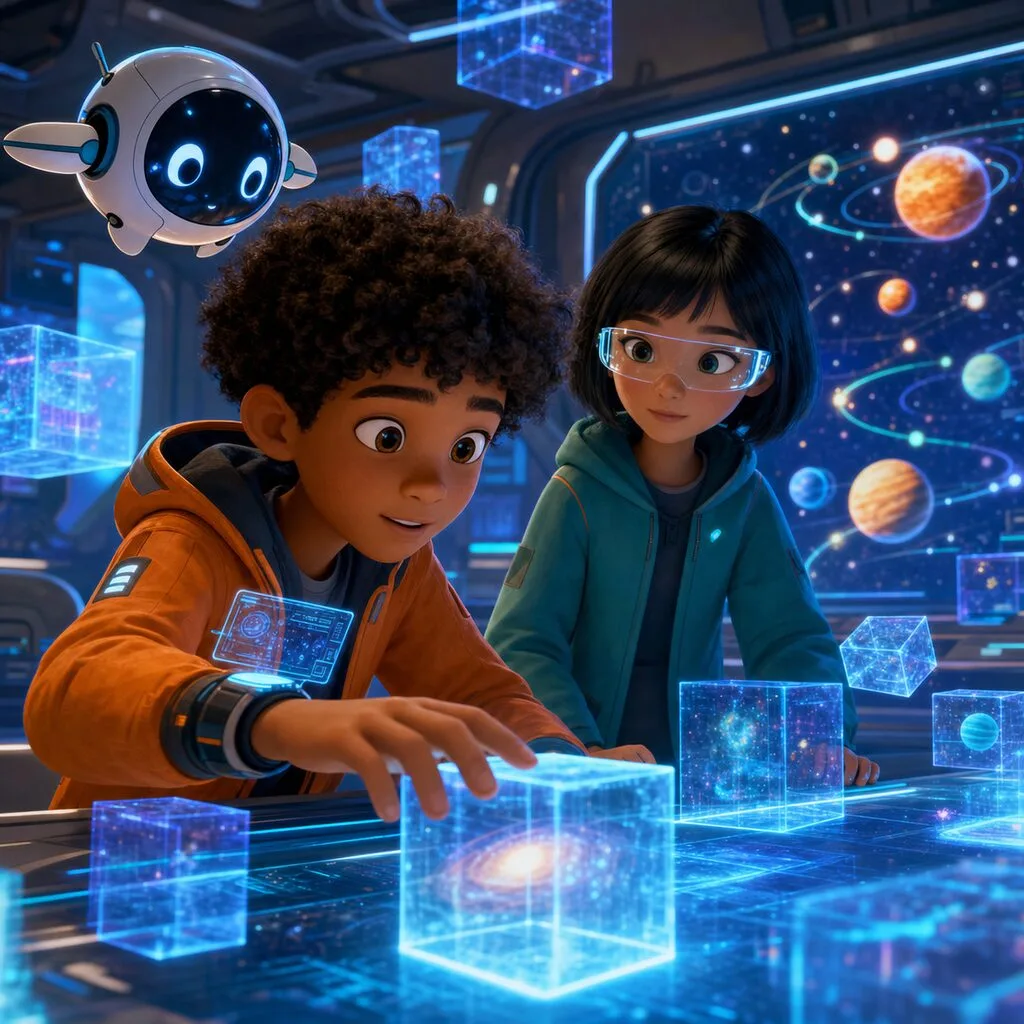
An old learning game sends Robo, Ami, and Pip a mysterious signal bearing the name of a lost planet: Niva-7.
Robo and the Lost Planet, Part 1: The Signal in the Game
The Story Begins
After dinner, the station was quiet in a way Robo did not much like. To him, silence felt like a place where something interesting might be hiding. He sat by the digital archive with the sleeve of his orange smart jacket pushed up, while his hologram wristband glowed softly. He was browsing old data cubes, learning programs, and maps of the night sky. Most of the files were dull, but Robo had a nose for things other people overlooked.
“Aha!” he suddenly blurted out, leaning closer to the archive’s floating menu. “This still works.”
An old educational game appeared on the display. It was called Star Navigation for Cadets. It was a simple space simulation designed for children at the first level of training. Colourful planets, star routes, and small tasks taught players how to find their way through space.
Robo smiled. Old things fascinated him. When something still worked after all those years, it felt like a small victory.
He called Ami and Pip over at once.
“Come here! I found a game that’s older than most of the archive, but it still runs!”
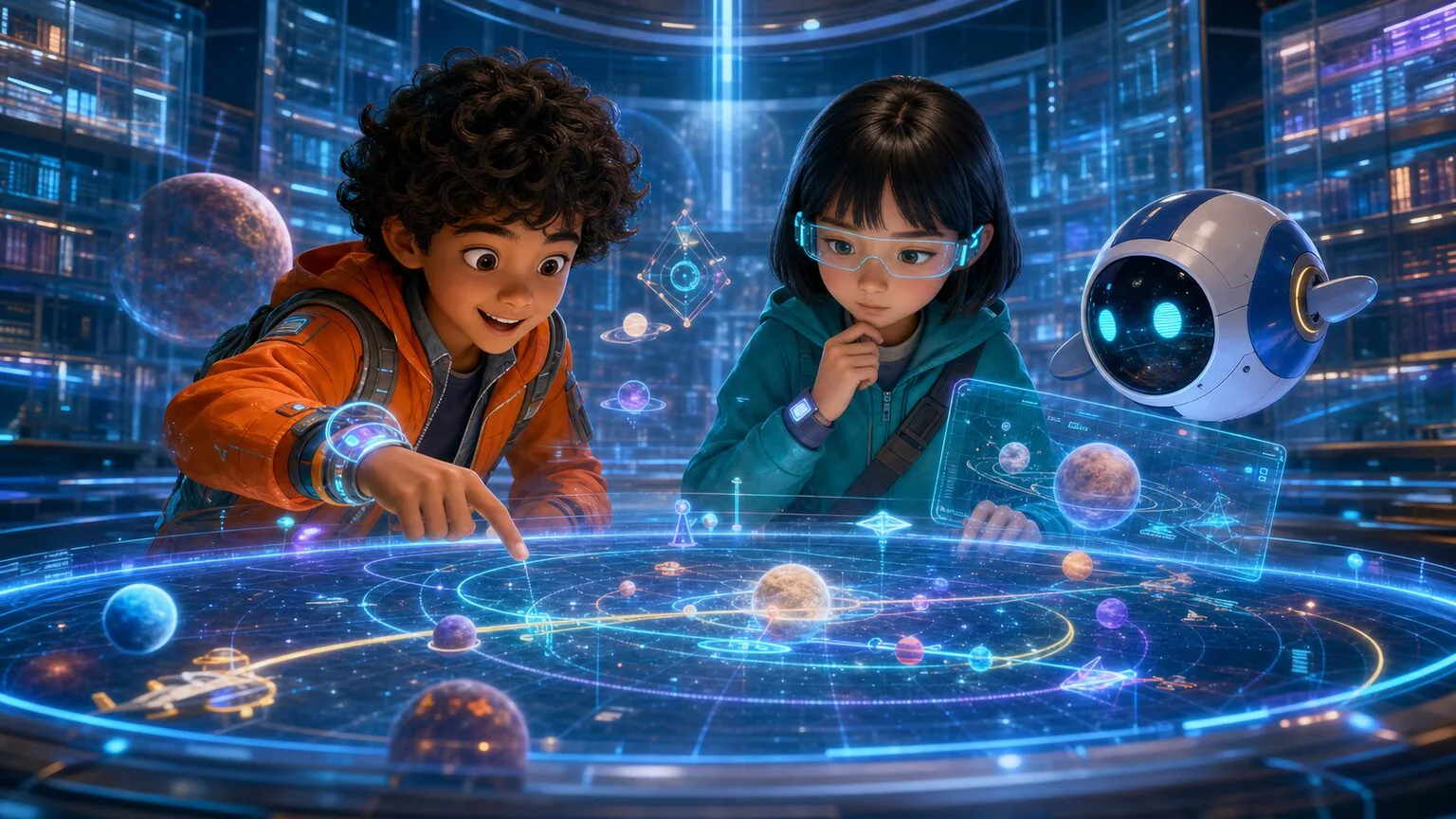
Ami arrived first. She had a short black bob, a turquoise hoodie, and small AR glasses that she nudged up her nose when she wanted a better look at something. She saw Robo’s excitement and smiled.
“Old games can be full of surprises,” she said calmly. “But first we need to find out whether it’s safe.”
Pip floated in behind her. His white-and-blue body gleamed in the archive light, and his blue LED eyes blinked rapidly. The little robot rose higher, circled the game’s title, and immediately began recording data.
“The program is active,” he announced in his precise voice. “Stability: ninety-three percent. Risk level: low. I welcome this educational experience.”
Robo laughed. “Pip, can you say anything without numbers?”
“Yes,” Pip replied after a moment. “This is an educational experience.”
Ami laughed too. “Was that an attempt at a joke?”
“Probably,” Pip replied seriously.
The three friends were amused, but only for a moment. Then they all turned back to the old game. Robo was already tapping one foot impatiently.
“So, shall we start it?” he asked.
Ami nodded. “Only as a safe program. We change nothing, open nothing outside the game, and skip nothing.”
“I agree,” said Pip, his eyes glowing softly. “Safety is essential.”
Robo pressed start.
The hologram lit up, and a cheerful universe unfolded around them. Planets shone like candy-coloured balls, navigation lines appeared between them, and short tasks popped up. At first, the game taught them to tell directions apart, estimate distances, and choose the correct flight path. Robo plunged into it at once.
“Right! No, no, farther right!” he called, waving his hand excitedly.
“Watch the map,” Ami warned him. “The planet may be close, but the route is curved.”
Pip hovered above the hologram, comparing the game’s data with his sensors. “The displayed distance matches. Flight speed is correct. Everything is within normal limits.”
It was pleasant. An ordinary game. Ordinary successes. Ordinary blue points for completed tasks. Robo was about to say they should try the next level when the image trembled for a moment.
At the edge of the simulation, a thin wave of light flickered.
At first, it looked like part of the game. Just another effect. Then the wave appeared again. And again. Each time, it came in exactly the same way and at exactly the same interval.
Robo blinked. “Did you see that?”
Ami quickly adjusted her glasses. “Yes. And it didn’t look like a random effect.”
Pip moved almost right up to the hologram. “I am detecting a repeating signal. The intervals are almost identical.”
When Things Start to Change
“Maybe it’s a secret part of the game!” Robo blurted out.
Ami shook her head. “Maybe. But first we need to find out whether it repeats the same way every time.”
Robo bit his lip. He wanted to continue at once, but this time he held himself back. He looked at Ami, then at Pip. Curiosity was still bubbling inside him, but this time he was listening.
“All right,” he said at last. “Then let’s measure it.”
Pip brightened. “Excellent decision.”
They began studying the signal closely. Pip recorded the exact time of each appearance. Through her AR glasses, Ami displayed its rhythm as a wave. Robo kept his eyes on the hologram and waited for the next repetition.
The wave returned.
Then again.
And once more.
Robo leaned closer and gently passed a finger through the air just above the glowing line, as if checking that he had not imagined it. The light flickered in exactly the same rhythm.
“Each return is almost identical,” Pip reported. “The variation is very small. Too small to be ordinary chance.”
Ami thought for a moment. “It looks more like a code than a display error.”
Robo leaned forward. “A code? But in a game?”
“Something can be hidden in a game too,” Ami said. “But we mustn’t rush.”
Pip projected small blue graphs in front of them. One axis showed the intervals of time; the other showed the signal’s strength. The lines were clean and regular, as if someone had drawn them with a ruler.
“This is not broken chaos,” Pip said. “This is order.”
At that moment, a new strip of text appeared in the centre of the hologram.
At first it was blurred, as if it were trying to rise to the surface. Then it came into focus.
Niva-7.
Robo froze.
“Wait… Niva-7?” he whispered.
Ami turned to him. “Do you know that name?”
Robo nodded, his eyes wide. “It’s in the old records. A lost planet. People used to learn about it, but then all trace of it was lost.”
Pip quickly accessed the database. “Confirmed. Niva-7 is listed as a lost world in the station’s historical records.”
For a moment, there was silence. The hologram continued to pulse, as if waiting for their reaction.
“That isn’t a coincidence anymore,” Ami said slowly. “That name did not appear in the signal for no reason.”
“So it’s a message!” Robo was excited again. “And maybe it leads straight to the planet!”
Ami raised a hand. “But first, notice this.”
She pointed to the lower part of the signal. Numbers appeared between the pulses, but they were incomplete. Some were missing. Others repeated. It looked like a broken sentence made of numbers, yet it still seemed to make sense.
Pip enlarged the data to maximum size. “It is an incomplete coordinate fragment.”
Robo blinked. “So, something like an address in space?”
“Exactly,” Ami said. “But not the whole address. Only part of it.”
Pip added, “The missing numbers are not random. They repeat in a regular sequence. If we had more data, we could complete the pattern.”
Robo looked from one friend to the other. He no longer wanted merely to chase the mystery. He wanted to understand it.
“So it isn’t just a mistake in an old game,” he said more quietly. “It’s a clue.”
Ami nodded. “Maybe the game was only hiding something. Or preserving something.”
“Or perhaps someone wanted somebody to discover it only now,” Pip added.
The words seemed to hang in the air.
An Important Moment
Robo folded his arms. He had always dreamed of discovering things. But now he felt something else as well. There was excitement, but also respect. When something is real, it is not wise to rush forward without thinking.
“So what do we do?” he asked.
Ami smiled, very slightly. “We compare the data. We find out whether the signal repeats after the next level too. Then we decide what to do next.”
Pip nodded. “I agree. Accuracy is better than speed when we are searching for the truth.”
Robo let out a breath and smiled. “All right. This time, I’ll wait.”
Ami looked at him, a little surprised, then pleased. “That was wise.”
“Don’t make a big thing of it,” Robo muttered, though he was smiling. “I just didn’t want to miss something important.”
“And that is exactly why a team is a team,” Ami said.
Together, they sat at the holographic table in the archive. The coordinate fragment pulsed across its surface. Pip divided it into separate parts, Ami compared the patterns, and Robo wrote down everything that seemed strange. Suddenly, it was no longer just a game. It was the first real clue to something hidden farther out among the stars.
When the signal sounded one last time, it almost sounded like an invitation.
Not a threatening one. More mysterious. As if someone were quietly knocking on a door and waiting to see whether anyone answered.
Robo looked up from the data. “So… who or what is sending it?”
Ami studied the pulsing numbers. “We don’t know yet.”
Pip tilted his head slightly. “But we do know that it is not merely a program error.”
Robo smiled, more calmly than usual this time. “And that means we found something.”
The name Niva-7 glowed once more on the hologram. Then the image dimmed, but the coordinate fragment continued shining like a small beacon in the archive.
The three friends watched it in a silence that no longer felt empty. Before them lay the first clue, and with it another mystery waiting beyond the edge of the game.
To be continued…