
Robo and the Lost Planet, Part 6: The Key from the Silent Station

A strange rhythm leads Robo, Ami and Pip to a silent station—and the first real clue to the lost planet Niva-7.
Robo and the Lost Planet, Part 6: The Key from the Silent Station
The Story Begins
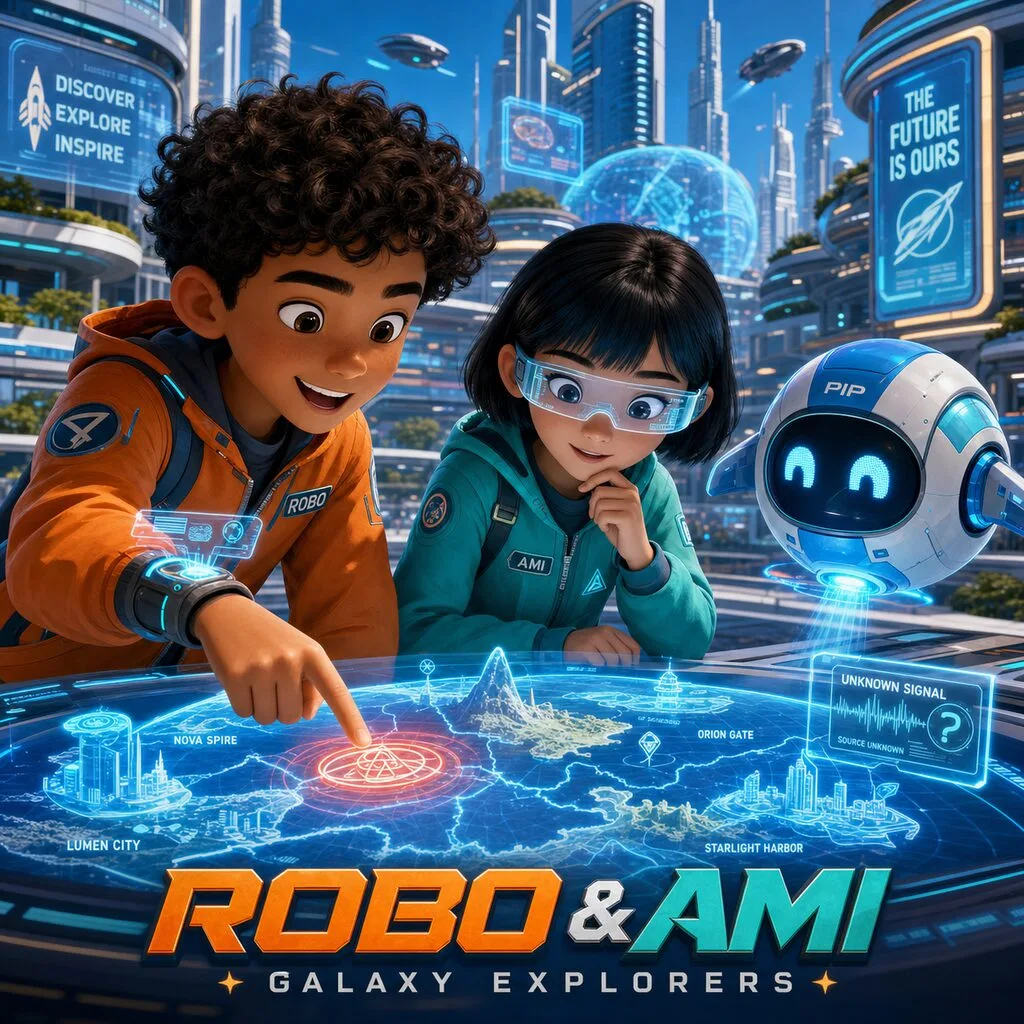
A new symbol flashed on the holographic map in the middle of the city. At first, it looked like a small square with a thin line, but then it began to turn slowly and shift from blue to silver. Robo immediately reached for it.
“That’s it!” he cried excitedly. “A new clue!”
Ami pushed her AR glasses higher on her nose and leaned closer to the map. “Wait. That symbol appeared only after the map data aligned with the old satellite. It can’t be a coincidence.”
Pip floated a little higher. His LED eyes blinked once, twice, then glowed a soft blue. “I’m detecting a rhythm,” he announced, just as he always did when something important was hidden in the data. “Repetition. A regular pattern. Something is calling.”
The city around them carried on at its busy pace, but everything near the map suddenly seemed quieter. The holographic symbol pointed towards the edge of the city, where an old research station stood. Captain Lyra, watching them through a secure communication channel, spoke calmly. “If you go there, be careful. The station is old, but some of its systems may still be active.”
Robo smiled. “An old station? That sounds like the sort of place where a great treasure might be hidden!”
“Or a data error,” Ami added. “And sometimes that matters more than treasure.”
The boy wanted to sling his backpack over his shoulder and set off at once. But he did not yet know that this very moment would teach him to slow down.
The route to the station led through a quieter edge of the city. The buildings were lower, the streets emptier, and small service drones drifted slowly above the rooftops. Before long, a metal complex with grey walls and narrow windows appeared ahead of them. It looked futuristic, yet abandoned. Still, it did not seem frightening. It felt more like a place waiting for someone to listen to it again.
The station doors stood slightly ajar. A faint white light shone from within. Above the entrance, an old sign blinked: RESEARCH NODE 4.
“So, here we are,” Ami whispered.
“And this is exactly the moment when we should go inside very, very quickly,” Robo whispered back, only half joking.
Pip turned towards him and gave a short electronic chirp. “Speed is not always accuracy.”
Robo rolled his eyes, but smiled. “You’re very wise today.”
Just then, Captain Lyra’s voice came through the channel again. “You’ll need to work together inside. This station was once part of a network of educational and research nodes. Without the correct sequence, the system will not let you proceed.”
“We understand,” Ami replied. “We’ll be careful.”
Inside, it was cold and quiet, but not unpleasantly so. It felt more like a library where nobody had argued for years. The walls were covered with panels, and narrow lines of light traced the floor. At the end of the corridor lay a room with three large panels and a map console in the centre. At first glance, it looked simple. But the moment they stepped inside, the doors behind them closed softly and the security system gave a brief beep.
Words appeared on the main display: VERIFY DATA. PROCEED TOGETHER.
Robo folded his arms. “That sounds like a challenge.”
“Exactly,” said Ami. “And not a place for hasty clicking.”
The first panel showed a compass with directional arrows. The second displayed a time code with blinking numbers. The third showed an old map of star nodes, but its lines were broken and unclear.
“Task one,” Pip read, turning towards the console. “Assess direction.”
When Things Start to Change
“Task two,” Ami added, “compare the time.”
“Task three,” Robo added, “guess what we’re supposed to do with all this?”
Ami smiled. “More like work out what to do correctly.”
Robo stepped up to the direction panel and raised his hand. He was just about to press the first button glowing blue when Ami gently caught his wrist.
“Wait,” she said calmly. “If you choose the wrong data point, the system could open the wrong branch. We need to compare the information first.”
Robo frowned. He was not used to holding back when he felt the answer was within reach. Even so, he stepped back. “Okay. What do you suggest?”
Ami leaned over the map console and switched it to analysis mode. Three layers of data appeared on the display. One was old, one came from the station network, and the third matched the map from the old satellite that the team had discovered earlier.
“Here’s the problem,” she said. “Not everything that flashes is correct. We can also see an echo of an old malfunction. That’s why we have to compare the data.”
Pip turned to the time code. His small side fins lit up as he began tracking the numbers with great precision. “Recorded deviation: three tenths of a second. Not an error. An old record is simply repeating.”
“Excellent,” Ami praised him. “You monitor the time. I’ll check the map. Robo, compare the direction panel with what the main console shows.”
“So I finally have a job,” Robo said with relief.
“You have an important job,” she corrected him.
The team split up. Their robotic friend hummed quietly beside the time code, Ami projected map layers through her glasses, and Robo focused on the directional arrows. Fine lines of light appeared on the wall, responding to each correct step. First one, then another. At last, all three panels glowed with a steady blue-green light.
A deep but pleasant tone sounded. The console in the middle of the room opened like a metal flower.
“Yes!” Robo burst out. “We knew it!”
“We knew it together,” Ami reminded him.
Pip gave a satisfied beep, as if he agreed with everything at once.
But at that very moment, the room shuddered. The screens began to crackle, and confused data filled the displays. Numbers tangled together, lines broke apart, and the map became a glowing snarl. Robo drew a sharp breath.
“No! Is it broken already?”
“Not completely,” Pip said quickly. His eyes swept across the screens. “There’s a rhythm in the noise.”
“What rhythm?” Robo asked.
The little robot turned towards one particular panel. A regular pulse was indeed repeating in the white static. One, one, pause. One, one, pause. It was not obvious at first, but once you noticed it, you could not miss it.
Ami adjusted her glasses more firmly. “Wait… Pip is right. This isn’t just a malfunction. It’s a pattern.”
She linked the rhythm data to the direction map, and a holographic line unfolded in the air before them. It curled, paused, and then stretched into a precise shape. The unclear noise became a map symbol. Clear. Repeating. Important.
“That’s a signal from Niva-7,” she whispered.
Robo leaned forward. “Really?”
“Yes,” she said quietly. “And it isn’t random. It’s a repeating pattern. As if someone or something is sending a call… or a plea.”
The station’s old archive opened on the main display. As the static slowly settled, a panel slid out from a side compartment that had not been visible before. Inside lay a small coordinate module. Narrow lines glowed across its surface, beside numbers that shifted gently until they finally held steady in one place.
An Important Moment
“That is the key,” Pip said precisely. “A coordinate key.”
Robo carefully took it in his hands. A new point appeared on the map on his wrist device. It was not a destination. It was a direction, more precise than anything they had had before.
“So now we know which way to go,” he said, awe in his voice.
“And we know that we mustn’t read a map with our eyes alone,” Ami added. “We have to verify it.”
Captain Lyra’s voice came through the communicator. “Excellent. Your work was precise and safe. The station has informed me that you passed the check and gained access to the next layer of data.”
“And our reward?” Robo asked.
For a moment, there was silence. Then an old message appeared on the screen: several sentences that had apparently once belonged to the station’s scientists. They wrote about a network of nodes linking schools, laboratories, and databanks through secure data bridges. Hidden among the lines was a note about Niva-7, a planet marked as lost in the records, though its signals continued to return.
“That means the station was part of a larger network,” Ami said. “And Niva-7 probably connected to it once.”
“But why does it keep sending the same pattern?” Robo murmured.
Nobody answered at once. Even Pip simply floated in silence, his eyes glowing thoughtfully.
Captain Lyra spoke again, this time more warmly. “Team, you’ve done good work. You may continue under supervision. But don’t be tempted by shortcuts. Save the new key, and use it only once you have verified the next set of data.”
“I understand,” Ami said.
“So do I,” Robo added. And this time, he truly meant it.
Then they all moved to the station’s departure platform. Below them spread the city, glittering like a net of tiny lights. Afternoon was slowly drawing to a close above their heads, and the air was calm. At a safe distance, the new holographic point from their map still hovered. It sparkled as though it were calling them onward.
Robo slipped his hands into his pockets and looked at the new clue. “So this is only the first key.”
“The first real key,” Ami corrected him, though her smile showed that she was just as excited as he was.
Pip turned towards the sky. Suddenly, he caught one final weak pulse. It was brief but clear: the same rhythm as before, only fainter. As if someone were trying to knock once more before the connection was lost.
“Final flash,” he announced.
Ami stared towards the place where the signal had come from. “It isn’t just technical noise. It looks like a plea for help.”
Robo nodded slowly. He was no longer in a hurry. In his mind, pieces were falling into place that he had not seen before. “Maybe we’ve spent all these days looking at the planet as if it were a puzzle. But something on Niva-7 really needs us.”
“And that’s why we must continue the right way,” Ami said.
Robo looked at her, then at Pip’s glowing panel. “Okay. No shortcuts.”
The little robot gave a gentle wiggle, as if he were proud of his crew. “No shortcuts,” he repeated.
As the three of them headed back from the platform into the city, the new coordinate key glowed on Robo’s wrist device like the first firm direction in a great mystery. The road ahead was still long and uncertain, but they no longer had only a random map. They had more precise data, greater trust in one another, and one big question driving them forwards.
What Comes Next
Who or what was sending that repeating signal from Niva-7?
And why did it seem more important than everything else?
They would have to wait for the answer. But now they had their first real key, and they knew they had found it the right way.