
Robo and the Lost Planet, Part 5: The Stardust Key

Robo, Ami, and Pip discover a stardust archive—and a key fragment linked to the missing world of Niva-7.
Robo and the Lost Planet, Part 5: The Stardust Key
The Story Begins
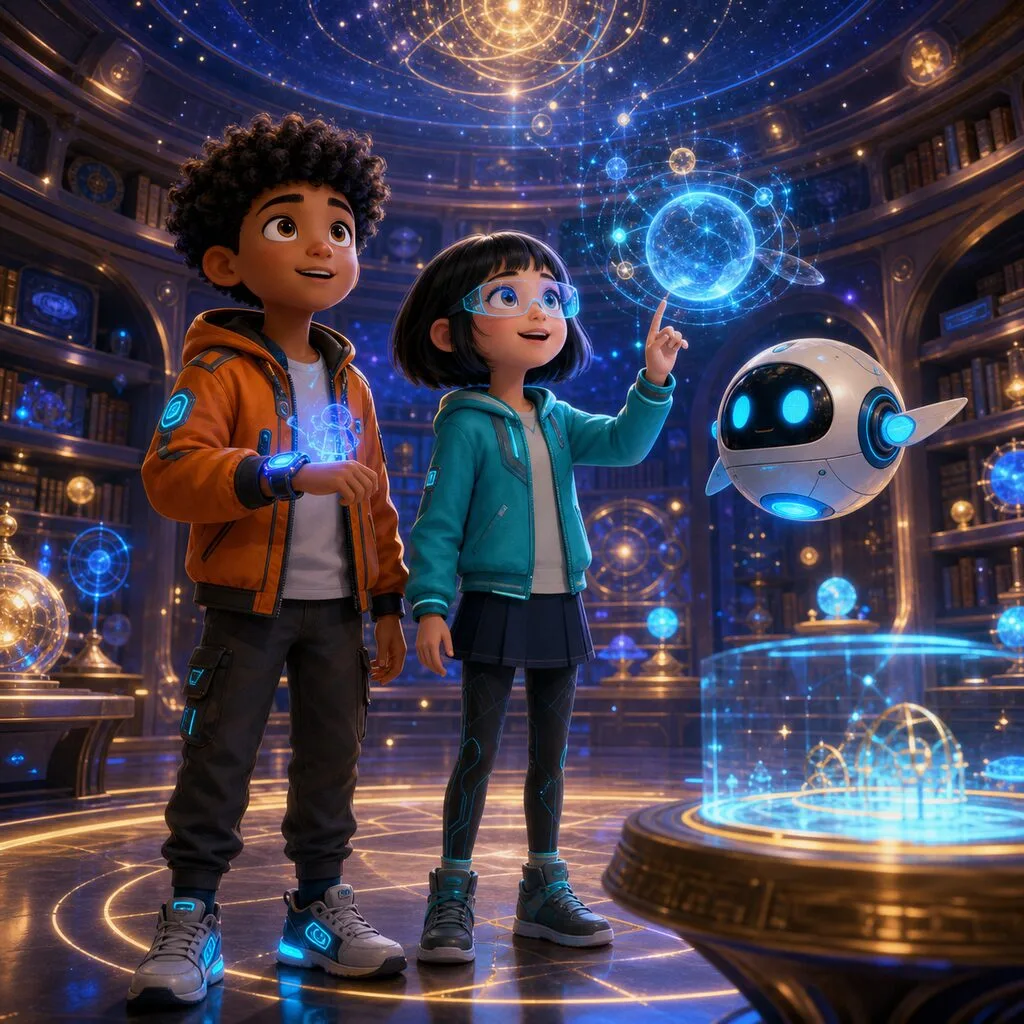
The old learning game was silent, as if it were waiting for the right touch. When Robo, Ami, and Pip logged back into the familiar program, they expected another simple puzzle. Instead, something new opened before them: a hidden circular room filled with fine stardust. It glittered in the air like a thousand tiny lights and reflected off the smooth floor in blue and gold patches.
"This is amazing," Robo breathed, his eyes lighting up. Starlight flashed across his orange smart jacket, and the hologram device on his wrist blinked softly. "I've never seen this here before."
Ami looked around slowly. Her short black hair stirred as she tilted her head towards a wall covered in symbols. Each one lit up for only a moment before going dark again. "This isn't just decoration," she said calmly. "Something here is waiting for the right order."
The little robot Pip floated a little higher and turned his blue-and-white body towards the panel by the entrance. His LED eyes narrowed into lines, a sign that he was concentrating. "I've found an archived inscription," he announced. "The system is a secure archive. It responds to a combination of game symbols and real astronomical data."
Robo frowned. "Real? You mean from space?"
"Exactly," Pip replied. "This isn't a random game. It's a precise mechanism. The correct order must be used."
Ami stepped closer to the panel. Two sequences of symbols appeared on the display for a moment, then vanished. "Did you see that too?" she asked.
"Sure," Robo said, nodding. "They looked almost the same."
"That's exactly why they may matter," Ami added. "When something seems too perfect, there's often a tiny detail missing."
The room responded with a muted sound, as if it had heard them. The symbols on the walls gleamed a little brighter, and a circle of light appeared briefly in the middle of the floor. Then everything fell silent again. The three friends understood that the archive was waking only gradually.
A moment later, the two versions of the symbol sequence appeared again. One was simple and neat; the other contained a tiny change in one symbol. At first glance, it seemed like a small thing. Yet the difference appeared exactly where the satellite data showed weaker light and a shift in time.
"The first one has to be right," Robo declared quickly. He leaned forwards, as if he were about to press the confirmation panel. "See the pattern? It repeats. It's logical."
"Maybe," Ami said slowly. "But the satellite record shows something else too. In one place, the signal weakened for a fraction of a second. That changed the order."
Pip turned between them and projected small numbers into the air. "I confirm the discrepancy. It is small, but real."
Robo crossed his arms. "If we hesitate too long, the room will close again."
"And if we make a mistake, we'll go back to the beginning," Ami reminded him. Her voice was still calm, but her concentration was clear. "Let's check it first."
But tension hung in the air along with the stardust. Robo wanted to help, so he trusted his first impression. Without waiting any longer, he selected the sequence that seemed right to him.
For a moment, everything glowed. The lights flickered, the symbols aligned into a thin line, and the room gave out a deep tone. Then a sudden reset began. The holograms broke apart into sparks, the stardust whirled like a gentle storm, and the whole space began to close.
When Things Start to Change
"Oops," Robo breathed.
"It's only a reset," Pip said at once, so that no one would be frightened. "It isn't dangerous. It's a signal that the combination was wrong."
Ami lowered her hand from her glasses and looked at her friend. "You meant well."
"But I rushed," Robo admitted. He lowered his eyes for a moment. "I thought I could see it clearly. I got carried away."
Meanwhile, the room continued to close around them. It wasn't frightening, more like a book closing after a page had been read incorrectly. The lights on the walls flashed red, and a calm countdown appeared.
"We still have enough time," Pip announced. "If we are precise."
"Then let's divide the work," Ami suggested. "I'll compare the map pattern with the satellite record. Robo, watch the time markers. Pip, prepare an overview of both versions."
Soon, each of them was busy with a task. Smaller panels appeared around the edge of the room, like pages from a textbook of the future. One showed a star map, another displayed timelines, and a third held a chart of symbols.
Ami bent over the hologram and noticed that one symbol in the second sequence had shifted by only a tiny fraction. She tapped the air beside it. "Here it is," she said at last. "Look. This symbol doesn't belong exactly here. When the signal weakened, it moved one step further."
"Ah," Robo murmured. He was watching the time markers more carefully now. "That's why the first sequence looked so convincing. It was simpler. But it wasn't exact."
Pip projected a chart with two columns. "The highlighted places match Ami's finding. The rest is the same. The difference is only in one section."
Robo smiled slowly. "So we shouldn't trust only our first impression. We should trust the data too."
"And one another," Ami added.
When they shared their observations aloud, the puzzle began to make sense. Not quickly, but precisely. Not through guesswork, but through facts. And that was what helped them now.
"Let's try again," Robo said, much more calmly this time.
The stardust rippled gently, as if the room agreed. Symbols lit up on the panel in a new order. Ami checked them against the satellite record, Pip added the final number, and Robo pressed confirm only when they had all nodded. First, they gave one another a thumbs-up. Only then did they press the button.
At that moment, the room opened.
The walls drew apart, and a thin beam of light shot up from the centre of the archive. The stardust gathered into a gleaming stream that circled quietly above the floor. Then a small key fragment appeared at its centre. It was silver, with a soft blue sheen, and one side bore an engraved symbol that strongly resembled the map marker on Niva-7.
"Look!" Ami cried.
Robo leaned closer. "That's the symbol from the map… exactly the same one."
Pip immediately magnified the image. "I confirm a match. The key fragment has the same marking as the marker on Niva-7."
The archive glowed once more, this time a little more brightly. A short inscription appeared on the back wall, shining for only a few seconds: Niva-7 was not merely lost. It was disconnected from the signal network.
For a moment, silence filled the room. Even the stardust stopped moving.
"Disconnected?" Robo repeated quietly. "Does that mean someone… switched it off?"
Ami bit her lip. "Or it happened deliberately. Not by accident."
Pip's LED eyes changed into slightly rounded shapes, a sign that he was thinking. "The text says it was disconnected from the signal network. That's an important clue. It isn't the end, only new information."
An Important Moment
The key fragment settled into a small opening in the middle of the floor, and for a moment it gave off a warm golden flash. Then the system calmed. The room no longer felt like a puzzle, but like a library that had just allowed them to glimpse the next chapter.
When the image stabilised, Captain Lyra spoke from the control room. She had seen the archive's result on the monitors and came closer to view it in person. Her short silver hair gleamed softly in the light from the panels, and a green star emblem shone on her uniform.
"Good work," she said calmly but clearly. "When it mattered, you stopped and checked the data."
Robo straightened a little. Praise from the captain always meant a great deal to him. "I almost messed it up," he admitted.
"But then you stopped," Lyra replied. "That counts."
Ami smiled. "It helped that we said things out loud."
"Exactly," the captain agreed. "Trusting your team also means listening to the quieter warnings."
Pip suddenly gave a short beep. "I have another signal."
Everyone turned towards him. The little robot projected a thin ripple of light into the air. It did not come directly from the game. It was faint but distinct, and it pointed to another secure location on the station.
"That isn't part of the program," Pip said. "It's something outside it. But it's still on the station."
Ami looked at the new points of light. "So the second fragment may be hidden outside the game?"
Lyra nodded. "It's possible. And if it is, you'll have to find out where the clue leads. Not in a hurry today. First, safely and precisely."
Robo slipped his hands into the pockets of his orange jacket and looked at the key fragment. He no longer seemed impatient. Instead, he looked determined. "Then we'll find out where that signal is pointing."
"Together," Ami added.
"Together," Pip repeated cheerfully, his LED eyes shining like little stars.
At the far end of the room, the faint glow of the new signal remained, along with a quiet question waiting for its next answer. Who or what had disconnected Niva-7 from the signals? And why? The three friends knew only one thing: they had the first key fragment. And the second clue was somewhere nearby, though not directly inside the game.