
Robo and the Lost Planet, Part 7: Voices in the Silent Sector

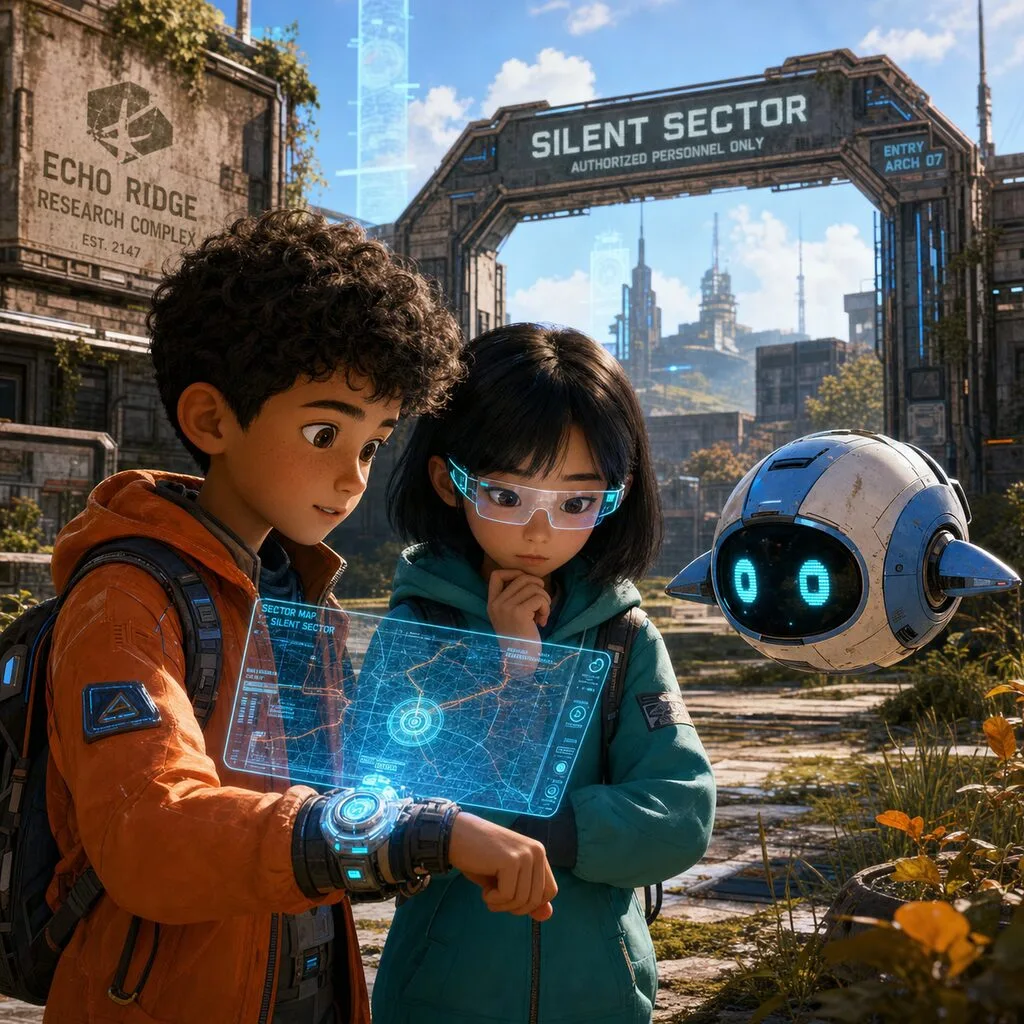
Robo, Ami and Pip enter the silent sector, where only teamwork can reveal the next clue to the mystery of Niva-7.
Robo and the Lost Planet, Part 7: Voices in the Silent Sector
The Story Begins
When the holographic map on Robo’s wrist lit up for the third time that day, all three of them knew it was time to go. At the edge of the old research complex stood a metal entry arch, and beyond it lay the silent sector. Even from a distance, it felt strange. There was no hum of ventilation, no footsteps from other people, and no usual beeping from panels. Only the soft buzz of machinery and their own breathing.
“There’s something here on the map,” Robo said, leaning over the projected image. His dark curly hair fell across his forehead. “If we go quickly through the middle, we might find a clue straight away.”
Ami adjusted her AR glasses and compared the map with the data they had from an old satellite. “Wait. The outline of this sector exactly matches the place we once picked up in a signal from an old educational game. Look, even that arch has the same shape.”
The small robot Pip hovered quietly above the floor, his LED eyes scanning the data. “The output confirms an unusual pattern,” he announced in a precise tone. “I recommend a brief analysis before entry.”
“An analysis?” Robo folded his arms. “But we already have the map.”
“That is exactly why it is worth checking again,” Ami replied calmly. “If it matches the satellite data too, it will be a stronger clue.”
For a moment, the boy said nothing. Then he nodded. “All right. But only for a little while.”
Soon, they were inside the silent sector. It was a long space with narrow corridors, old speakers in the walls, and light strips that glowed with a faint blue light. Nothing moved here. Even the air seemed not to flow as it did elsewhere.
“It’s… almost too quiet here,” Ami whispered.
“Quiet is good,” Robo said, though tension edged his voice.
Thin markings stretched across the floor. Pip lowered himself closer to the ground and projected them onto his screen. “The shape of the steps matters,” he warned. “Some panels respond to the order of movement, not to force.”
Robo reached for the control panel on the wall. “Then I’ll try to start it.”
“Not so fast,” Ami stopped him. “First, let’s look at the markings.”
But when he pressed the panel too early, nothing happened. No light. No sound. Only silence, which seemed to scold them all by itself.
“See?” Pip turned gently in the air. “The system does not respond to sudden input.”
Ami knelt and pointed at the lines on the floor. “Here is the first step, then the second, and only after that the third. Let’s do it together.”
The trio crossed the room exactly as the markings showed. Ami went first, then Pip’s small light projection indicated the correct spot, and finally Robo took the last step. At that moment, a short voice recording sounded from a speaker. It was not loud, only soft and slightly raspy, as if it came from a very old recording.
“If you are hearing this,” said a man’s voice, “you are in the right place. The communication beacon is still linked to Niva-7. Look for the light beneath the silence.”
Robo smiled. “There it is! I knew we were close.”
But Ami did not rush to celebrate. “That is only the first voice. We need to find out whether the recording is complete.”
Pip beeped softly. “Recorded length: seven seconds. The rest is hidden or separated.”
“Then we keep going,” Ami decided.
When Things Start to Change
The next part of the sector was divided into small archive rooms. In one lay an old map with handwritten notes; in another stood a scratched display panel; and in a third, an archived clip from the station had been preserved. Each source looked a little different. Yet they were connected.
“This is like a game with three keys,” Robo muttered.
“Exactly,” Ami said with a smile. “One key cannot open every door.”
She began comparing the symbols on the map with the shapes on the panel. Her fingers moved quickly and precisely. In one corner of the map, she noticed a mark like a small arch with a dot. The same shape appeared on the display panel, but only partly.
“Something is missing here,” she said after a while. “The second half of the symbol is gone.”
Pip projected the archived clip and began arranging numbers and words in a neat column. “Two recordings are incomplete,” he reported. “If we rely on only one, the result will not be accurate.”
Robo looked at the three sources side by side. “Then we combine them. Map, panel, recording.”
“And the satellite data as well,” Ami reminded him. “So we can be sure.”
The boy nodded. This time, he truly paid attention to what the others were saying. When Pip compared the numbers, it became clear that all three sources pointed to the same mark: the same symbol Ami had once seen on the game map from the old signal.
“Look!” Robo burst out. “It matches exactly.”
“And not only the symbol,” Ami added. “The location too. The game really led us here, to a real place.”
In the next chamber, the playback suddenly stopped. The light strips slowed, as if they were waiting. A simple sign blinked on the wall, and the room glowed with softer light for a moment. The system seemed to want the three of them to agree before it revealed anything more.
“Now we just press the last panel and we’re done,” Robo said. His old impatience had returned: let’s go now.
But Ami stopped him with a look. “No. First, let’s listen to what the recordings are saying between the lines. Something here is incomplete.”
Pip rose a little higher. “The correct order of steps has not yet been confirmed. The final voice will not activate without it.”
Robo sighed, then leaned against the wall and nodded silently. “All right. I’ll watch for what matches. You two look for patterns.”
This moment was more important than it first seemed. Each of them did what they did best, but this time they were not working separately. Ami read the symbols and the order, Pip compared the accuracy of the data, and Robo noticed where the information came together. That was when they spotted something strange.
The sound filters in the room responded only to their shared agreement. Whenever at least two of them agreed on a step and the third confirmed it using another source, the lights glowed brighter for a second. It was not about pressure. It was not about force. It was about agreement.
“So the system is testing whether we trust one another,” Ami said quietly.
“Or whether we know how to listen,” Pip added.
Robo thought for a moment. “Maybe both.”
At last, they agreed on the correct procedure. First Ami showed the symbol on the map, then Pip compared the archived clip with the original numbers, and finally Robo confirmed that all three sources pointed to one place in the middle of the chamber. When the last panel lit up softly, a short, deep tone sounded through the room. It was only a small moment, but it made all three of them laugh and feel calmer, as if the system had finally answered them.
An Important Moment
A new voice came from the speaker. This time, it was a woman’s voice. It was calm, yet it carried an old urgency.
“If you are hearing this message, it means you have joined three parts of the truth,” said a former researcher. “We protected the communication beacon near Niva-7 so that no one could properly understand it from only one side. The information was divided deliberately. Not so it would be lost, but so that only those who cooperate would find it.”
Ami did not move for a moment. “So it wasn’t a mistake,” she whispered.
“No,” the voice continued. “Whoever wishes to find the way to Niva-7 must listen to others. And must trust the data that completes the rest.”
Robo smiled slowly. He was no longer pushing ahead. He simply stood there and listened.
Then the message spoke the name of the familiar symbol, the very one they had seen on the map. When the researcher said it aloud, a blue strip of light lit up on the wall above them. It was clear that the game had not lied. It pointed to a real place.
“We were right,” Pip said softly, as if he did not want to disturb the rest of the recording.
“And there is more to it than that,” Ami added. “Someone in the past deliberately divided the information into several parts, so that only a team that truly agreed could find it.”
When the voice fell silent, the chamber grew calm. No echoing hum remained in the space. Only gentle light and the feeling that the answer was closer than before.
Suddenly, a new signal appeared on Robo’s wrist. A faint, pulsing dot lit up on the holographic map. It pointed towards a locked observatory at the edge of the station.
“Look at that,” Ami said, leaning closer. “The pulse matches the old symbol from the map exactly.”
Pip quietly recorded the signal’s frequency. “The data repeats in a regular rhythm. That will be important.”
For the first time since entering the sector, Robo did not rush ahead. Instead, he looked at his friends and waited to hear what they would say.
“So what now?” he asked.
Ami smiled. “Now we know where to go next.”
“And we also know,” Pip added, “that without comparing the three sources, we would never have found this message.”
The boy nodded. “And without you, I would have rushed for no reason.”
The trio walked back along the corridor towards the exit. The blue lights behind them slowly faded, but their steps were surer than before. The silent sector had given them more than a voice. It had given them trust.
When they stepped outside, the air felt far more alive. Dusk was already falling over the complex, but the new point still shone on the map. The locked observatory waited for further exploration. And somewhere beyond its walls, another piece of the mystery of Niva-7 might be hiding.
“This is how I like it,” Robo said with a laugh. “Another clue, a new level.”
Ami laughed too. “But this time with care, not just speed.”
Pip gave a satisfied beep. “Recommended procedure: go together.”
And so they left calmer, more united, and a little wiser. In the silent sector, only the voices of the past remained. But for them, those voices had already become a real path forward.