
The House at the Edge of the Map, Part 1: The Map Without a Street

A map hidden in the school library shows a house beyond every road—and its blue window begins to glow.
The House at the Edge of the Map, Part 1: The Map Without a Street
The Story Begins
The last bands of sunlight moved slowly across the school library floor when Mrs Urbanová rang a small brass bell.
“We’re closing in ten minutes,” she announced over her silver spectacles. “Books don’t put themselves away. At least, not the well-behaved ones.”
Nina leaned over the table by the window and closed the atlas. They had been looking for something about the old town—more precisely, what the area around the school had once looked like. Oliver insisted that old streets must have been marked on town plans. Mia wanted to find photographs because, in her view, they revealed more than lines could.
“Every map has order,” Oliver said, tapping the atlas with one finger. “Street, number, direction. People like things to belong somewhere.”
“That’s what you’d say,” Nina replied. She pushed her pencil more firmly behind her ear. “Sometimes a road ends only because no one has drawn the rest of it yet.”
Meanwhile, Mia walked around the table and stopped by the lowest shelf. Between the large school volumes, their years faded on the spines, she noticed a thin, dark corner.
“I don’t think this belongs here,” she whispered.
She pulled the book out carefully, as if she feared it might crumble. It had no title and no picture. Its cover was grey-brown and worn, and on the spine there was only a pale rectangle where a label had long ago been peeled away.
Nina took it in her hands. The paper smelled of dust, wood, and something dry that reminded her of her grandmother’s attic.
“Maybe it’s a diary,” Oliver suggested. “Or a boring account book. Those are usually the thickest.”
But the book was neither thick nor especially heavy. When Nina opened it near the middle, a folded sheet slid out from between the pages and landed softly on the table.
All three of them bent over it.
It was a map of their town.
At first, they saw nothing unusual: the square, the river, the school, the bus stop, the park by the hospital. The streets were drawn in fine black ink, and some of the names were already almost impossible to read.
Then Nina pointed to the lower-right corner.
Beyond the last street drawn on the map, where the paper became blank space, stood a small house. It had a narrow roof, two windows, and a door with no path leading to it. No road led there. There were no trees or fence around it. Only empty space.
“That’s a mistake,” Oliver declared at once.
Mia frowned. “What kind of mistake draws an entire house?”
“Maybe someone was testing their pen.”
“You don’t test a house with a pen,” Nina said. She was already opening her little notebook of maps. “And look. It’s exactly by the housing estate—but a little farther than any road reaches.”
Mrs Urbanová appeared at the end of the bookcase, keys hanging from a ribbon. She did not look surprised. Rather, she looked as though she had found pupils with a book they should not have taken from the shelf.
“Have you found something interesting?” she asked.
Oliver quickly laid a hand over the map. “Just an old town plan.”
The librarian looked at it over her spectacles. Her gaze paused for a moment on the little house. Then she nodded.
“Old things can be interesting when you look at them closely enough,” she said.
Nina noticed that Mrs Urbanová had not said the map was ordinary.
They spread the map out on a larger table among the atlases. Outside the windows, the treetops were darkening, and the school corridor beyond the door was empty. A metallic sound came from the next classroom—perhaps someone had placed a chair on a desk. Oliver turned around anyway.
When Things Start to Change
“A draft,” he muttered, though the windows were shut.
Nina compared the fine lines on the paper with the new town map in the atlas. She wrote down every crossroads in her notebook. Near the housing estate, she drew three apartment blocks, a path, a bench, and the empty strip of grass behind them.
“It should be here,” she said after a while. “But there’s nothing there. Just short grass and an old bench beside the path.”
“Sometimes there’s fog there,” Mia added. “When we walk to school in the morning.”
Oliver pulled a small torch from his pocket, one that had belonged to his grandfather. An old brass compass was attached to it. He switched on the light and moved it over the map.
“If the ink reacts to heat or light, another layer might appear,” he explained. “That would be logical.”
The beam passed over the square, across the river, and finally stopped at the house at the edge of the map.
At that very moment, Mia gasped.
“By the window!”
All three leaned closer.
A tiny bluish dot had appeared beside the house’s upper window. It was no bigger than a pinhead. Even so, it was clearly visible. It definitely had not been there a moment ago.
Oliver switched off the torch. The dot did not disappear.
He switched it on again. The blue remained, but in the light it seemed to glow softly.
“That’s not possible,” the boy said more quietly than he had intended.
Mia kept hold of the edge of the table. “That house doesn’t look scary.”
“It doesn’t?” Oliver looked at the drawing.
The girl shook her head. “It looks as though it’s alone.”
Mrs Urbanová came closer. Her fingers, slightly bent with age, stopped just above the paper, but did not touch the map.
“The book without a title has been hidden among the school volumes for a very long time,” she said. “Perhaps it was waiting for someone to open it in the right way.”
“What does that mean?” Nina asked.
The librarian smiled, but did not answer directly. “It means that some things do not reveal themselves to people who are in a hurry. And now, please, we must hurry. The library is closing.”
Oliver pointed at the blue dot. “Is it a trick? Old paper, a chemical, light?”
“Perhaps,” said Mrs Urbanová. “Or perhaps you should look properly first, and only then think up explanations.”
She folded the map back into the book, then took it out once more and handed it to Nina.
“Keep it with you until morning. The book stays here.”
Nina took the paper as carefully as if she were holding thin ice.
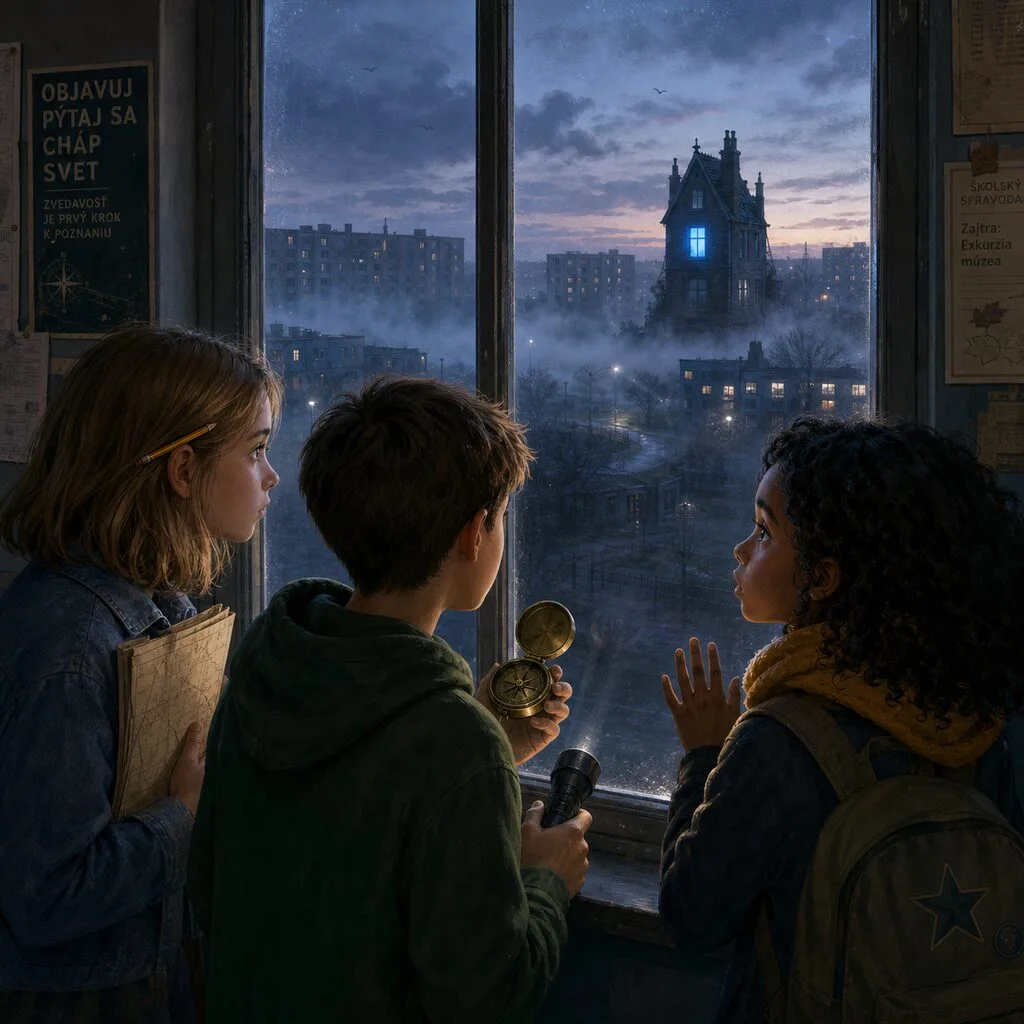
Night had already fallen when the three friends met by the housing estate. Oliver arrived in a green hoodie, carrying his torch and compass. Mia wore a yellow scarf and a small backpack with a star patch. Nina had brought her notebook, a pencil, and the map tucked between two stiff boards.
“We don’t have to go all the way there,” Oliver said at once. “We can look from the path first. That’s the sensible approach.”
“Does that mean you’re scared?” Mia asked, without teasing him.
“It means I don’t want to trip over a bench in the dark.”
Nina smiled, but her stomach was tight. The empty strip of grass had never bothered her during the day. Now fog drifted behind the apartment blocks, and every darker bush looked like something that had chosen to wait perfectly still.
An Important Moment
From an open window came the ticking of an old clock. The steady tick, tick, tick mingled with the distant hum of cars.
Nina unfolded the map beneath a streetlamp. “If the scale is right, we need to go past the third apartment block. Then right across the path, and about another twenty steps.”
Oliver set the compass. “North is over there. At least something is working normally.”
Mia stared into the fog. “The air is colder here.”
“Air doesn’t have an address,” Oliver said.
“No, but a place can have a mood.”
The boy was about to argue, but at that moment his torch flickered. The light dimmed, then returned. Ahead of them stood a bench, exactly like the one in Nina’s drawing.
Behind it, there was no longer only grass.
In the soft fog, a narrow house took shape.
It had two storeys and a roof that leaned slightly to one side. Its walls were not quite clear, as if someone had drawn them in pencil and then smudged them with a hand. A muted blue light shone in the upper window.
Nina stopped breathing.
Oliver’s torch pointed directly at the building, but its beam did not touch it. It ended just before the house, as if the light had decided not to go any farther.
“A reflection,” Oliver said. “Maybe… a reflection from a window.”
But there was no window in front of them that could reflect a house that had not been there during the day.
Mia took a small step forward. “It doesn’t look as though it’s angry with us.”
“A house can’t look,” Oliver snapped, though his voice trembled.
A moment later, the blue light in the window grew stronger. It did not dazzle them. It reminded Nina of a lamp covered with blue glass. Behind it, a faint shadow flickered—the suggestion of someone standing near the window frame.
Nina backed away until she reached the bench.
The house did not rush towards them, open its door, or make any terrible sound. It simply stood there, alone, quiet, and fragile. Then the fog swept over the grass, and the building slowly faded away.
Only the bench, the wet grass, and emptiness remained.
“Did you see that too?” Oliver asked.
“Yes,” Mia answered.
Nina said nothing. She knelt beside the bench, opened the map, and pressed it against the wooden seat. The blue dot was no longer beside the window. It had moved directly onto it.
On the paper, its colour trembled softly, as if a tiny light were breathing inside it.
“It marks the window,” Nina said. “Not the place beside the house. The window itself.”
Mia sat down beside her. “Maybe someone there is waiting for something.”
“Or maybe it’s the place we should look at next,” Oliver added. This time, he did not sound as if he had found an answer. He sounded as though he were carefully trying one out.
The fog moved closer to the bench. Nina realised she was gripping her pencil so tightly that her fingers hurt.
“I don’t want to go closer,” she admitted.
Oliver turned to her. “We don’t have to.”
“Not because I don’t want to find out what it is.” Nina looked at the empty place where the house had stood. “I do. Very much. It’s just… the dark makes me nervous. And when that house appeared, I felt as if my legs no longer belonged to me.”
Mia leaned towards her. “That’s all right. I’m scared too. I just don’t feel that it wants to hurt us.”
What Comes Next
Oliver handed Nina the torch. “You hold it. We’ll shine it together.”
For a moment, she looked at the small metal handle. Then she took it. Her fingers touched Oliver’s, and the light remained steady.
“We’ll come back tomorrow,” Nina decided. “But better prepared. I’ll bring a more accurate drawing. Maybe you can find out whether a building ever stood here. And Mia…”
“I’ll listen to see whether it’s this quiet again,” Mia finished.
“That’s a plan,” Oliver agreed. “Not an entirely normal plan, but a plan.”
Together, they walked back to the brighter path by the school. A streetlamp shone by the entrance, and beneath it stood Mrs Urbanová. She was locking the library’s side door, as if she had been waiting for them, though she asked no questions.
Nina spread out the map one last time. The blue dot had settled clearly at the little house’s window. For a moment, the edge of the paper flickered faintly.
Mrs Urbanová looked at it and said quietly, “Tomorrow, you will need courage and patience.”
Oliver swallowed. “At least the house doesn’t demand homework.”
Mia laughed first. Then Nina laughed too, though she could still feel a gentle tremble in her chest.
She folded the map, slipped it between the covers of her notebook, and set off home between her friends. Behind them lay the school, the fog, and the empty place by the housing estate. But on the paper, beside the little window, a dot shone as it waited for the next night.
To be continued…