
The House at the Edge of the Map, Part 9: The Classroom That Vanished

A vanished classroom appears at school, and Nina, Oliver, and Mia discover the name someone tried to erase.
The House at the Edge of the Map, Part 9: The Classroom That Vanished
The Story Begins
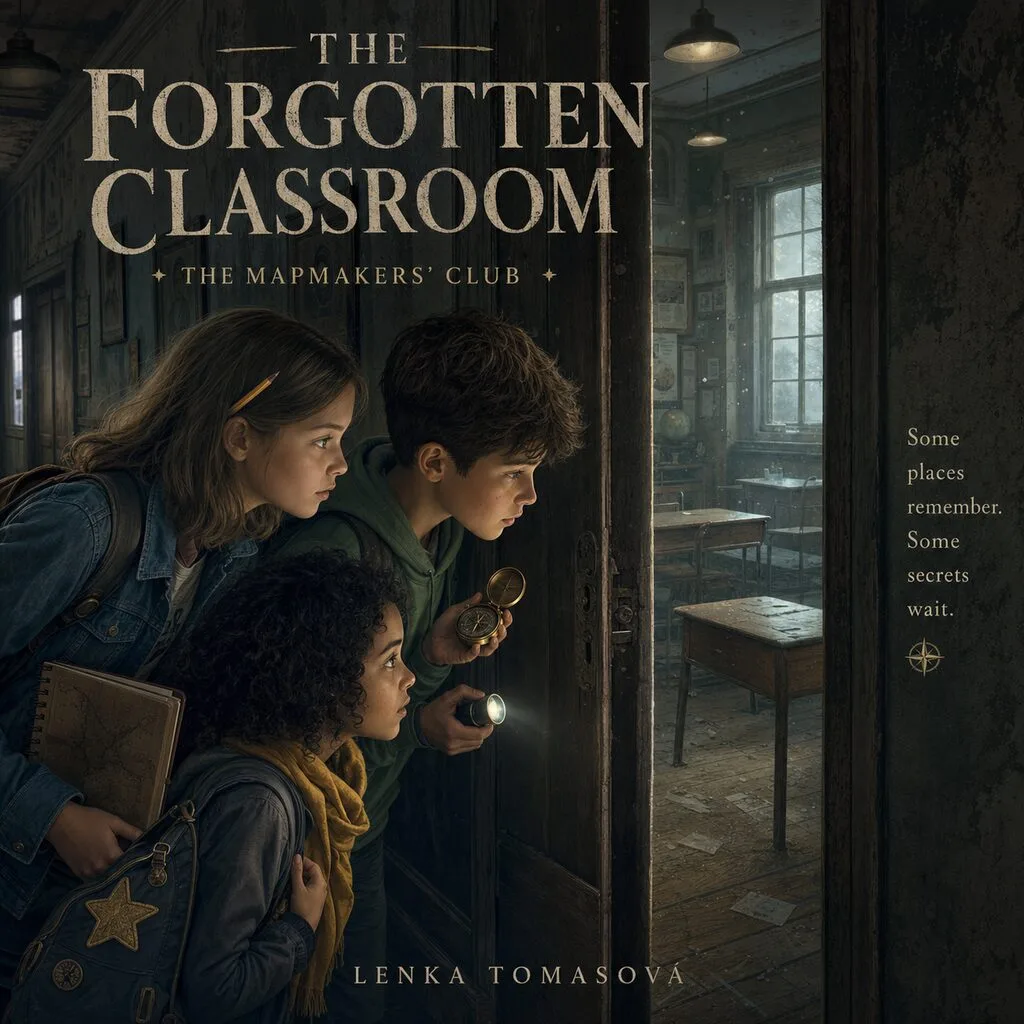
The last bell rang through the school so loudly that Nina jumped. At once, the halls filled with footsteps, voices, and closing doors. A few minutes later, however, the older part of the building fell quiet. That was where Nina, Oliver, and Mia remained, beside wooden doors with a faded sign reading Textbook Storage.
Beyond the doors began a hallway the school had not used for a long time. The plaster was cracked, a thin mark from an old leak ran near the ceiling, and the air smelled of wood, dust, and something dry that reminded Nina of chalk.
“Mrs Urbanová said the abandoned part of the school was somewhere here,” Oliver whispered. He held a small flashlight in one hand and an old brass compass from his grandfather in the other. “But on the regular floor plan, it ends at the stairs.”
Nina opened her map notebook. The old map they had once found in the school library, the one that had led them to the House at the Edge of the Map, lay carefully flattened between its pages. That morning, the thin grey line on it had ended by the back wing of the school.
Now it continued.
She held the map closer to the window light. The new line was pale, but definite. It ran straight beside the wall where they stood.
“This hallway was not there yesterday,” she said firmly.
Oliver leaned closer. “Maybe we just saw it wrong. Old plans can be inaccurate. Someone might have redrawn them.”
“A map does not redraw itself,” Mia reminded him. She pulled her yellow scarf more tightly around her neck. “And it is colder here than by the stairs.”
Oliver was about to argue, but just then the storage doors behind them slowly swung shut. They did not slam. They simply settled quietly into the frame.
All three turned around.
“A draft,” the boy said, though no window near those doors was open.
Nina swallowed. Darkness had never been easy for her, especially this kind of school darkness, where she knew every corner and still could not be sure what lay beyond it. But she did not want Mia to feel any worse.
“We go together,” she said. “Slowly. And we do not touch anything until we know what it is.”
“That is a sensible plan,” Oliver agreed. “At last, we have rules for walking through hallways that should not exist.”
Mia gave him a faint smile. Then she gripped the strap of her backpack with its star patch, and they set off.
The hallway was longer than it should have been. Nina noticed after ten steps. Then after twenty. According to the map, there should have been a wall, but the old wooden trim and grey tiles continued ahead of them.
“One corner is missing,” she muttered, drawing in her notebook. “The original wing should turn right. Instead, there is a narrow passage.”
Oliver began counting steps. “Twenty-six, twenty-seven, twenty-eight… If this is really behind the gym, we should already be standing in the ball cupboard.”
“I do not want to stand in the ball cupboard,” Mia said.
“Neither do I,” he admitted. “Especially if there is a basketball with opinions of its own.”
His joke was not very good, but perhaps because of that, Mia laughed softly. The sound did not travel down the hallway as an ordinary laugh would. It was as if the old walls swallowed it at once.
Near the next wall, Oliver’s compass trembled. The needle turned a little to the left, then back to north, then left again.
When Things Start to Change
“That is not possible,” the boy said, without joking now. “There is no metal cabinet here, and no cables. At least, not as far as I know.”
Just then, a door appeared at the end of the hallway.
It had not been there a moment before. Nina would have noticed. It was dark green, with tiny flakes of paint peeling away. Above the brass handle hung a crooked sign. Its writing was almost worn away, but it could still be read.
5.B
Mia stopped. “Is that the classroom?”
Nina nodded, though her throat had gone dry. In the eighth episode, the map had filled in the floor plan of the abandoned part of the school. Now it had led them exactly here.
“According to the records, it was closed many years ago,” Oliver said. “Classrooms do not just disappear.”
“This one perhaps did,” Mia whispered.
Nina put her fingers on the handle. The metal was cold. For a moment, she wanted to turn around and return to the storage room, the noisy main hallway, and the ordinary classrooms where fresh drawings hung on the notice boards.
Then she remembered how the house reacted when they found a true clue. It did not ask them to be fearless. It only asked them to look carefully.
She pressed down the handle.
The door opened without a creak.
Beyond it was a classroom full of old desks. Dust floated in tiny specks in the weak light by the windows. Yellowed notice boards hung on the walls; on one, drawings of trees could be seen above the words Our Spring. A wooden pointer remained by the blackboard. An exercise book lay open on the teacher’s desk, on a page that could no longer be read.
What was most striking, though, was that the room did not look abandoned.
It looked as if the pupils had left five minutes ago, except that those five minutes had lasted for decades.
Oliver switched on his flashlight, but held it low so that he would not shine directly on the old papers. “Nobody touches anything,” he said. “The rule still stands.”
“It does,” Nina confirmed.
Meanwhile, Mia went to the first desk. A small paper rectangle lay on its edge. It was dusty, but the writing remained legible.
“There is a name here,” she said.
The name tag read: Zuzana Kováčová.
The next desk had a name tag too. And the next. Oliver let his gaze travel over the rows and read quietly: “Peter Janík. Lenka Bartošová. Roman Šimek…”
Nina sat at a desk beside an empty place near the door and sketched the desks in her notebook. Four rows, with four desks in each. Windows along the left side. The teacher’s desk by the blackboard. Old stoves in the back corner, though they had not been connected for a long time.
“There are fifteen,” Oliver said after a while. “Fifteen name tags.”
“And how many desks?” Nina asked.
He counted them again, more slowly this time.
“Sixteen.”
By the window, in the last row, stood one desk without a name tag.
It was neither broken nor out of place. The same dust lay on its top as everywhere else. The chair was pushed neatly beneath it, as if its owner might return from break at any moment.
Mia did not go up to it at once. She stopped a step away and looked at the other desks. “They all have their place,” she said. “Only this one does not.”
“Maybe the name tag fell off,” Oliver suggested. He searched the floor around the desk, but did not pick anything up. “Or someone took it.”
An Important Moment
Nina shook her head. “No. Look at the arrangement. All the names are in places where someone sat. This desk was part of the class too. It is not a spare desk.”
When she moved closer, she felt the cold even through the sleeves of her denim jacket. It made her stop.
“Are you afraid?” Mia asked gently.
Nina wanted to say no automatically. Then she looked at the empty desk by the window, and the truth came out more easily than she expected.
“Yes,” she admitted. “More than at the house. There, at least, we know something is changing. This looks completely ordinary. And that is what makes it worse.”
Mia nodded. “The scariest thing here is not the darkness. It is that desk. It looks as if someone was meant to sit among the others, but nobody left even a name for him.”
Oliver lowered his flashlight. Its circle of light stopped on the notice board. Beneath a layer of dust hung the class rules: We do not shout. We help one another. We borrow things only with permission.
Beside them was a duty rota. The names were arranged in columns, with small crosses beside each week. In the middle, however, one square was empty. Not torn out. Not smudged. Just empty.
“That does not make sense,” Oliver said. “If they had sixteen desks, they should have had sixteen pupils. But there are fifteen names on the rota.”
A drawer in the teacher’s desk stood slightly open. Its wood was darker than the rest of the furniture, and the corner of a yellowed sheet of paper showed from inside.
“We are not moving anything,” Nina reminded them, “but the paper is already out.”
Oliver leaned in carefully. With two fingers, he pulled the sheet out just far enough for them to read it. It was a class list. The names matched the tags on the desks.
One space among them, however, was covered by a grey smear. Not ink. It looked as if someone had wiped across the line with a wet cloth, then rubbed at it again and again.
“I will try to read it at an angle,” Oliver whispered. He tilted the flashlight, but the writing did not appear.
Nina compared the order of the names, the desks, and the duty rota. Her pencil scratched quickly across the page. “It is not a mistake in the list. Someone was here. He had a desk, probably even a place in the order. They simply left him out of these things.”
Mia looked at the empty desk by the window. The weak grey light reflected in her eyes.
“Do you think the others did not want him among them?” she asked.
No one answered at once.
“Maybe he moved away,” Oliver said, but he no longer sounded convinced.
“If he had moved away, his name would still be here,” Nina objected. “At least on the list. But someone tried to make sure it was not.”
Mia took a breath. She did not speak loudly, but every word was clear in the classroom.
“Maybe someone was left out of the shared place. And then they acted as if he had never been there.”
The air by the window stirred.
It was not like wind. The curtains did not move, and the windows remained firmly shut. Only the dust above the empty desk swirled into a thin circle. Oliver’s flashlight flickered for a moment.
A pale rectangle appeared on the desktop.
All three stood without a word.
At first, the paper name tag looked like a stain in the dust. Then its edges sharpened. At last, letters began to form upon it, slow and dark, as if someone were writing them with an invisible pencil.
What Comes Next
Samuel Horský.
Mia pressed her hand to her mouth. Nina copied the name into her notebook so carefully that her pencil did not tremble once.
Oliver looked at the yellowed list. “Samuel Horský,” he repeated. “That must be the line. The one someone erased.”
“But the classroom did not forget him completely,” Mia said. “Otherwise, it would not have shown us his name.”
At those words, the cold by the window eased a little. It was not gone, but it no longer felt like a cold finger at the back of the neck.
Nina closed her notebook. “We should not force ourselves to search for more here.”
Oliver nodded. That surprised her. Usually, he would have wanted to measure every desk, draw a chart, and find ten more clues.
“The numbers told us that one place is missing,” he said quietly. “But they do not tell us why someone erased it.”
For a while, they sat at three neighbouring desks in the middle of the classroom. They did not open any more drawers, call Samuel’s name, or try to pull an answer from the room before it was ready.
The silence was heavy, but it was no longer unfriendly.
After a moment, Oliver raised the compass. The needle had finally settled on north.
“At least it has stopped dancing like it is on a carousel,” he remarked.
Mia laughed a little louder than before. “Your compass would look very confused on a carousel.”
“It looks confused even without a carousel,” Nina said, and felt some of the tension ease from her, if only a little.
When they stood up, a softer light shone by the window. It was neither bright nor warm like sunlight, but it no longer had that sharp, wintry colour.
At the door, Nina opened the map again.
On the old floor plan, the outline of classroom 5.B was now complete. It was no longer broken. It formed a whole room with four rows of desks and a narrow space by the window. On the edge of the page, where there had been nothing before, two words appeared.
Samuel Horský.
Oliver compared them with the name tag on the desk. “Exactly the same handwriting.”
“The map remembered him,” Mia said.
Behind them, the classroom did not vanish with a crash or dissolve into smoke. Instead, it began to recede, though they were still standing at the same door. The desks darkened in the dust, the notice boards faded, and the weak window light narrowed into a thin strip.
Nina looked at Samuel’s desk one last time. It no longer lacked a name. Yet it remained empty.
The door closed behind them as quietly as it had opened.
In the hallway, they felt the ordinary school air again, and from far away came the laughter of someone on the playground. Only the map in Nina’s hand remained warm.
“We know who the desk belonged to,” Oliver said.
Mia looked back at the green door, which now looked like nothing more than an old storage door without a sign. “But we do not know what happened on the last day of 5.B.”
Nina carefully closed the map. “Someone may still know.”
And as they walked back together towards the stairs, a new line appeared beside Samuel’s name on the last page of Nina’s notebook, still empty for now.
To be continued…