
The Unnumbered Corridor, Part 9: The Last Window

A window appears in the Unnumbered Corridor, showing Nora, Filip and Ben a courtyard from the past—and a clue left by Klara.
The Unnumbered Corridor, Part 9: The Last Window
The Story Begins
The corridor on the third floor was unusually quiet. Every now and then, a faint metallic ping came from the lift shaft, and somewhere behind a wall, a tap dripped. Nora stood by the plaster wall where they had found the chalk message a week earlier. In one hand she held a small paper notebook, and in the other, a pencil.
“According to the map, the vanished wing was exactly this way,” she said, pointing at the wall opposite the stairs. “Not behind the lift. Behind this wall.”
Filip pulled his flashlight from beneath his hoodie. “But Mrs. Kováčová’s flat is behind this wall now. And her kitchen. If the whole wing used to be here, her stove would be in the past.”
Ben did not smile. He stared at the grey plaster, where old cracks ran in wavy lines. “Mrs. Richterová said they only covered up a lot of things after the renovation. They did not have to tear everything down.”
Just then, the light above them flickered.
All three froze.
The bulb flashed once, then again. Then the whole corridor went dark. The darkness lasted only a few seconds, but Nora knew those seconds far too well. They were the same seconds after which the Unnumbered Corridor appeared.
“Together,” she whispered.
Filip found her sleeve, Ben touched her backpack, and a familiar, quiet rustle sounded in the darkness. It was as though a heavy curtain had shifted somewhere behind the walls.
The lights came back on.
But the ordinary corridor had vanished.
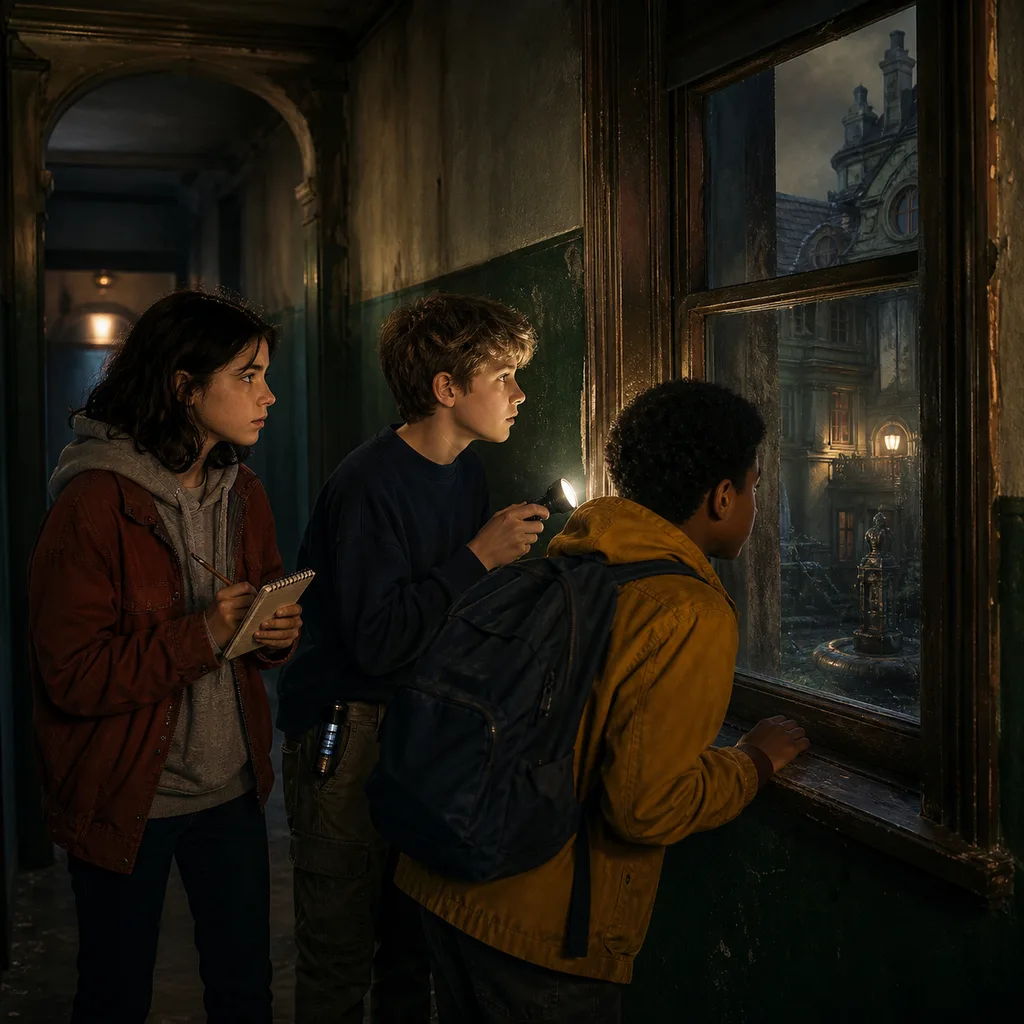
In its place was a narrow space with faded green walls, a low ceiling, and old doors without numbers. Yellowish bulbs glowed weakly, as if they were not sure they ought to be lit at all. At the far end stood a wall Nora knew from their earlier visits.
Except that now, it was not bare plaster.
There was a window.
It had a tall wooden frame painted dark brown. The varnish was cracked in places, and dust had gathered in the corners. Pale daylight moved behind the glass, although evening was already falling outside the building.
Nora opened her notebook to a blank page. Her hand shook a little, so she wrote more slowly than usual. “Wall opposite the third door. Window: about one metre twelve from floor to sill. Width… maybe eighty centimetres.”
“Leave me room for corrections,” Filip said, though his joke sounded strained. He stepped up to the frame and shone his flashlight on it. The beam passed across it, but the glass gave back none of the reflection he expected.
Ben stayed a step away. “That window wasn’t here before, was it?”
“No,” Nora answered at once. “And no window from the outside courtyard leads here. We checked when we found the map.”
Filip bent over the lower part of the frame. “Maybe it’s a panel. An old service hatch. Or a mirror that takes an image from somewhere else.”
“A mirror should not show a courtyard that does not exist,” Ben said quietly.
At last, Ben dared to step closer. There really was a courtyard behind the glass. But it was not the one they knew. Today, two young maple trees grew there, colourful bins stood near the fence, and a bench with peeling blue paint stood beside it. Beyond the window, though, was a smaller, emptier courtyard with uneven grey paving stones. The fence was dark wood. Beside it stood a round garden table with iron legs.
“That table,” Ben said. “We saw it in a photograph at Mrs. Richterová’s. The one where she had a big bow in her hair as a little girl.”
When Things Start to Change
Nora quickly added more notes. Then she took a folded copy of the map of the vanished wing from her pocket. The paper had bent corners and one tea stain, but the lines were still clear.
“Look.” She held the map against the wall beside the window. “Here is the old passage from the corridor to the courtyard. And here is the window. On exactly the same side.”
Filip ran a finger along the map, then along the frame. “That would mean this corridor was not added later. It belonged to that wing. It was here before they bricked it up.”
“So it is not just some strange dream of the house?” Ben felt a little relieved, but only a little.
“Houses do not dream,” Filip replied automatically. Then he frowned. “Well, at least they should not.”
He tapped the wall beside the sill with his knuckles. The plaster answered with a hollow sound. A little lower, it gave a different, fuller note. He took a small screwdriver from the key ring he carried and carefully ran its tip along a narrow gap beside the wood.
“There are metal fittings here,” he said. “Very old ones. Like the kind used for sliding panels or a ventilation mechanism.”
“Don’t try to open it,” Nora warned him.
“I don’t want to. Not yet.”
Suddenly, there was a knock from behind the glass.
All three stepped back.
No one stood in the courtyard. There was no wind, the sheet on the clothesline hung motionless, and the leaves of the low bush did not even rustle. Yet a moment later, a second knock sounded. Short. Precise.
Ben folded his arms across his chest. “That did not come from the corridor.”
“Maybe something is moving in the pipes,” Filip suggested, but he did not convince himself. The flashlight beam trembled faintly in his hand.
Nora took a breath. “We’ll step back to the doors. Only for a moment. Then we’ll come back and see whether the image changes. No splitting up.”
No one objected.
They stood by the nearest door without a number. Nora watched the window over Filip’s shoulder. Meanwhile, a pale reflection of the corridor appeared in the glass, then vanished. A minute crawled by slowly. A tiny chime rang from the ceiling, as if a spring had shifted in an old lamp.
“Now,” she decided.
They returned to the window together.
The courtyard had changed.
Large white sheets hung drying on the lines. They moved in the wind and briefly covered the whole view. When they drifted aside again, two small children in short trousers and shirts ran across the paving stones. One carried a tin bucket. A woman in a dark dress stood by the fence, holding a rolled-up paper.
“That’s the past,” Ben breathed.
Filip said nothing for a long time. He no longer aimed the flashlight at the frame, but at his own palm, as though he needed to see something ordinary. “An old film? A projection? But from where? And why from exactly this angle?”
Nora pointed to the corners of the courtyard. “It is not a film. Look at those places. The courtyard matches the map. Where the fence is today, there used to be a wall of the wing. And the window must have been right here.”
More people passed behind the glass. Two men carried a wooden crate. They stopped at a low door in the back corner of the courtyard, a door that no longer existed. One of them took a bunch of keys from his pocket.
An Important Moment
“An archive point,” Filip muttered. “Or a storeroom. There’s a small mark on the map by the passage. I thought it was a chimney.”
For a moment, the image tore into grey bands. Nora only had time to see the man with the keys open the door, while the other man glanced nervously towards the window.
Not towards the window in the courtyard.
Towards this window.
His face was too far away for them to make out his features. Even so, Nora shivered. The man was not looking up by chance. He was staring straight at the place where they stood.
“Can he see us?” Ben asked.
“He can’t,” Filip said quickly. “If it’s a recording, he can’t see us. If it’s… something else, then…”
“Then maybe he can,” Nora finished.
No one moved. Suddenly, everything in the corridor sounded louder: the buzz of the bulb, their breathing, the rustle of Ben’s jacket. Then the sheets swept across the image again, and the man disappeared.
When the cloth moved aside, the courtyard showed a different moment.
A girl stood at the small side window in the vanished wing. She was perhaps a little older than Nora. Her dark hair was fastened with a clip, and she wore a light sweater with the sleeves rolled up. One hand held the sill. In the other, she clutched something small and shiny to her chest.
Ben leaned so close that his nose nearly touched the glass. “Klara.”
“Are you sure?” Nora whispered.
“Mrs. Richterová showed me her photograph once. She had the same clip. And she always looked like this… as if she were listening to more than she wanted to say.”
The girl behind the glass was not looking at the children. She was watching the courtyard and the men by the low door. When one of them opened the crate, Klara raised the shiny object. In the dim light, a metal ring flashed, perhaps a pendant or a small key.
Then a taller figure appeared beside her. An adult man in a light shirt. He placed a hand on her shoulder, not roughly, but clearly enough to make her understand that she should move away from the window.
Klara did not turn at once. First, she quickly traced something on the dusty sill with her finger. A single sign.
Nora did not see all of it. The sheet moved again and covered the window in the past.
“She wrote something,” she said.
“Maybe only a letter,” Filip argued, though he was already taking out his pencil. “If it was a letter, it could mark a room. If it was a number, perhaps a box, a vent, or part of a mechanism.”
“The man beside her knew what Klara was watching,” Ben said. His voice shook, but he did not step back. “And the people in the courtyard knew they should not look up. That is why the one with the keys looked this way.”
The image began to fade. Colour drained from the sheets, the children in the courtyard became blurred shadows, and for a moment the old table overlapped with the modern bench. The corridor light blinked.
“We do not have much time,” Nora said. “Filip, the sill height. Ben, watch Klara. I’ll get the sign.”
They got to work without another question.
Filip held the screwdriver against the wall and marked a spot below the frame with his thumb. “Sill: one metre twelve. Left corner: thirty centimetres from the crack in the plaster.”
Ben stood at the glass with clenched fingers. “She is still holding that ring. No, wait… something is hanging from it. A small tag.”
What Comes Next
Nora stared at the dusty sill in the past. Klara’s finger moved once more. At that moment, the sign on the wood became clearer, as if sunlight had lit it for a moment.
It was not a letter.
It was a small drawing of a door, with the number 7 in a circle beside it.
Nora scribbled it into her notebook so quickly that the pencil tore through the paper. Beneath the sign, she wrote: “Klara. Sill. Door? Seven?”
At that moment, one final knock came from the other side of the glass.
Not two short knocks as before.
Just one.
And after it, Klara turned around behind the window.
Her face was not frightening. She looked focused, a little sad, and very tired. She looked straight at Nora, as if she knew that, after all these decades, someone was finally looking back.
Then everything vanished.
The glass darkened. The wooden frame broke apart into a grey outline. A moment later, only the old plaster wall remained before them, with the crack they already knew. The bulbs above their heads shone normally. The Unnumbered Corridor had become an ordinary third-floor corridor again.
No one spoke until Filip placed his palm against the wall. It was cold, but solid.
“No panel,” he said at last. “No mirror. And definitely no projection that someone had somehow shone through a wall.”
Nora closed her notebook and gripped it tightly. “The window showed a place that used to be here. Exactly where the passage is on the map.”
Ben looked at the empty place where Klara had stood moments earlier. “And she was watching what they were taking out of that room. Maybe she wanted someone to find it. That is why she left the sign.”
Filip spread the copy of the map on the sill by the stairs. With his finger, he found the line leading from the courtyard into the former wing. Beside it was a tiny mark they had so far taken for an ordinary mistake in the drawing.
Now it looked like a door.
“The seven in a circle may not be an apartment number,” he said. “It could mean the seventh point on the old plan. Or the seventh door. The last door we have not opened yet.”
“First, we’ll compare the map with all our notes,” Nora decided. “Then we’ll ask Mrs. Richterová about Klara. Not about the corridor directly. First about the man by the window.”
Ben nodded. “Maybe she will keep quiet. But if we know what to ask, she will not just say, ‘That was a long time ago.’”
Footsteps sounded from the stairs. This time, they were perfectly ordinary: someone going home with a shopping bag. The three quickly folded the map and headed downstairs.
Nora looked back once more.
There was no window on the empty wall. Only the old crack in the plaster, thin as a pencil line. Yet at its end, the corridor light briefly made a small curve.
Almost exactly around an invisible seven.
To be continued…