
Chodba bez čísla, časť 9: Posledné okno
Posledné okno v chodbe bez čísla ukáže dvůr z minulosti a stopu ku Kláre. Nora, Filip a Ben odhalia ďalšie tajomstvo.
Vypočujte si slovenskú audio verziu príbehu
posledné okno je nová časť seriálu Chodba bez čísla, pripravená ako dvojjazyčný detský príbeh v slovenčine aj angličtine.
posledné okno: začína sa príbeh
Na chodbe na treťom poschodí bolo nezvyčajne ticho. Z výťahovej šachty občas prišlo slabé kovové cinknutie a niekde za stenou kvapkal kohútik. Nora stála pri omietke, na ktorej pred týždňom našli kriedový pokyn. V jednej ruke držala malý papierový notes, v druhej ceruzku.
„Podľa mapy bolo zaniknuté krídlo presne týmto smerom,“ povedala a ukázala na stenu oproti schodom. „Nie za výťahom. Za touto stenou.“
Filip si vytiahol baterku spod mikiny. „Ale za touto stenou je dnes byt pani Kováčovej. A jej kuchyňa. Ak by tu bývalo celé krídlo domu, mala by sporák v minulosti.“
Ben sa neusmial. Pozeral na sivú omietku, kde sa vlnili staré praskliny. „Pani Richterová povedala, že po prestavbe veľa vecí len prekryli. Nie všetko museli zbúrať.“
Práve vtedy svetlo nad nimi zablikalo.
Všetci traja stuhli.
Žiarovka raz zasvietila, potom druhýkrát. Následne celá chodba zhasla. Tma trvala iba pár sekúnd, ale Nora ich poznala až príliš dobre. Boli to tie isté sekundy, po ktorých sa objavovala chodba bez čísla.
„Spolu,“ zašepkala.
Filip nahmatal jej rukáv, Ben sa dotkol jej batoha a v tmavom priestore sa ozvalo známe, tiché šuchnutie. Akoby sa niekde za stenami presunul ťažký záves.
Svetlá znovu naskočili.
Obyčajná chodba však zmizla.
Namiesto nej pred nimi ležal úzky priestor s vyblednutými zelenými stenami, nízkym stropom a starými dverami bez čísel. Žltkasté žiarovky svietili slabo, akoby si neboli isté, či majú svietiť vôbec. Na konci sa črtala stena, ktorú Nora poznala z ich predchádzajúcich návštev.
Lenže teraz na nej nebola holá omietka.
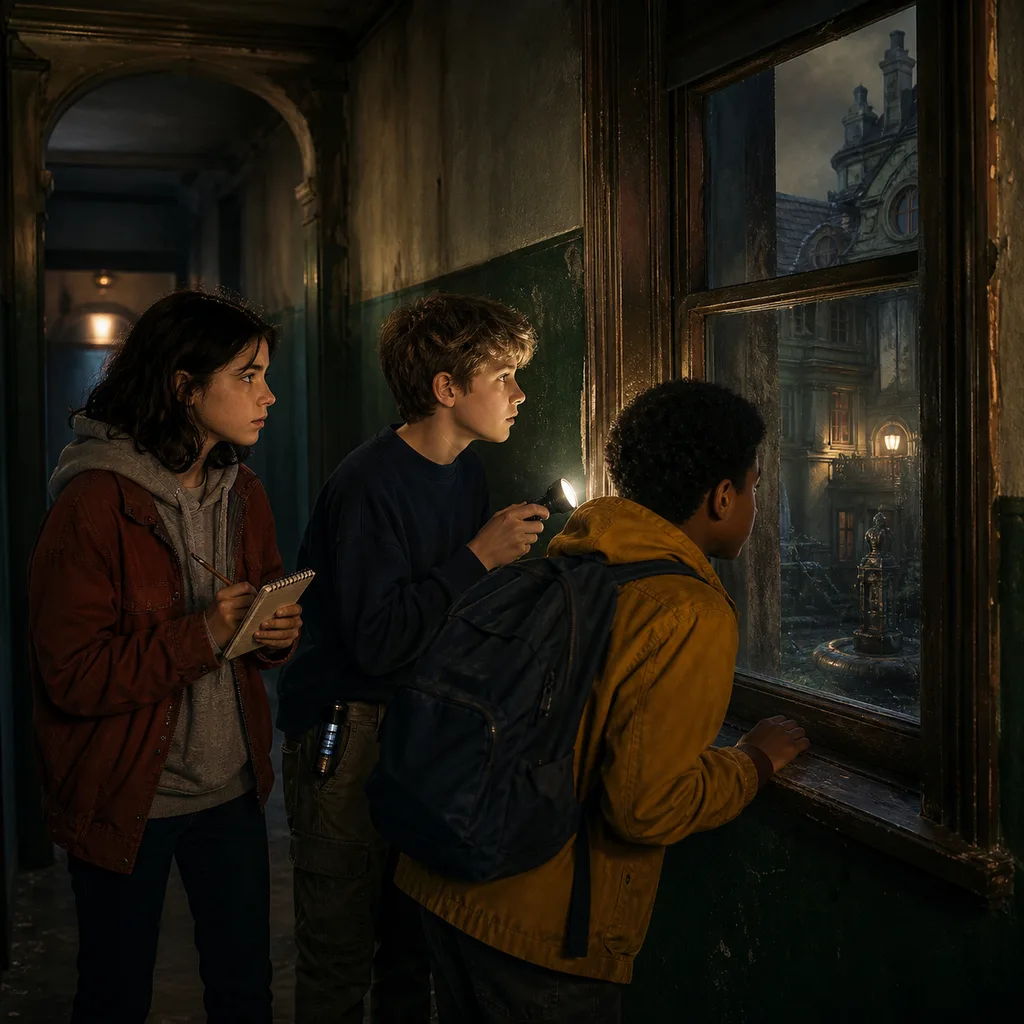
Bolo tam okno.
Malo vysoký drevený rám natretý tmavou hnedou farbou. Lak bol na niektorých miestach popraskaný a v rohoch sa držal prach. Za sklom sa pohybovalo bledé denné svetlo, hoci vonku za oknami domu už klesal večer.
Nora otvorila notes na čistej strane. Ruka sa jej trochu triasla, preto písala pomalšie než zvyčajne. „Stena oproti tretím dverám. Okno asi meter a dvanásť od podlahy po parapet. Šírka… možno osemdesiat centimetrov.“
„Nechaj mi miesto na opravy,“ povedal Filip, no jeho vtip znel napäto. Pristúpil k rámu a zasvietil naň baterkou. Kužeľ svetla po ňom prešiel, ale na skle sa neobjavil taký odraz, aký čakal.
Ben zostal o krok ďalej. „To okno tu predtým nebolo, však?“
„Nebolo,“ odpovedala Nora hneď. „A z vonkajšieho dvora sem žiadne okno nevedie. Kontrolovali sme to, keď sme našli mapu.“
Filip sa sklonil k spodnej časti rámu. „Možno je to panel. Starý servisný otvor. Alebo zrkadlo, ktoré berie obraz z iného miesta.“
„Zrkadlo nemá ukazovať dvor, ktorý neexistuje,“ povedal Ben ticho.
Chlapec sa nakoniec odhodlal pristúpiť bližšie. Za sklom bol naozaj dvor. Lenže nie ten, ktorý poznali. Dnes tam rástli dva mladé javory, stáli farebné kontajnery a pri plote bola lavička s odlúpnutou modrou farbou. Za oknom však ležal menší, prázdnejší dvor s nerovnými sivými dlaždicami. Plot bol z tmavého dreva. Pri ňom stál okrúhly záhradný stôl so železnými nohami.
„Ten stôl,“ povedal Ben. „Videli sme ho na fotografii u pani Richterovej. Na tej, kde mala ako malá veľkú mašľu vo vlasoch.“
Nora si rýchlo dopísala ďalšie poznámky. Potom vytiahla z vrecka preloženú kópiu mapy zaniknutého krídla. Papier mal ohnuté rohy a jednu škvrnu od čaju, no čiary boli stále čitateľné.
„Pozrite.“ Priložila mapu ku stene vedľa okna. „Tu je starý priechod z chodby do dvora. A tu je okno. Presne na tej istej strane.“
Filip prešiel prstom po mape, potom po ráme. „To by znamenalo, že táto chodba nebola pridaná neskôr. Patrila k tomu krídlu. Bola tam skôr, než ho zamurovali.“
„Takže nie je len zvláštny sen domu?“ Benovi sa uľavilo, ale iba trochu.
„Domy nesnívajú,“ odvetil Filip automaticky. Potom sa zamračil. „Teda, aspoň by nemali.“
Skúsil poklepať hánkami po stene vedľa parapetu. Omietka odpovedala dutým zvukom. O kus nižšie sa ozval iný, plnší tón. Chlapec vytiahol z vrecka malý skrutkovač, ktorý si nosil na kľúčenke, a opatrne prešiel jeho koncom po úzkej škáre pri dreve.
Keď sa veci začnú meniť
„Sú tu kovové úchyty,“ povedal. „Veľmi staré. Ako pri zasúvacích paneloch alebo mechanizme na vetranie.“
„Neskúšaj to otvárať,“ upozornila ho Nora.
„Ani nechcem. Zatiaľ.“
Spoza skla sa zrazu ozvalo klopnutie.
Všetci traja sa odtiahli.
Na dvore nikto nestál. Vietor sa nehýbal, plachta na šnúre visela nehybne a listy nízkeho kríka ani nezašuchotali. Napriek tomu sa o chvíľu ozvalo druhé klopnutie. Krátke. Presné.
Ben si prekrížil ruky na hrudi. „To nebolo z chodby.“
„Možno v potrubí niečo pracuje,“ navrhol Filip, ale sám sa nepresvedčil. Svetlo baterky sa mu jemne chvelo v ruke.
Nora sa nadýchla. „Ustúpime k dverám. Len na chvíľu. Potom sa vrátime a zistíme, či sa obraz zmenil. Žiadne rozdeľovanie.“
Nikto nenamietal.
Postavili sa pri najbližších dverách bez čísla. Nora sledovala okno spoza Filipovho ramena. Medzitým sa na skle objavil bledý odraz chodby, potom sa stratil. Minúta sa vliekla pomaly. Zo stropu zazvonilo drobné cinknutie, akoby sa v starej lampe pohla pružina.
„Teraz,“ rozhodla.
Vrátili sa k oknu naraz.
Dvor sa zmenil.
Na šnúrach sa sušili veľké biele plachty. Pohybovali sa vo vetre a na chvíľu zakryli celý výhľad. Keď sa znovu odsunuli, po dlaždiciach bežali dve malé deti v krátkych nohaviciach a košeliach. Jedno nieslo plechové vedierko. Pri plote stála žena v tmavých šatách a držala v rukách zrolovaný papier.
„To je minulosť,“ vydýchol Ben.
Filip dlho nič nepovedal. Baterkou už nemieril na rám, ale na vlastnú dlaň, akoby potreboval vidieť niečo obyčajné. „Starý film? Premietanie? Lenže odkiaľ? A prečo presne z toho uhla?“
Nora ukázala na rohy dvora. „Nie je to film. Pozri na tie miesta. Dvor sedí s mapou. Tam, kde je dnes plot, bývala stena krídla. A okno muselo byť práve tu.“
Za sklom prešli ďalší ľudia. Dvaja muži niesli drevenú debnu. Zastali pri nízkych dverách v zadnom rohu dvora, ktoré v súčasnosti neexistovali. Jeden z nich vytiahol z vrecka zväzok kľúčov.
„Archívny bod,“ zamrmlal Filip. „Alebo sklad. Na mape je pri prechode malá značka. Myslel som, že je to komín.“
Obraz sa na okamih roztrhol do sivých pásov. Nora si stihla všimnúť len to, že muž s kľúčmi otvoril dvere a druhý sa nervózne obzrel smerom k oknu.
Nie k oknu na dvore.
K tomuto oknu.
Jeho tvár bola príliš vzdialená, aby rozoznali črty. Napriek tomu sa Nora zachvela. Muž nehľadel náhodne hore. Díval sa presne na miesto, kde stáli oni.
„Vidí nás?“ spýtal sa Ben.
„Nemôže,“ povedal Filip rýchlo. „Ak je to záznam, nevidí nás. Ak je to… niečo iné, tak…“
„Tak nás možno vidí,“ dokončila Nora.
Nikto sa nepohol. Všetko v chodbe zrazu znelo hlasnejšie: bzučanie žiarovky, ich dýchanie, šúchanie Benovej bundy. Potom plachty znovu preleteli cez obraz a muž zmizol.
Keď sa látka odsunula, dvor ukazoval inú chvíľu.
Pri malom bočnom okne v zaniknutom krídle stála dievčina. Bola asi o trochu staršia než Nora. Mala tmavé vlasy zopnuté sponou a svetlý sveter s vyhrnutými rukávmi. Jednou rukou sa držala parapetu. Druhou si pri hrudi zvierala niečo malé a lesklé.
Ben sa naklonil tak blízko, až sa nosom skoro dotkol skla. „Klára.“
„Si si istý?“ zašepkala Nora.
„Pani Richterová mi raz ukázala jej fotku. Mala tú istú sponu. A stále sa pozerala takto… akoby počúvala viac, než chcela povedať.“
Dievčina za sklom sa nepozerala na deti. Sledovala dvor a mužov pri nízkych dverách. Keď jeden z nich otvoril debnu, Klára zdvihla lesklý predmet. V slabom svetle zablysol kovový krúžok, možno prívesok alebo malý kľúč.
Potom sa pri nej objavila vyššia postava. Dospelý muž v svetlej košeli. Položil jej ruku na plece, nie hrubo, ale tak, aby pochopila, že má odísť od okna.
Klára sa neotočila hneď. Najprv rýchlo niečo načrtla prstom na zaprášený parapet. Jediný znak.
Dôležitý okamih
Nora ho nevidela celý. Plachta sa znovu pohla a zakryla okno v minulosti.
„Zapísala niečo,“ povedala.
„Možno len písmeno,“ namietol Filip, no už si vyťahoval ceruzku. „Ak to bolo písmeno, môže označovať miestnosť. Ak číslo, možno schránku, ventil alebo časť mechanizmu.“
„Ten muž pri nej vedel, čo sleduje,“ povedal Ben. Hlas sa mu chvel, no neustúpil. „A tí na dvore tiež vedeli, že sa nemajú pozerať hore. Preto sa ten s kľúčmi obzrel sem.“
Obraz začal slabnúť. Farby sa vytrácali z plachiet, deti na dvore sa menili na nejasné tiene a starý stôl sa na okamih prekrýval so súčasnou lavičkou. Svetlo v chodbe zamrkalo.
„Máme málo času,“ povedala Nora. „Filip, výška parapetu. Ben, sleduj Kláru. Ja beriem znak.“
Rozdelili sa bez ďalších otázok.
Filip priložil skrutkovač k stene a palcom označil miesto pod rámom. „Parapet: meter a dvanásť. Ľavý roh: tridsať centimetrov od praskliny v omietke.“
Ben stál pri skle so zaťatými prstami. „Stále drží ten krúžok. Nie, počkaj… je na ňom niečo zavesené. Malý štítok.“
Nora hľadela na zaprášený parapet v minulosti. Klárin prst sa pohol ešte raz. Práve vtedy sa na dreve objavil znak jasnejšie, akoby ho na chvíľu osvetlilo slnko.
Nebolo to písmeno.
Bola to malá kresba dverí a vedľa nej číslo 7 v krúžku.
Nora ho načmárala do notesu tak rýchlo, až ceruzka prerazila papier. Pod znak dopísala: „Klára. Parapet. Dvere? Sedem?“
V tom okamihu sa z druhej strany skla ozvalo posledné klopnutie.
Nie dve krátke rany ako predtým.
Jedna jediná.
A po nej sa Klára za oknom otočila.
Jej tvár nebola strašidelná. Vyzerala sústredene, trochu smutne a veľmi unavene. Pozrela priamo na Noru, akoby vedela, že sa po desaťročiach niekto konečne díva späť.
Potom všetko zmizlo.
Sklo potemnelo. Drevený rám sa rozpadol na sivý obrys. O chvíľu pred nimi zostala len stará omietka s prasklinou, ktorú už poznali. Žiarovky nad hlavami svietili normálne. Z chodby bez čísla sa znovu stala obyčajná chodba na treťom poschodí.
Nikto neprehovoril, kým Filip nepoložil dlaň na stenu. Bola chladná, ale pevná.
„Žiadny panel,“ povedal napokon. „Žiadne zrkadlo. A určite žiadna projekcia, ktorú by niekto náhodou pustil cez stenu.“
Nora zatvorila notes a pevne ho stisla. „Okno ukazovalo miesto, ktoré tu kedysi bolo. Presne tam, kde je na mape priechod.“
Ben sa zadíval na prázdne miesto, kde pred chvíľou stála Klára. „A ona sledovala, čo vynášali z tej miestnosti. Možno chcela, aby to niekto našiel. Preto ten znak.“
Filip rozložil kópiu mapy na parapete pri schodoch. Prstom našiel čiaru vedúcu od dvora do bývalého krídla. Vedľa nej bola drobná značka, ktorú doteraz považovali za obyčajnú chybu v kresbe.
Teraz vyzerala ako dvere.
„Sedem v krúžku nemusí byť číslo bytu,“ povedal. „Môže to znamenať siedmy bod na starom pláne. Alebo siedme dvere. Tie posledné dvere, čo sme ešte neotvorili.“
„Najprv mapu porovnáme so všetkými poznámkami,“ rozhodla Nora. „A potom sa spýtame pani Richterovej na Kláru. Nie priamo na chodbu. Najprv na toho muža pri okne.“
Ben prikývol. „Možno bude mlčať. Ale keď budeme vedieť, na čo sa pýtať, nepovie len: ,To bolo dávno.‘“
Od schodov sa ozval zvuk krokov. Tentoraz celkom obyčajných, od niekoho, kto šiel domov s nákupnou taškou. Trojica rýchlo zložila mapu a vykročila dolu.
Nora sa ešte raz obzrela.
Na prázdnej stene nebolo žiadne okno. Len stará prasklina v omietke, tenká ako ceruzková čiara. Na jej konci však svetlo z chodby na okamih vytvorilo malý oblúk.
Takmer presne okolo neviditeľnej sedmičky.
Pokračovanie nabudúce…
The Unnumbered Corridor, part 9: The Last Window
The Story Begins
The corridor on the third floor was unusually quiet. Every now and then, a soft metal ping came from the elevator shaft, and somewhere behind the wall, a tap kept dripping. Nora stood by the plaster wall where they had found the chalk message a week before. In one hand she held her small paper notebook, and in the other, a pencil.
“According to the map, the lost wing was exactly in this direction,” she said, pointing to the wall opposite the stairs. “Not behind the elevator. Behind this wall.”
Filip pulled his flashlight out from under his sweatshirt. “But behind this wall is Mrs. Kováčová’s flat today. And her kitchen. If the whole wing used to be here, her stove would be in the past.”
Ben did not smile. He stared at the grey plaster, where old cracks moved in wavy lines. “Mrs. Richterová said they just covered a lot of things after the rebuild. They did not have to tear everything down.”
Right then, the light above them flickered.
All three froze.
The bulb flashed once, then again. After that, the whole corridor went dark. The darkness lasted only a few seconds, but Nora knew those seconds too well. They were the same seconds after which the corridor without a number appeared.
“Together,” she whispered.
Filip found her sleeve, Ben touched her backpack, and in the dark there was a familiar soft rustle. It was as if a heavy curtain had moved somewhere behind the walls.
The lights came back on.
But the normal corridor had disappeared.
In its place lay a narrow space with faded green walls, a low ceiling, and old doors without numbers. Yellowish bulbs shone weakly, as if they were not sure they should be on at all. At the far end, Nora could see a wall she knew from their earlier visits.
Only now, there was no bare plaster on it.
There was a window.
It had a tall wooden frame painted dark brown. The varnish was cracked in some places, and dust sat in the corners. Behind the glass, pale daylight moved, even though evening was already falling outside the building.
Nora opened her notebook to a blank page. Her hand shook a little, so she wrote more slowly than usual. “Wall opposite the third door. Window about one meter and twelve from the floor to the sill. Width… maybe eighty centimeters.”
“Leave me room for corrections,” Filip said, but his joke sounded tense. He stepped up to the frame and shone his flashlight on it. The beam moved over the wood, but the glass did not show the reflection he expected.
Ben stayed one step back. “That window wasn’t here before, was it?”
“No,” Nora answered at once. “And no window from the outside yard leads here. We checked when we found the map.”
Filip bent down to the lower part of the frame. “Maybe it’s a panel. An old service opening. Or a mirror that shows a different place.”
“A mirror is not supposed to show a yard that does not exist,” Ben said quietly.
In the end, the boy moved closer too. Behind the glass, there really was a yard. But not the one they knew. Today there were two young maple trees there, colorful bins stood near the fence, and by the wall was a bench with peeling blue paint. Behind the window, though, there was a smaller, emptier yard with rough grey tiles. The fence was made of dark wood. Near it stood a round garden table with iron legs.
“That table,” Ben said. “We saw it in the photo at Mrs. Richterová’s place. The one where she had a big bow in her hair when she was little.”
When Things Start to Change
Nora quickly wrote more notes. Then she pulled out the folded copy of the map of the lost wing. The paper had bent corners and one tea stain, but the lines were still clear.
“Look.” She held the map against the wall next to the window. “Here is the old passage from the corridor to the yard. And here is the window. Exactly on the same side.”
Filip ran his finger over the map, then over the frame. “That would mean this corridor was not added later. It belonged to that wing. It was here before they walled it up.”
“So it is not just a strange dream of the house?” Ben felt a little better, but only a little.
“Houses do not dream,” Filip said automatically. Then he frowned. “Well, at least they should not.”
He tried tapping the wall next to the sill with his knuckles. The plaster answered with a hollow sound. A little lower down, another sound came back, fuller this time. The boy took a small screwdriver from the key ring he always carried and carefully ran its tip along a narrow gap in the wood.
“There are metal catches here,” he said. “Very old ones. Like for sliding panels or a ventilation mechanism.”
“Don’t try to open it,” Nora warned him.
“I don’t want to. Yet.”
Then there was a knock from behind the glass.
All three stepped back.
No one stood in the yard. The wind was still, the sheet on the clothesline hung motionless, and the leaves on the low bush did not even rustle. Still, a second knock sounded a moment later. Short. Exact.
Ben crossed his arms over his chest. “That did not come from the corridor.”
“Maybe something is moving in the pipes,” Filip suggested, but he did not sound convinced. The flashlight beam trembled slightly in his hand.
Nora took a breath. “Let’s move back to the doors. Only for a moment. Then we’ll come back and see if the picture changes. No splitting up.”
No one argued.
They stood by the nearest door without a number. Nora watched the window from behind Filip’s shoulder. At the same time, a pale reflection of the corridor appeared on the glass, then vanished. A minute dragged by very slowly. Somewhere in the ceiling, a tiny chime rang, as if a spring had moved in an old lamp.
“Now,” she decided.
They returned to the window together.
The yard had changed.
Big white sheets hung on the clotheslines. They moved in the wind and for a moment covered the whole view. When they moved aside again, two small children in short trousers and shirts were running across the tiles. One carried a tin bucket. A woman in dark clothes stood by the fence and held a rolled paper in her hands.
“That’s the past,” Ben breathed.
Filip said nothing for a long time. He was no longer aiming the flashlight at the frame, but at his own palm, as if he needed to see something ordinary. “An old film? A projection? But where from? And why exactly from this angle?”
Nora pointed to the corners of the yard. “It’s not a film. Look at the places. The yard matches the map. Where the fence is today, the wing wall used to be. And the window must have been right here.”
More people passed behind the glass. Two men carried a wooden crate. They stopped by a low door in the back corner of the yard, a door that no longer existed today. One of them pulled a bunch of keys from his pocket.
An Important Moment
“Archive point,” Filip muttered. “Or storage. There’s a small mark on the map by the passage. I thought it was a chimney.”
For a moment, the image broke into grey stripes. Nora only managed to see that the man with the keys opened the door, and the other man looked nervously toward the window.
Not toward the window in the yard.
Toward this window.
His face was too far away to make out clearly. Even so, Nora shivered. The man was not looking up by chance. He was looking exactly at the place where they stood.
“Can he see us?” Ben asked.
“He can’t,” Filip said quickly. “If it’s a recording, he can’t see us. If it’s… something else, then… ”
“Then maybe he can,” Nora finished.
No one moved. Suddenly everything in the corridor sounded louder: the buzzing bulb, their breathing, the rustle of Ben’s jacket. Then the sheets swept across the image again and the man disappeared.
When the cloth moved away, the yard showed a different moment.
A girl stood by the small side window in the lost wing. She was a little older than Nora. She had dark hair held back with a clip and a light sweater with rolled-up sleeves. One hand rested on the sill. In the other, she held something small and shiny against her chest.
Ben leaned in so close his nose almost touched the glass. “Klara.”
“Are you sure?” Nora whispered.
“Mrs. Richterová showed me her photo once. She had the same clip. And she kept looking like this… as if she was listening to more than she wanted to say.”
The girl behind the glass was not looking at the children. She was watching the yard and the men by the low door. When one of them opened the crate, Klara lifted the shiny object. In the weak light, a metal ring flashed, maybe a charm or a small key.
Then a taller figure appeared beside her. An adult man in a light shirt. He put a hand on her shoulder, not roughly, but firmly enough to tell her to move away from the window.
Klara did not turn right away. First she quickly drew something with her finger on the dusty sill. One single sign.
Nora did not see it fully. The sheet moved again and covered the window in the past.
“She wrote something,” she said.
“Maybe just a letter,” Filip argued, but he was already taking out his pencil. “If it was a letter, it could mark a room. If it was a number, maybe a box, a vent, or part of a mechanism.”
“The man beside her knew what he was watching,” Ben said. His voice shook, but he did not step back. “And the people in the yard knew they should not look up. That is why the one with the keys looked here.”
The image began to fade. The colors on the sheets disappeared, the children in the yard turned into unclear shadows, and the old table overlapped for a second with the modern bench. The light in the corridor blinked.
“We have little time,” Nora said. “Filip, the height of the sill. Ben, watch Klara. I’ll take the sign.”
They split up without any more questions.
Filip pressed the screwdriver to the wall and marked the place below the frame with his thumb. “Sill: one meter and twelve. Left corner: thirty centimeters from the crack in the plaster.”
Ben stood by the glass with his fingers clenched. “She is still holding that ring. No, wait… something is hanging from it. A small tag.”
What Comes Next
Nora stared at the dusty sill in the past. Klara’s finger moved again. Right then, the sign on the wood appeared more clearly, as if sunlight had touched it for a moment.
It was not a letter.
It was a small drawing of a door, and next to it, the number 7 inside a circle.
Nora copied it into her notebook so fast that the pencil tore through the paper. Under the sign she wrote: “Klara. Sill. Door? Seven?”
At that very moment, there was one last knock from the other side of the glass.
Not two short hits like before.
Just one.
And after that, Klara turned around behind the window.
Her face was not scary. She looked focused, a little sad, and very tired. She looked straight at Nora, as if she knew that after many years someone was finally looking back.
Then everything vanished.
The glass turned dark. The wooden frame broke into a grey outline. A moment later, only the old plaster wall remained in front of them, with the crack they already knew. The bulbs above their heads glowed normally. The corridor without a number became an ordinary corridor on the third floor again.
No one spoke until Filip put his hand on the wall. It was cold, but solid.
“No panel,” he said at last. “No mirror. And definitely no projection someone just turned on through the wall.”
Nora closed her notebook and held it tightly. “The window showed a place that used to be here. Exactly where the passage is on the map.”
Ben looked at the empty spot where Klara had stood a moment ago. “And she was watching what they carried out of that room. Maybe she wanted someone to find it. That is why the sign was there.”
Filip spread the copied map on the sill by the stairs. He found the line leading from the yard into the old wing. Next to it was a tiny mark they had thought was just a mistake in the drawing.
Now it looked like a door.
“Seven in a circle may not mean a flat number,” he said. “It could mean the seventh point on the old plan. Or the seventh door. The last door we have not opened yet.”
“First we’ll compare the map with all our notes,” Nora decided. “Then we’ll ask Mrs. Richterová about Klara. Not about the corridor at first. First about the man by the window.”
Ben nodded. “She may stay quiet. But if we know what to ask, she won’t just say, ‘That was long ago.’”
Footsteps sounded from the stairs. This time they were completely ordinary, from someone coming home with a shopping bag. The trio quickly folded the map and headed down.
Nora looked back one more time.
There was no window on the empty wall. Only the old crack in the plaster, thin as a pencil line. Yet at the end of it, the corridor light made a tiny curve for a moment.
Almost exactly around an invisible seven.
To be continued…