
The Zero Signal, Part 1: The Blackout

At 21:17, the city goes dark. Four teenagers receive the same impossible signal: a white zero waiting on their phones.
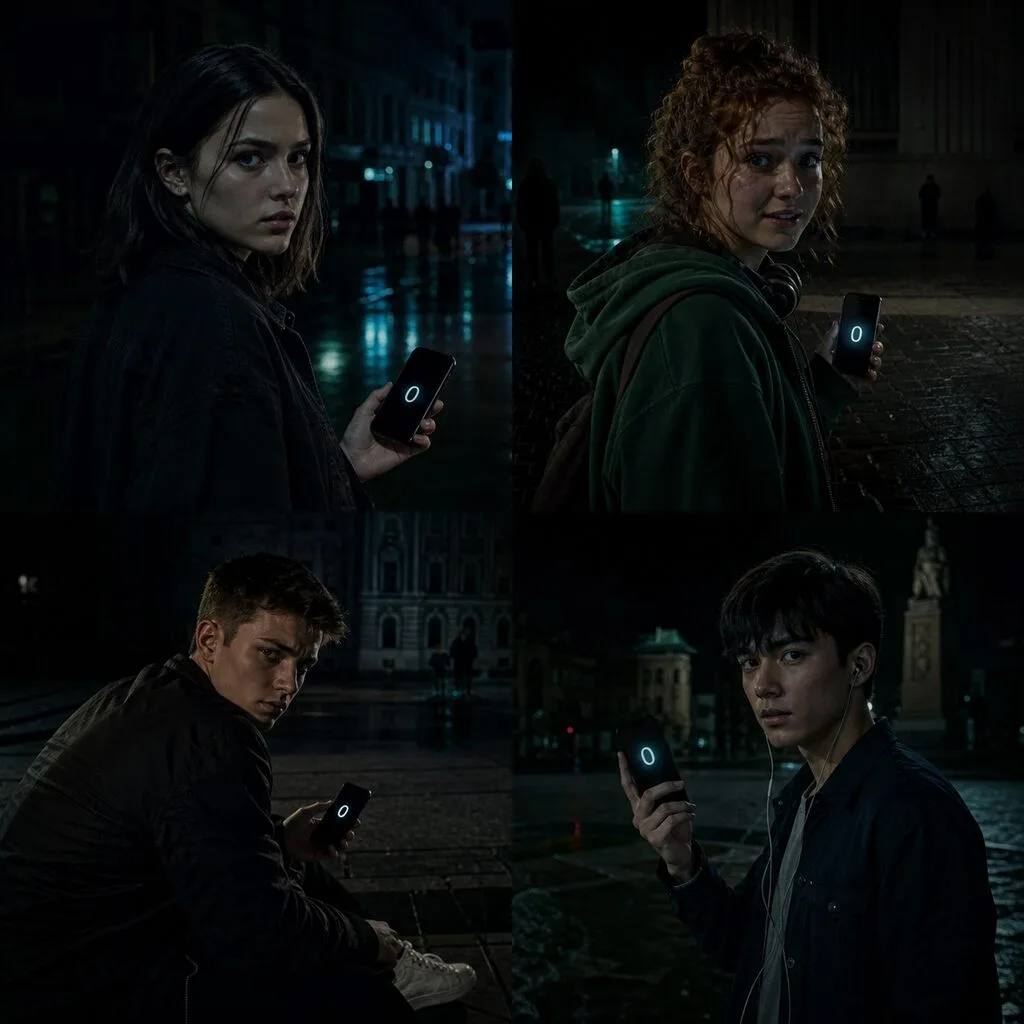
The Zero Signal, Part 1: The Blackout
The Story Begins
At 21:17, the city still looked completely normal.
Buses braked at the stops, shop windows spilled light onto the wet pavement, and the blue glow of TVs mixed with the yellow light of lamps in apartment windows. Lea stood beneath the shelter at a stop near the centre, her hands buried in the pockets of her black denim jacket. The bus was seven minutes late. Not unusual, really, but the rain was turning into cold fog and she was not in the mood to wait another seven.
Then everything went out.
First, the advertisement above the pharmacy. Then the street lamps. A second later, darkness swept down the whole street, from the traffic lights to the windows on the highest floors. Only car headlights remained, along with the trembling beams of mobile phones and the distant orange window of an old tram stopped in the middle of the junction.
Someone near Lea said, “Great. Exactly what I needed today.”
Nervous voices rustled through the stop. One woman tried to call her daughter. A boy with a scooter waved his phone above his head, as if that might catch a signal. Lea pulled out her own phone. In the corner, where the signal bars should have been, there was only empty space.
No service.
That happened during blackouts, she thought. But there was no familiar click of emergency lighting either. The city had not gone dark in stages. It had gone dark all at once, cleanly and precisely, as if someone had pressed a single switch.
Her phone screen dimmed. Then it lit up by itself.
No app opened. There was no advertisement, alert or error message. Only a black screen, with a small white zero in the middle.
Beneath it stood a single word: CHANNEL.
Lea did not tap it. Her finger stopped a few millimetres above the glass.
The screen was not behaving like a frozen app. It had not crashed. It was waiting.
She could not see it directly. Rather, she felt it in the faint pulse of light around the zero, steady and patient. Like a lift waiting behind closed doors, not yet sure on which floor it would open them.
“Is your internet working?” the boy with the scooter asked.
Lea looked at his phone. It had a zero too.
A moment later, it vanished. The phone returned to its lock screen as if nothing had happened. Only the time in the top bar still read 21:17.
Lea remembered it. She did not know why.
Meanwhile, a few streets away, Tami stood beneath the broad shelter at the entrance to a shopping arcade. Canvas headphones hung around her neck, and her copper curls blew across her eyes in the cold wind. The doors to the arcade had jammed at the exact moment the tills and the music from the shops went dead.
People were stuck inside. More people were stuck outside. Between them stood glass doors that could not be opened from either side.
“So,” Tami said loudly enough for the two nervous men by the doors to hear, “we have a new escape room. Task one: find a torch. Task two: don’t panic like extras in a disaster series.”
The man in the coat frowned at her. The girl beside him gave a brief laugh, though she immediately covered her mouth.
Tami liked that moment. The joke did not have to be good. It only had to interrupt the fear for a second. But when she pulled out her phone to use it as a light, the smile slipped from her face.
Black screen. White zero.
When Things Start to Change
“What is that?” she whispered.
To her left, a woman drew a sharp breath. “Is yours showing it too?”
Tami turned. The woman held her phone in front of her. The same zero. By the locked doors, a third phone lit up, and the same empty channel appeared on its screen.
“Maybe it’s the provider’s new way of telling us we pay too much,” Tami blurted out automatically.
Nobody laughed. That frightened her more than the dark.
She quickly took a screenshot. Her finger slipped on the glass, but the image saved. Then the zero blinked and vanished. Service still did not work. The arcade remained dark, with only the dull reflection of the powerless city filtering through the skylights.
“I got a picture of it,” she said, more to herself than anyone else.
“What did you get?” the girl beside her asked.
Tami immediately pulled the phone to her chest. “Nothing. Just a very boring glitch, probably.”
On the other side of the city, Denis kicked the kerb with the toe of his white trainer. He stood at a bus stop on the edge of a shopping zone. In front of him were the dark logo of a sports shop and a line of cars bunching helplessly at the junction. The traffic lights were dead. Drivers had been honking for so long that their horns began to sound like an argument without words.
“Excellent,” he muttered. “Public transport has rage-quit too.”
He tried to message his teammate that he would not make it to training that day. His phone merely spun a little loading wheel. Then the wheel stopped and vanished.
A zero appeared.
Denis frowned. He opened the settings, tried airplane mode, switched it off, turned mobile data on, though he knew it was pointless. The zero remained on the display, calm and unnervingly clean.
“Is this some kind of test?” the boy at the kebab stand asked.
“If it were a test, they’d at least give us a button,” Denis snapped.
The boy raised his own phone. Zero.
Denis pulled out the small watch he wore only so nobody could tell him the time on his phone had gone wrong. Its display read 21:17. Two seconds later, the zero disappeared.
Weird, he thought. Not scary. Weird.
He crossed the edge of the car park towards a side street, where the bustle was lighter. He wanted to find somewhere he could see whether the power had gone out in the next blocks too. Then a group of people rushed past him, someone shouted that an emergency entrance had opened near the station, and Denis spun around sharply.
For a moment, his head swam.
It was not ordinary dizziness. The street in front of him seemed to skip a frame. One moment he stood beside a bike rack; the next, two metres of pavement lay before him and his hand was braced against a cold wall. He had not stumbled. He simply could not remember the two steps in between.
He stopped, his heart hammering in his throat.
“Great,” he said quietly. “Now my brain is in power-saving mode too.”
He would not let himself believe that anything other than stress had happened. Blackout, darkness, noise. It was easy to imagine things. So he wrote a note: 21:17. Zero. Brief loss of orientation.
If he was going to be scared, at least he would have data.
Viktor was closest to the old district, where metal utility boxes, unmarked service doors and cables vanishing beneath the pavement still hid among the renovated houses. He wore a dark blue shirt over a grey T-shirt, and one old wired earbud hung by his collar. He held the other to his ear.
An Important Moment
He was not listening to music. He was listening to the hiss from a small receiver he had assembled from cheap parts and patience.
When the city went dark, the hiss changed.
Viktor stopped beside a low technical building with a worn sign whose writing was almost completely illegible. Anyone unfamiliar with such things might have assumed that an ordinary blackout meant stations going silent one by one. But this was not gradual. A short, sharp tone sounded in his ear, too low for an ordinary alert and too regular to be random interference.
It lasted barely two seconds.
Then metal clattered beside him. The wind had shifted a loose cover on the fence. Viktor snatched his hand away from the earbud and looked at his phone.
Zero.
An unmoving black background. One white digit. Beneath it: CHANNEL.
He pulled the receiver from his pocket and held it beside the phone. The device caught faint crackling again. Not a mobile network. Not Wi-Fi. Not even radio as he knew it. For a moment, the signal swept through the band as if someone had opened a door into a room full of old transmitters, then shut it again at once.
Two seconds later, there was silence.
Viktor looked across the road at the dark tower beyond the rooftops. It had not been fully used for years. At least, not officially.
“It didn’t come from outside,” he said to the empty street. “It came through the city layer.”
Later, city police appeared at the junctions with torches, and building managers came out of neighbouring houses to open entrances. The blackout was not over yet, but people began to move. Someone claimed the problem was at a substation. Someone else swore they had seen a blue flash above the old tower. Each new version was louder than the last.
Tami emerged from the arcade with the crowd and headed for the nearest open entrance to an apartment block. The caretaker let people in so they could warm up and wait for the buses to resume. By the stairs, she bumped her shoulder into someone.
“Sorry, I—” she began.
“Watch where you’re going,” Denis said, then noticed her expression. “What?”
“Nothing. The whole city is just losing the worst level in history.”
They knew each other by sight from school. Not well enough to talk, but well enough for Denis to know that the girl in the green hoodie usually talked more than everyone else put together.
Lea stood by the railing. She noticed Tami’s phone, which Tami was still gripping too tightly.
“Did it show you a zero?” she asked without preamble.
Tami blinked. “Sorry?”
Denis gave a mocking smile, but it lasted only a moment. “You too?”
Viktor entered the corridor just as a weak emergency lamp came on above the entrance. His hair was wet against his forehead, and he held the receiver in one hand.
“You too?” he said carefully.
The four of them looked at one another. Around them, people were dealing with torches, water, locked garages and broken lifts. Yet their small circle by the stairs suddenly seemed separate from the rest of the building.
“Okay,” Tami breathed out. “Either we all broke at once, or it wasn’t just a glitch.”
“It could still be a glitch,” Denis objected. “A big one. In the networks, the phones, whatever.”
“Across several phone brands?” Viktor asked. “And with the same interface?”
Tami opened the photo. The zero shone sharply in it, almost unnaturally bright. In the corner was the time: 21:17:42.
What Comes Next
Denis took out his watch and showed them the note on his phone. “I have 21:17. The phone didn’t save the exact seconds. The watch did. Forty-two.”
Lea stared at the screenshot. “It wasn’t a frozen screen.”
“How do you know?” Denis’s tone was not kind, but it was not mocking either. Just too tense.
“Because a glitch behaves chaotically. This didn’t.” She ran a fingernail along the edge of her phone. “That zero… it was waiting for someone to tap it.”
Tami lowered her voice. “I almost did.”
“Me too,” Viktor admitted.
Denis said nothing.
Viktor set the receiver on the windowsill. “I caught interference. Short and strange. It seemed as though the city’s old transmission layer had switched on for a moment. Not modern antennas. More like something near the tower in the old district.”
“And we were all within its range?” Lea asked.
The boy nodded. “Roughly. Not right beside it. But close enough.”
Tami folded her arms around herself. “So the internet didn’t disconnect us. The tower called us?”
“That is exactly the kind of sentence that makes people start inventing aliens,” Denis said.
“Nobody said aliens,” Tami replied. “You brought those up.”
Even so, the corner of Lea’s mouth moved. It was not quite a smile, but almost.
At last, Denis let out a breath and looked at the other three. “We don’t know what it was. We only know it happened at the same time. And clearly not everyone saw it.”
“Then let’s not tell anyone yet,” Lea said. “Not until we have more than a zero in a photo and some hiss in a box.”
Viktor nodded first. After a moment, Tami did too.
Denis leaned against the railing. “Fine. But if it turns out to be marketing for a new phone plan, I’m leaving.”
At that moment, the main corridor light came on.
People in the apartment block applauded. Someone shouted that the power was back. Outside, windows gradually lit up, then shop fronts, and finally the distant traffic lights. The city drew breath and filled with noise again.
Viktor’s phone vibrated on the windowsill.
All four turned towards it.
There was no notification on the display. Only a black field, a white zero and, beneath it, a thin blinking mark like a cursor in an empty message.
It was waiting for an answer.
To be continued…