
Vypočujte si slovenskú audio verziu príbehu
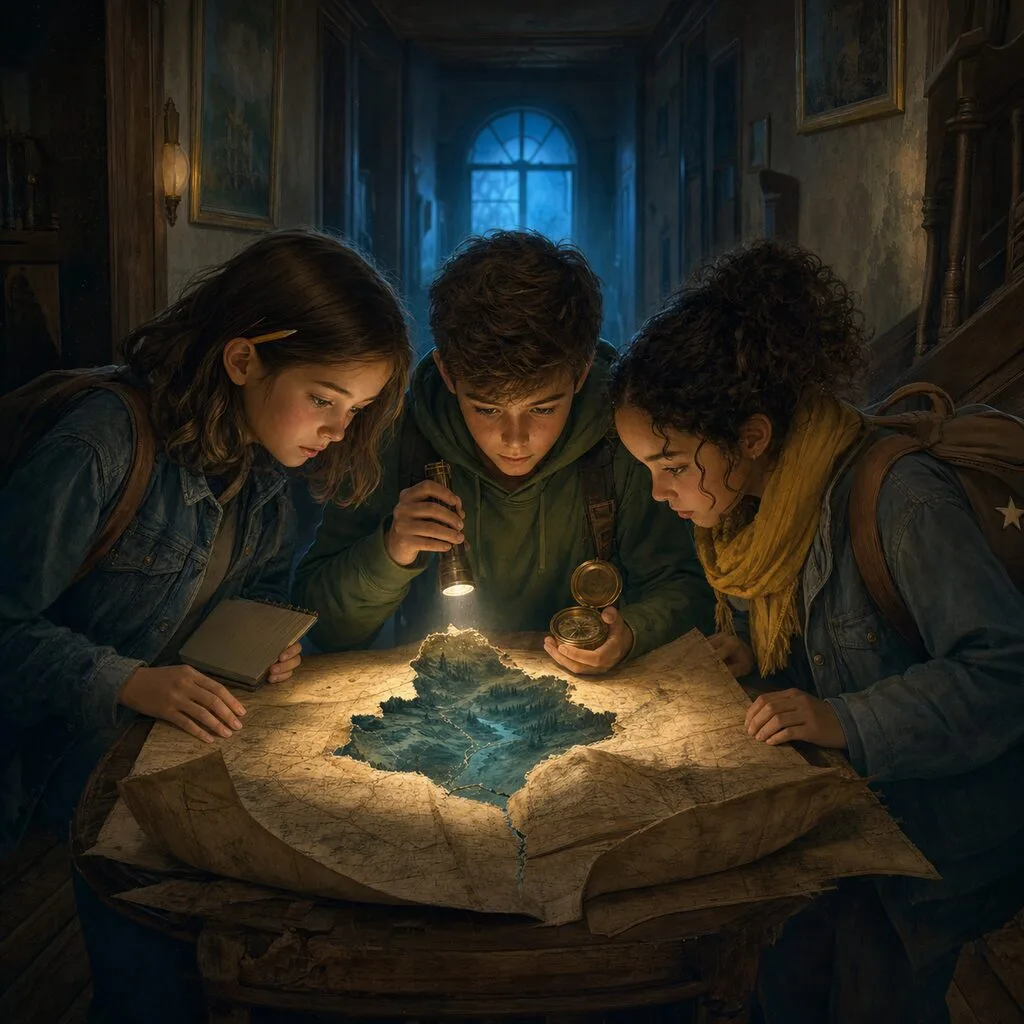
Posledný deň pred prázdninami je nová časť seriálu Dom na konci mapy, pripravená ako dvojjazyčný detský príbeh v slovenčine aj angličtine.
Posledný deň pred prázdninami: začína sa príbeh
V chodbe domu na konci mapy bolo chladno aj vtedy, keď sa za oknami lenivo opieralo o sklo sivé popoludnie. Na stole ležala stará mapa, rozložená presne tam, kde ju Nina nechala po minulej noci. Papier bol jemne zvlnený, akoby dýchal, a pri okraji triedy sa zrazu objavila nová veta. Nina sa k nej nahla tak blízko, až jej prameň vlasov padol do tváre.
„Sľúbili sme, že sa vrátime,“ prečítala potichu.
Oliver zdvihol obočie. „Mapa si píše poznámky?“
„Alebo si ich pamätá,“ povedala Mia a prstami si pritlačila žltú šatku ku krku, akoby jej to pomohlo lepšie počuť ticho.
Pri triede, kde bola na mape malá bodka, sa niečo zmenilo aj v samotnom kreslenom pôdoryse. Bodka sa posunula o kúsok ďalej, presne k prázdnemu miestu medzi dvoma úzkymi čiarami. Nebol tam žiadny názov. Len biela medzera. Nina si ju všimla ako prvá.
„Tu niečo chýba,“ zašepkala.
Oliver si priložil malú baterku bližšie k papieru, hoci svetla bolo dosť. Mosadzný kompas mu jemne cinkol o prsty. „Možno sa mapa len posunula. Alebo niekto prepisoval školský plán a vynechal značku.“
Mia sa však nepozerala na bodku. Pozerala sa na dvere na konci chodby, ktoré boli dovtedy zatvorené. Teraz stáli pootvorené na vlásoček. Zvnútra vychádzal slabý pach mokrého papiera, prachu a niečoho sladkého, čo pripomínalo pečené koláčiky.
„Myslím, že nás volajú,“ povedala.
Dom sa nehýbal ako človek, ale keď Mia vyslovila tie slová, svetlo na strope sa na okamih zjemnilo. Potom sa chodba pred nimi predĺžila. Krok za krokom ich viedla k starej školskej triede.
Vstúpili pomaly, akoby si neboli istí, či smú. Trieda však nebola prázdna. Bola živá. Nie hlučná, nie veselá ako na začiatku prestávky, ale naplnená posledným dňom pred prázdninami. Na laviciach viseli papierové girlandy, na tabuli bol napísaný zoznam úloh a pri okne sa sušil veľký hárok papiera, na ktorý ešte stále dopadali slabé kvapky dažďa.
Vzadu pri katedre stála pani Urbanová, starostlivo rovná ako pravítko. Na nose mala strieborné okuliare a okolo krku kľúče na stužke. Niečo zapisovala do zošita a popritom sa rozprávala s deťmi, ktoré sedeli v laviciach. Ich hlasy boli tlmené, akoby sa ozývali z druhej miestnosti času.
Mia sa zhlboka nadýchla. „Všetci sú tu,“ zašepkala. „Ale je to akési… napäté.“
„To je asi tým, že je posledný deň školy,“ odvetil Oliver. Hneď si však uvedomil, že jeho vysvetlenie úplne nesedí.
Na prvý pohľad vyzeralo všetko obyčajne: papierové hviezdičky, pohár s ceruzkami, miska s drobnými sušienkami. Napriek tomu sa v miestnosti držalo ticho, ktoré malo na okrajoch akoby drobné zúbky. Nebolo nepriateľské. Skôr nesmelé.
Nina pristúpila k nástenke pri tabuli. Visel na nej triedny plán pripravený na slávnosť. Meno po mene, riadok po riadku. Prešla po ňom očami a potom sa zastavila.
„Samuel tu nie je,“ povedala.
Oliver sa hneď naklonil bližšie. „Kde presne?“
„Nikde,“ odvetila Nina. „A pritom by tam mal byť.“
Chlapec v zelenom tričku v poslednej lavici sa otočil k oknu. Z profilu vyzeral pokojne, no ramená mal stiahnuté, akoby sa snažil zabrať čo najmenej miesta. Mia si ho všimla skôr, než stihol ktokoľvek iný prehovoriť.
„Pozrite,“ šepla. „On je tam.“
Oliver zamrkal. „Samuel Horský?“
Mia prikývla. „Asi áno. Ale nikto sa naňho nepozerá.“
V triede sa medzitým rozbehol ruch. Dve dievčatá skladali farebné papieriky do košíka, niekto rozdeľoval sušienky a pri katedre pani Urbanová prepočítavala mená. Zrazu však pani Urbanovú niečo zneistilo. Jeden zo zoznamov sa jej na chvíľu zastavil v ruke, akoby sa na ňom zasekol pohľad.
Nina si všimla, že pri stole leží starší papier. Bol to pracovný zoznam na dnešnú slávnosť, prepísaný poctivo a úhľadne. Len jedno miesto bolo zvláštne. V strede riadku zostala svetlá stopa po gumovaní, akoby niekto meno najprv napísal a potom si to rozmyslel.
Keď sa veci začnú meniť
„Tu,“ povedala potichu. „Tu bolo niečo vymazané.“
Oliver si prešiel palcom po okraji papiera. „Ešte je tam priehlbina. Niekto písal rýchlo a potom to opravil.“
„Ale nie dosť,“ dodala Mia. „Vidím to aj bez lupy.“
Vtom sa z rohu triedy ozval tlmený hlas jedného z chlapcov z minulosti. „Koľko nás je?“
„Dvadsaťtri,“ odpovedal niekto.
„Určite?“
„Veď sme to počítali pred chvíľou,“ ozvalo sa od okna.
Oliver zdvihol hlavu. „Takže to nie je tajomstvo. To je chyba v počítaní.“
„A možno zabudnutie,“ namietla Nina. Hlas mala ostrý, no nie nepríjemný. Skôr presný. „Ale aj zabudnutie môže byť chyba.“
Kým sa o tom hádali, pani Urbanová vzala do ruky malý papierik a niečo si na ňom poznačila. Pri tom prešla očami po pláne. Jedno z dievčat jej podalo ďalší zoznam a krátko sa zasmialo. Ten smiech však znel neisto, ako keď sa človek smeje len preto, aby nebolo počuť, že niečo nie je v poriadku.
Mia stála nehybne. Jej pohľad sa vrátil k Samuelovi, ktorý sedel pri okne a pozeral von na dažďové kvapky stekajúce po skle. Nepôsobil smutne nahlas. Práve naopak. Bol smutný ticho, tak, aby nikoho nezaťažoval.
„On vie,“ povedala Mia.
„Čo vie?“ spýtal sa Oliver.
„Že nie je na papieri.“
V miestnosti sa pritom nič dramatické nestalo. Nikto nekričal, nikto nebúchal dverami. A práve preto to bolo horšie. Všetko išlo ďalej, akoby sa nič nestalo. Sušienky sa rozdávali. Girlandy sa vešali. Mená sa čítali. A jedno meno chýbalo tak obyčajne, až to bolelo.
Nina cítila, ako sa jej v hrudi zdvihne zlosť. Nebola divoká ani hlučná. Bola ostrá ako hrot ceruzky.
„Ako sa dá niekoho len tak vymazať z plánu?“ spýtala sa.
Oliver chvíľu mlčal. Potom si odkašľal. „Možno to nebolo naschvál. Možno niekto zapisoval mená, zle spočítal listy a potom sa bál priznať chybu.“
„A tak nechali papier tak,“ doplnila Mia ticho.
Pri tej vete sa Samuel na okamih pozrel smerom k nim. Nepozrel sa presne cez nich, ani ich nevidel tak, ako vidíme človeka v skutočnom svete. No jeho smútok bol zrazu jasný. Bol v spustených pleciach, v prázdnom mieste pri stole, v tom, že sa k nemu nikto neotočil a nepovedal: poď sem.
Deti sa presunuli bližšie k oknu. Dažďové kvapky za sklom tvorili tenké čiary a tie sa Nininej pozornosti páčili. Boli presné, hoci krehké.
Na parapete ležal starý zošit. Oliver ho otvoril a našiel v ňom voľný riadok. „Tu sa meno mohlo doplniť,“ povedal. „Stačilo vziať pero.“
„Ale nejde len o to doplniť ho teraz,“ odpovedala Nina. „Ide o to vedieť, že tam malo byť od začiatku.“
Mia pomaly siahla do bočného vrecka na batohu so hviezdou a vytiahla maličký papierik. Nebol to žiaden veľký predmet, len úzky pásik so zreteľne napísaným menom: Samuel Horský. Položila ho na parapet, priamo k oknu, ako keby mu vracala miesto pri triede.
V tej chvíli sa svetlo na stene jemne pohlo. Nebolo to ako blesk ani ako veľká zmena. Skôr ako keď sa záves na chvíľu nadýchne vetra. Nina sa prudko otočila k mape, ktorá ostala na stole pri dverách.
Bodka pri triede sa posunula. Nie späť na pôvodné miesto, ale presne k malému bielemu miestu v zozname, ktoré predtým svietilo prázdnotou.
Oliver sa usmial, hoci len trochu. „Tak to je ono. Dom si všimol, že sme si to všimli.“
„Alebo že sme povedali pravdu nahlas,“ opravila ho Nina.
„A pokojne,“ doplnila Mia.
Z triedy sa ozval ďalší šepot, tentoraz slabší než predtým. Akoby niekto na druhom konci spomienky povedal niečo veľmi jednoduché: že meno sa malo dopísať. Že niekto mal splniť sľub. Že sa to dalo opraviť, lenže už sa nikomu nechcelo otvárať hotový papier.
Samuel sa pri okne narovnal len o kúsok. Nebol šťastný, nie hneď. No už nepôsobil, akoby sedel mimo vlastného príbehu. To bolo dôležité.
Dôležitý okamih
„Kto mal ten sľub splniť?“ spýtal sa Oliver, keď sa triedna spomienka začala rozplývať do jemnej hmly.
Nina si rýchlo otvorila zápisník a načrtla nový detail na mape. Pri triede pribudla presná poznámka: prázdne miesto v pláne, ktoré sa nevyplnilo samo. Potom zdvihla oči, aby si ešte raz zapamätala tvar okna, stôl a bodku na okraji papiera.
„To zistíme neskôr,“ povedala.
Mia si pritiahla šatku a prikývla. „Ale Samuel už aspoň nie je len vymazané meno.“
Dom za ich chrbtom stíchol. Na chvíľu to vyzeralo, že aj chodba zadržala dych. Potom sa v diaľke ešte raz ozvalo šuchnutie papiera, akoby stará veta o sľube poletovala medzi stenami a hľadala niekoho, kto ju konečne pochopí.
Keď deti vyšli späť do chodby, vzduch bol stále chladný, no už nie nepríjemný. Bol len tichý. Nina držala zápisník pevne. Oliver zatočil kompasom v prstoch a Mia šla medzi nimi, pokojná ako niekto, kto vie, že aj malý papierik môže niekomu vrátiť miesto.
Na stole ostala mapa. Pri triede sa na nej leskla malá prázdna škvrna. A práve tá sa stala ich ďalšou stopou.
Pokračovanie nabudúce…
The House at the Edge of the Map, part 10: The Last Day Before the Holidays
The Story Begins
The hallway of the house at the edge of the map was cold, even though a grey afternoon was leaning lazily against the windows outside. On the table lay the old map, spread out exactly where Nina had left it after the night before. The paper was softly wavy, as if it were breathing, and near the edge of the classroom a new sentence had appeared.
Nina bent over it so close that a strand of hair fell into her face.
“We promised we would come back,” she read quietly.
Oliver lifted his eyebrows. “Does the map write notes now?”
“Or maybe it remembers them,” Mia said, pressing her yellow scarf to her neck with her fingers, as if that could help her hear the silence better.
Near the classroom, where there had been a small dot on the map, something had changed in the drawn floor plan too. The dot had moved a little farther, right to an empty space between two thin lines. There was no name there. Only a white gap. Nina noticed it first.
“Something is missing here,” she whispered.
Oliver brought his small flashlight closer to the paper, even though there was enough light. His old brass compass gave a soft clink against his fingers. “Maybe the map just shifted. Or someone was changing the school plan and left out a mark.”
Mia was not looking at the dot, though. She was looking at the door at the end of the hallway, which had been shut before. Now it stood open just a crack. From inside came a faint smell of wet paper, dust, and something sweet, like baked cookies.
“I think it’s calling us,” she said.
The house did not move like a person, but when Mia said those words, the light on the ceiling softened for a moment. Then the hallway in front of them seemed to stretch. Step by step, it led them toward the old classroom.
They went in slowly, as if they were not sure they were allowed. The classroom was not empty. It was alive. Not loud, and not happy like a break time at school, but full of the last day before the holidays. Paper garlands hung over the desks, a list of tasks was written on the board, and near the window a big sheet of paper was drying, still catching small drops of rain.
At the back, by the teacher’s desk, stood Mrs Urbanová, straight and careful as a ruler. She wore silver glasses on her nose, and keys hung around her neck on a ribbon. She was writing in a notebook while talking to the children sitting in the desks. Their voices were soft, as if they came from another room of time.
Mia took a deep breath. “Everyone is here,” she whispered. “But something feels… tight.”
“That’s probably because it’s the last day of school,” Oliver said. He quickly noticed that his explanation did not really fit.
At first glance, everything looked normal: paper stars, a cup of pencils, a bowl of small cookies. Still, the room held a silence with tiny teeth at its edges. It was not unfriendly. It was just shy.
Nina walked up to the notice board near the blackboard. A class plan for the celebration hung there. Name by name, line by line. She read it with her eyes, then stopped.
“Samuel isn’t here,” she said.
Oliver leaned closer at once. “Where exactly?”
“Nowhere,” Nina replied. “And yet he should be.”
The boy in the green shirt in the last desk turned toward the window. From the side, he looked calm, but his shoulders were drawn in, as if he wanted to take up as little space as possible. Mia noticed him before anyone else had time to speak.
When Things Start to Change
“Look,” she whispered. “He’s there.”
Oliver blinked. “Samuel Horský?”
Mia nodded. “I think so. But nobody is looking at him.”
Meanwhile, the room had started to stir. Two girls were folding colored papers into a basket, someone was giving out cookies, and by the teacher’s desk Mrs Urbanová was counting names. Then something made her pause. One of the lists stopped in her hand for a moment, as if her eyes had caught on it.
Nina noticed an older sheet of paper on the table. It was a work list for today’s celebration, copied neatly and carefully. Only one place was strange. In the middle of one line, there was a pale mark where something had been erased, as if someone had written a name first and then changed their mind.
“Here,” she said softly. “Something was erased here.”
Oliver ran his thumb along the edge of the paper. “There’s still a dent. Someone wrote it fast and then fixed it.”
“But not enough,” Mia added quietly. “I can see it without a magnifying glass.”
Just then, a boy from the memory spoke in a muted voice from the corner of the room. “How many are we?”
“Twenty-three,” someone answered.
“Are you sure?”
“We counted a moment ago,” came a voice from the window.
Oliver lifted his head. “So this isn’t a mystery. It’s a counting mistake.”
“Or being forgotten,” Nina said. Her voice was sharp, but not unkind. More exact than anything else. “And forgetting can be a mistake too.”
While they were talking, Mrs Urbanová picked up a small note and wrote something on it. At the same time, she looked over the plan again. One of the girls handed her another list and gave a short laugh. The laugh sounded uncertain, like the kind people make when they want to hide that something is wrong.
Mia stood very still. Her eyes returned to Samuel, who sat by the window and watched raindrops slide down the glass. He did not look sad in a loud way. He was sad in silence, so that he would not trouble anyone.
“He knows,” Mia said.
“Knows what?” Oliver asked.
“That he isn’t on the paper.”
Nothing dramatic happened in the room. Nobody shouted, and nobody slammed doors. Because of that, it felt even worse. Everything kept going as if nothing had happened. Cookies were handed out. Garlands were hung. Names were read aloud. And one name was missing so normally that it hurt.
Nina felt anger rise in her chest. It was not wild or loud. It was sharp as a pencil tip.
“How can you just erase someone from a plan?” she asked.
Oliver was quiet for a moment. Then he cleared his throat. “Maybe it wasn’t on purpose. Maybe someone was writing down the names, counted the papers wrong, and then was too afraid to admit the mistake.”
“And so they left the paper like this,” Mia said softly.
At those words, Samuel looked toward them for a moment. He did not look straight through them, and he did not see them the way people see someone in the real world. Still, his sadness suddenly became clear. It was in his lowered shoulders, in the empty place by the desk, in the fact that nobody turned to him and said: come here.
The children moved closer to the window. Raindrops behind the glass made thin lines, and Nina liked the way they looked. They were exact, even if they were fragile.
An old notebook lay on the windowsill. Oliver opened it and found a blank line inside. “The name could have been added here,” he said. “It only needed a pen.”
An Important Moment
“But it’s not just about adding it now,” Nina replied. “It’s about knowing it should have been there from the beginning.”
Slowly, Mia reached into the side pocket of her star patch backpack and took out a tiny slip of paper. It was not a big thing, only a narrow strip with the name written clearly on it: Samuel Horský. She placed it on the windowsill, right by the window, as if she were giving him his place in the classroom back.
At that moment, the light on the wall moved gently. It was not like lightning or a big change. More like a curtain taking one breath of wind. Nina turned sharply to the map that was still lying on the table by the door.
The dot near the classroom had moved. Not back to its old place, but right to the small white space in the list that had been shining empty before.
Oliver smiled, though only a little. “So that’s it. The house noticed that we noticed.”
“Or that we said the truth out loud,” Nina corrected him.
“And calmly,” Mia added.
From the classroom came another whisper, softer than before. It was as if someone on the other side of the memory had said something very simple: that the name should have been written in. That someone should have kept a promise. That it could have been fixed, but then nobody wanted to open the finished paper again.
Samuel straightened a little at the window. He was not happy, not yet. Still, he no longer looked like he was sitting outside his own story. That mattered.
“Who was supposed to keep that promise?” Oliver asked as the classroom memory began to fade into a soft mist.
Nina quickly opened her notebook and drew the new detail on the map. Near the classroom, she added a clear note: an empty place in the plan that had not filled itself. Then she lifted her eyes to remember the shape of the window, the desk, and the dot on the edge of the paper one more time.
“We’ll find out later,” she said.
Mia pulled her scarf closer and nodded. “But Samuel is not just an erased name anymore.”
The house behind them grew quiet. For a moment, it felt as if the hallway was holding its breath too. Then, in the distance, there was one more rustle of paper, as if the old sentence about the promise were drifting between the walls and looking for someone who would finally understand it.
When the children stepped back into the hallway, the air was still cold, but it did not feel unpleasant anymore. It was simply quiet. Nina held her notebook tightly. Oliver turned his compass in his fingers, and Mia walked between them, calm as someone who knows that even a small slip of paper can give someone their place back.
The map remained on the table. Near the classroom, a small empty spot shone on it. And that became their next clue.
To be continued…